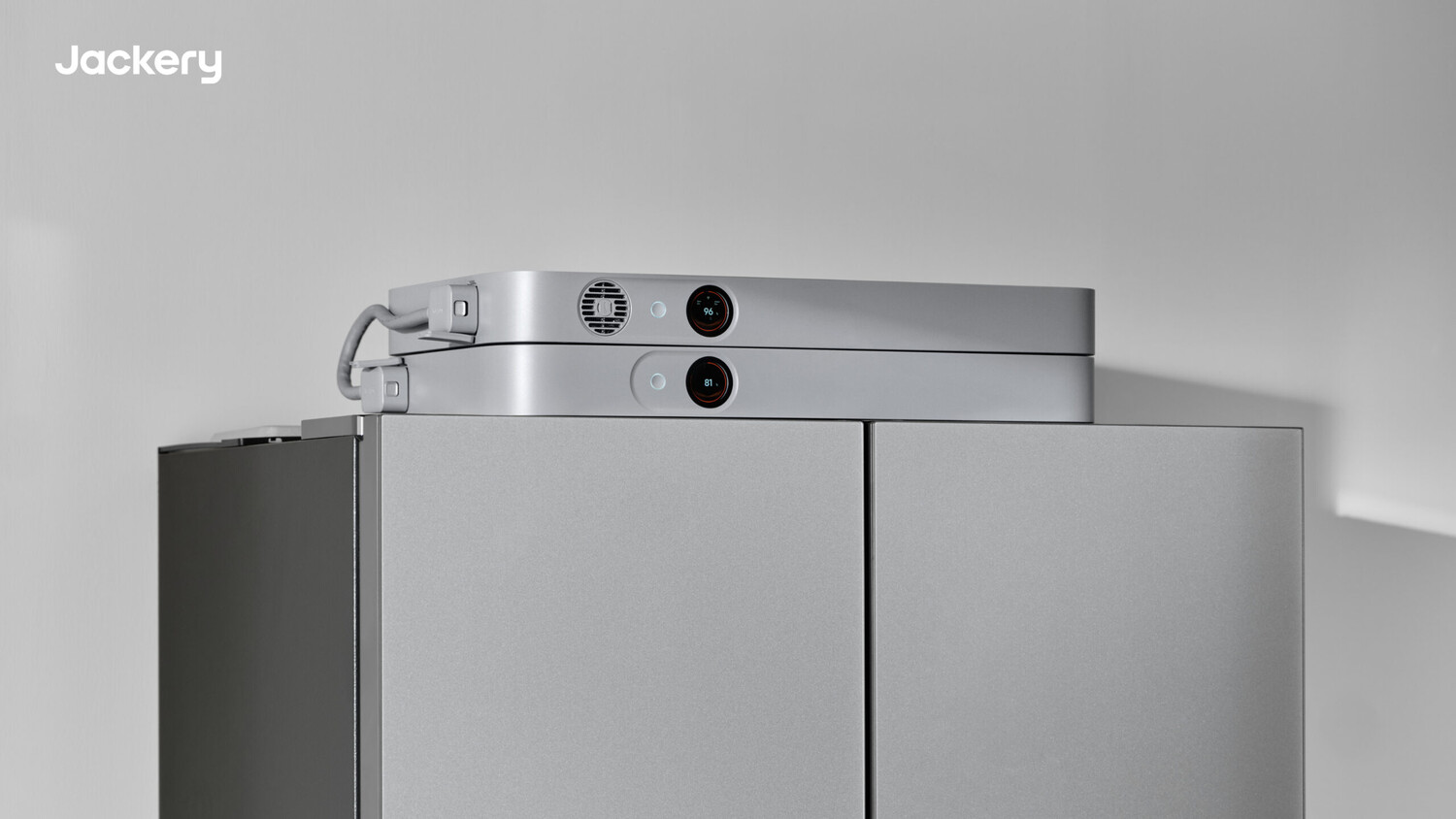
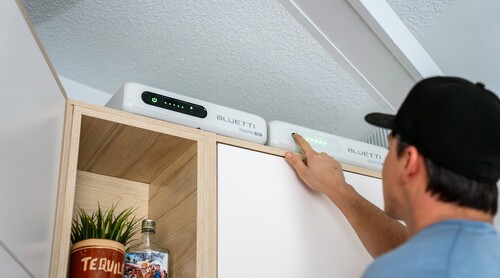
Jackery launched its stylish, slim FridgeGuard CleanTechnica was given an exclusive preview of the FridgeGuard a couple of months ago and we came away impressed with what we saw. Clear attention was given to design the refrigerator backup battery to fit customer needs and the refrigerator application The final product only amplifies those impressions. The overall offering could be compelling to many who may have not considered battery backup and storage. At just 2.6” thick Jackery calls it the world slimmest refrigerator battery. In addition, at 23 lbs. (10.5 kg), it is also relatively lightweight. This makes the battery easy to move and place, with flexible mounting options. Compared to some other batteries, FridgeGuard is far more aesthetically pleasing, making it easy to integrate into the décor of many homes. Jackery FridgeGuard. Image Credit: Jackery The sleek, refined design of FridgeGuard has won several accolades, including the iF DESIGN AWARD 2026. Attention to detail gives a sense of sophistication to the relatively simple, rounded shape. A circular display integrated into the front of FridgeGuard clearly communicates remaining battery percentage, input power, remaining charge time, output power, remaining discharge time, UPS status, Wi-Fi status, Time-of-Use (TOU) mode, AC input/output status, battery status and DC input status. Above the display is a small round vent to provide cooling to the inverter. A silver metallic finish is intended to complement stainless steel appliances, but is molded into the case, ensuring durability. FridgeGuard is controlled via the Jackery App. Users can monitor status, set the delay start time and set Time-of-Use (TOU) to save on electricity costs. This lets users manage the battery as well as other Jackery devices to provide power monitoring and smart energy management. Jackery FridgeGuard. Image Credit: Jackery Rather than complex installation, the battery is simply plugged into an outlet and plugged into the refrigerator. It connects to 2.5 GHz Wi-Fi for use with the Jackery App. It can be floor standing, bracket mounted, wall mounted or simply placed horizontally on top of the refrigerator. At 23.6” X 12.8” X 2.6” the relatively small battery can unobtrusively fit into many locations. The battery is designed specifically for refrigerator use. Due to the compressor starting up, peak power demands tend to be significantly higher than average power. Batteries not designed for this peak can struggle. In addition to 800W of continuous power, FridgeGuard can support 1600W peak power to easily handle the compressor starting. Jackery calls this FridgeSafe Technology, “which is built specifically around how refrigerators actually run.” It combines ≤10 ms UPS switchover, Delay Start, Bypass Mode and surge protection with the 1600W of compressor-ready power Jackery FridgeGuard. Image Credit: Jackery The battery comes with a capacity of 1024Wh, delivered through a single 110V outlet. An available expansion battery doubles the system capacity to 2048Wh. The expansion battery weighs slightly less at 19.8 lbs. (9 kg), due to the lack of an inverter. While Jackery claims a 15-hour run time with the standard battery and twice that with the expansion battery, that is based on typical use of a full-sized refrigerator. For my apartment-sized, high efficiency Midea refrigerator, the battery would last significantly longer, especially if the refrigerator was kept shut while we were out of town. If the battery is depleted and AC power is still available, the unit can bypass the battery to provide AC directly, without power interruption. However, the battery is not limited to just refrigerators. In addition to refrigerators, air conditioners also are compressor-based. FridgeGuard could be used with the small window air conditioning units that many of us have in our pre-war New York City apartments. And it wouldn’t look out of place in a bedroom or living room. Jackery FridgeGuard. Image Credit: Jackery Beyond compressor applications, this kind of battery backup could be very valuable to those of us with 3D printers, like my Bambu Labs X1C. If you have ever had a power interruption happen part way through a multi-hour print, you will understand the value. While the presence of the 3D printer may not be the most style-forward addition to a living space, the addition of the battery could fit behind it and go unnoticed. With a switchover of less than 10ms, the unit works as a UPS and provides integrated surge protection and grid anomaly safeguards, protecting those 3D printers, computers, home theaters and other sensitive equipment. Jackery FridgeGuard. Image Credit: Jackery And it could potentially work in other applications where maintaining electricity supply is essential. FridgeGuard Could perform well for the home for medical devices like CPAP machines or fish tanks. Although not the most environmentally friendly application, I could see it also providing power to the fan and igniter in some gas furnaces during winters, where weather can take down power lines. By integrating a DC input module, up to 500W of solar panels or other DC sources can be used to recharge the battery. If the solar panels use MC4 connectors, a MC4-to-8020 adapter would be needed. While the battery is being charged on DC, it can also output power. The DC input can also be combined with the AC input at the same time to charge the battery at a combined total input power of up to 1300W. Being IP20 rated, FridgeGuard is intended for dry indoor environments. However, I could see applications like adding a few panels to an off-grid cabin combined with the battery to keep a refrigerator running. For extended power outages, the battery could also be temporarily connected to solar power to recharge. And in applications where it can get hot, the battery supports 45°C (113°F) full-load operation for 15–20 minutes. Jackery FridgeGuard. Image Credit: Jackery FridgeGuard uses cylindrical LFP cells that retain over 70% capacity after 6,000 cycles, or 16 years of daily use. If used purely for backup, it could last much longer. The system meets UL1778, UL1741, and UL1973 safety certifications, with UL94-5VA flame-retardant materials. Operation below 40db is easily quieter than many of the refrigerators it will be powering. Built of UV-resistant PC+ABS material, the case is durable with a paint-free finish, making it VOC-free and fully recyclable, designed to reduce environmental impact and avoid harmful substances. Meanwhile, at less than 40db, it is no louder than the refrigerator it is protecting. FridgeGuard will be widely distributed, initially as a Costco member exclusive for $559.99, 20% off its MSRP of $699.99. Meanwhile, the expansion battery is priced at $399, the DC converter is $89 and a wall mounting set $29. Those will also be sold through Costco, although availability will vary by region. Jackery encourages people to visit their website for more information and to check the Costco website and retail locations for availability. That price point is significantly less per kWh than a Tesla Powerwall or GM Energy Storage Bundle. And it does not require an electrician to install it, which can be costly in some homes and simply unavailable in many apartments. The cost and ease of implementation helps drive overall home battery and energy storage technological adoption. Jackery FridgeGuard. Image Credit: Jackery Clean Technology Designed For Customer Needs With rising electricity bills, inflation, an increase in extreme weather linked to climate change and the potential for greater grid instability, many are looking for new ways to manage their energy use and become more self-reliant. Energy storage plays an important role in managing energy, increasing renewable energy utilization, reducing emissions and potentially reducing costs for those with solar panels or TOU utility plans. But there are multiple energy storage roles to play. Utility scale ESS is effective on a per kWh basis, but it does little for off grid applications, during power disruptions or to reduce home utility bills by shifting electricity use. And people are still dependent on the utility to implement it effectively. A whole home battery can provide storage that can shift consumption and provide power in a blackout. But the entire home can drain capacity quickly unless the electrical panel is replaced or modified to provide dedicated power to critical applications. Hiring an electrician for installation and potential system upgrades can also become expensive, particularly in some older homes. In addition, not everyone has the access needed to modify their home electrical system. That is especially the case for renters and those living in apartments. Portable power batteries can power off-grid, leisure and emergency applications that would have otherwise needed a generator. But their bulky, utilitarian design makes few people willing to keep them in their living space. As such, when power is disrupted, people would have to move the heavy batteries to where they are needed and often have to move heavy appliances to access the plug. That could be a challenge if an outage happens in the middle of the night and an even greater challenge for people with mobility issues. While that is happening, power remains interrupted. If people are out of town during an outage, it wouldn’t happen. In addition, if the battery does not stay plugged in and is not set up for TOU, then customers would not see the potential cost savings. Jackery FridgeGuard. Image Credit: Jackery Point of use battery storage for major appliances plays a potentially important role. While it does not replace all the capabilities of whole home storage, it extends energy storage capacity and provides backup power where it is needed most. Even if the whole home battery is depleted, the refrigerator can keep running. It can also effectively expand storage in applications where more battery capacity is needed to take advantage of rooftop solar or TOU electricity plans. For people planning to use their EV for V2L battery backup, they could take short trips during outages and not leave critical appliances without power. FridgeGuard also can enable people in apartments to see the benefits of TOU that were previously unavailable. The plug-and-play setup makes it easy to install, move within the home or take with you when you change apartments. Flexible placement lets it be used in a variety of home layouts and applications, even in tight urban studios. Jackery FridgeGuard. Image Credit: Jackery But beyond the technological capabilities, the design removes aesthetic barriers to adoption. Being able to blend in with stainless steel appliances or be easily concealed provides battery storage capability without visually violating kitchen remodels that can often cost more than a new car. Being sized and designed specifically for the refrigerator provides convenient battery storage for this critical application. In addition, the plug and play installation avoids the time and expense of hiring an electrician. Combined with an accessible price point, accessible distribution, Costco’s generous return policies and a 5-year manufacturer warranty, many people may be motivated to try a home backup battery. Jackery shines in the attention they give toward designing products that fit customer needs. Many of those customers may have significantly different tastes and preferences compared to the people willing to make their homes look like science experiments. While some products have a specific customer base, it is hard to imagine anyone who could not put the FridgeGuard to use. By designing for customer needs, clean technology adoption can accelerate, and customers can better realize the benefits. FridgeGuard isn’t the only recent example, with Jackery’s Solar Gazebo and solar roofing tiles that mimic clay tiles also incorporating customer-centric design. Even their traditional orange and black portable batteries contain thoughtful design touches, fit for the application. Jackery has more on the way, but that is for a future article.