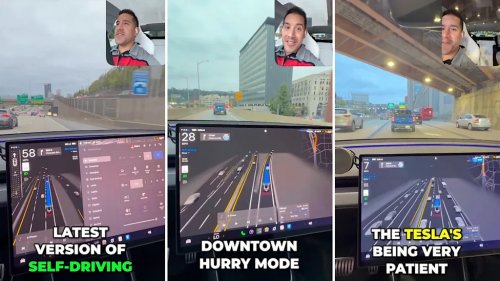
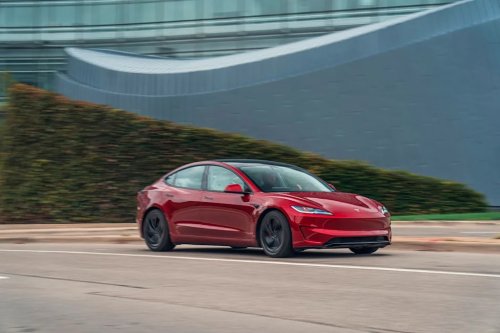
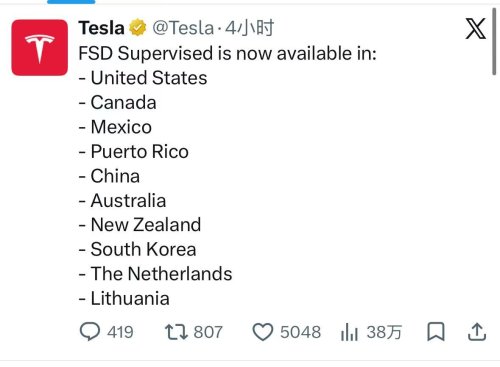
Gasgoo Munich- What exactly did Elon Musk achieve during his latest trip to China?Aside from a viral snapshot with Xiaomi's Lei Jun, the rest remains a mystery.In reality, there is one unspoken mission Chinese consumers hoped Musk would fulfill: finally bringing Full Self-Driving (FSD) to market in China. Musk's promises on this front have gone unfulfilled for far too long.It wasn't until six days after Musk wrapped up his visit to China alongside Trump—on May 21—that Tesla officially announced the "launch of Supervised FSD in China."Look past the market's blind euphoria, though, and scrutinize the term "Supervised," and an intriguing paradox emerges: the announcement is real, but its actual capabilities remain an open question.Does listing China as an available region signal the final starting gun for a full rollout, or is it merely a market signal designed to boost slumping sales?Supervised FSD: An "Announced" L2?What exactly changes when FSD gets the "Supervised" label?"The name FSD is inherently misleading—it translates to 'Full Self-Driving,' but the supervised version is still essentially L2." That is the consensus among many industry professionals regarding Tesla's announcement.Image Source: XUnder the UN R-171 regulation, the Supervised FSD Tesla is rolling out globally falls under Level 2 driver assistance. This means the driver must remain fully attentive with hands ready to take over at all times; if an accident occurs, the driver bears full legal liability.In the SAE L0-L5 classification system, Level 2 means the system assists with acceleration, braking, and steering only in limited scenarios, leaving the driver as the primary responsible party. It is not until Level 3 that the role shifts to "system-led driving with driver readiness to intervene" in specific conditions.Is a Level 2 FSD really that exciting? What is Tesla's true objective in signaling the arrival of Supervised FSD in China right now?"It is simply driver assistance. It's just that for a listed company like Tesla, under intense competitive pressure, you need to release a new feature every so often," said Zhang Xiang, Secretary-General of the International Intelligent Transport Technology Association. "There's no major innovation here—just a new term to attract orders."Zhang emphasized: "Currently, no private passenger cars from Chinese automakers have reached Level 3. The basic requirement remains that hands must be on the wheel; you can't leave them unattended for long periods. The owner is liable for accidents, which means we haven't hit the L3 standard yet."To some extent, Tesla's move to list Supervised FSD as available in China amounts to a massive compliance exercise on the Level 2 track.Consider the timeline's twists and turns. In February 2025, Tesla pushed "City Autopilot" to Chinese owners who had purchased FSD, but suspended the rollout just a month later due to approval issues. By November 2025, Musk was optimistically predicting approval for February or March 2026. Then, on the first-quarter 2026 earnings call, Tesla's CFO shifted the target again to the "third quarter."The May 21 announcement that China is "available" is still a far cry from actually getting City NOA into the hands of all users.So, what are the real hurdles for FSD's rollout in China?Zhang pointed out that the lack of full promotion for FSD in China has little to do with policy restrictions; domestic policies treat Tesla and local automakers equally. "There is no need to worry about whether FSD meets Chinese technical standards because China currently has no national or mandatory standards for autonomous driving," Zhang said. "There may be some recommended standards or drafts for comment, but these are not mandatory for automakers."He cited energy consumption labels for new energy vehicles as an example: "We see cars with labels showing fuel consumption in liters per 100 kilometers, electricity usage in kilowatt-hours per 100 kilometers, and National V or VI emission ratings. But new energy vehicles do not have labels for autonomous driving levels—not a single one. So Tesla doesn't need to worry about Chinese technical standards and regulations."Zhang further assessed that while China leads in autonomous driving, the standard system is not yet fully formed—"standards might be issued in a few years." As an industry leader in autonomous driving, Tesla faces relatively little compliance pressure.He concluded: "For Tesla, the opportunities outweigh the challenges."Opportunities may outweigh challenges, but the challenges are not nonexistent.In Zhang's view, Tesla's FSD algorithm has evolved from initial programming to end-to-end and now to VLA (Vision-Language-Action) large models. The immediate issue is the "black box" dilemma. "The FSD algorithm is essentially a black box; the internal code and algorithms are unknowable." In other words, FSD faces potential challenges regarding technical trust.Next is the data barrier. "Chinese traffic scenarios differ vastly from those in North America, so the data needs to be retrained and relearned," Zhang noted bluntly. Tesla started collecting data in China later than domestic brands like Huawei and XPENG, putting it "a beat behind."Regulations jointly issued by several ministries impose strict compliance requirements on road data collection in China: important data must be stored domestically, and cross-border transmission requires security assessment.Although Tesla established a data center in Shanghai back in 2021 and achieved localized storage for over 3 billion kilometers of Chinese road data, leveraging these real-world scenarios for deep training has been constrained by computing power, platform limitations, and cross-border restrictions. Consequently, its model iteration speed in China lags noticeably behind local rivals.Then there is the hardware generation barrier. FSD requires vehicles to be equipped with the HW3.0 hardware platform or higher. While models rolling off the line since around 2024 come standard with HW4.0, the outlook for the vast number of existing owners with HW3.0 hardware is less optimistic.Image Source: TeslaAccording to industry sources, Tesla has explicitly admitted that hardware for vehicles purchased between 2019 and 2023 "cannot support unsupervised Full Self-Driving." As a remedy, Tesla plans to push a significantly stripped-down "FSD V14 Lite" version to HW3.0 owners by the end of June 2026, or offer a paid option to upgrade to HW4.0 hardware.This means that even with full approval, a significant portion of Tesla's legacy users will be unable to experience the complete FSD functionality—a potential public relations risk that will need careful management.Is the "L2 Version of FSD" Arriving in China Too Late?Limiting the discussion of FSD's entry to Tesla's own product timeline offers a view that is far too narrow.The bigger story is this: Chinese domestic brands have already taken substantive steps on the L3/L4 advanced autonomous driving track. By the time Tesla enters the Chinese market with Supervised FSD, it is stepping onto a mature battlefield that has already weathered years of all-out competition.Domestic pilot programs for L3 autonomous driving are now officially underway. In late 2025, the Ministry of Industry and Information Technology announced the first batch of admission permits for L3 conditional autonomous driving models. Two vehicles—one for city congestion and one for highway use—developed by BAIC and Changan's Shenlan brand, were approved to begin road trials in designated areas of Beijing and Chongqing.Both pilot L3 models adopt a "commercial users first, gradual public rollout" strategy. BAIC New Energy stated that L3 models are expected to gradually become available to individual users in the second quarter of 2026.Furthermore, FAW, BYD, and NIO have also entered the approval pipeline, signaling that L3 autonomous driving in China is "blooming across multiple fronts."Meanwhile, the mandatory standard "Intelligent Connected Vehicle Autonomous Driving Data Recording System," which takes effect on January 1, 2026, provides clear data support for determining liability in L3 accidents.This suggests that competition in the Chinese market has moved beyond the hype of terminology and entered a phase of genuine compliance and systematization. Supervised FSD, however, remains strictly locked into the L2 framework, where the automaker assumes no liability for accidents, leaving the driver with full legal responsibility.When Chinese L3 pilot vehicles from brands like Arcfox and Shenlan are already completing hundreds or thousands of kilometers of highway driving with the system in control, the arrival of Supervised FSD in China feels, to some extent, like a chase to catch up with a bygone era.Globally, FSD is a sharp sword for Tesla. But in China, local brands have already built formidable walls using massive data and rapid iteration before that sword can even fall.Image Source: TeslaPricing pressure is also a factor. Tesla's FSD previously carried a buyout price of 64,000 yuan. After a full shift to a subscription model, owners in Lithuania pay 99 euros per month (approximately 782.9 yuan at current exchange rates); those who previously purchased Enhanced Autopilot pay as little as 49 euros (approximately 387.5 yuan).If Tesla's FSD pricing in China aligns with European levels, its appeal to Chinese consumers could be significantly diminished.This means that even if FSD gains approval, it faces not just the technical hurdles of localization, but a comprehensive battle involving pricing, brand perception, user loyalty, and ecosystem competition.Does Tesla's "Catfish Effect" Still Work?As a globally innovative automaker, Tesla has generated immense anticipation in China for its FSD. Conversely, Tesla's desire to bring FSD to China far exceeds outside imagination."China possesses the world's largest new energy vehicle market, and FSD can help Tesla with marketing and boosting sales," Zhang said. He further analyzed that FSD is essentially a software product, aligning with the trend of software-defined vehicles. "Software has high value; it requires no materials, just intellectual property. If Tesla adopts a subscription model for FSD in China, it could generate significant profit."From a macro industry perspective, FSD's entry into China will have profound implications on two levels, regardless of its success or failure.First: The catfish effect stimulating a technology race.Much like Tesla's localization in 2018 forced the Chinese EV industry to accelerate innovation, the substantive entry of FSD—a foreign high-level intelligent driving system—will likely compel Chinese autonomous driving companies to launch a new round of technological competition.During Musk's visit as a core member of the U.S. business delegation, some observers argued that China's openness to FSD is essentially a trade of technology for market access and compliance for space. Introducing FSD as a "catfish" is intended to force further maturation of local solutions from Huawei, XPENG, and Baidu."Domestic intelligent driving is so advanced now that there's no need to fear Tesla; everyone can just compete," an industry analyst told Gasgoo.The autonomous driving industry is currently shifting from "modular architecture" to "native end-to-end" designs. Future evaluation standards will shift from "is it end-to-end?" to "model density"—the depth of AI model penetration in the system's decision-making chain.Tesla holds a first-mover advantage on this track; its data loop based on a global fleet and end-to-end neural network architecture has long been its core technological differentiator. Once this system completes a localized loop in China, it is bound to pose a formidable systemic challenge to domestic autonomous driving solutions.Image Source: TeslaSecond: The localization dilemma of the latecomer.As previously mentioned, domestic autonomous driving companies have spent the past three to four years accumulating vast amounts of data on real Chinese road conditions. This includes complex scenarios such as unprotected left turns, mixed traffic with pedestrians, weaving delivery scooters, reversible lanes, and temporary traffic lights.Although FSD has established a compliance foundation through localized storage at its Shanghai data center, transitioning from a North American model to one specialized for Chinese road conditions requires a relatively long training and iteration cycle."FSD cannot be rushed to launch," Zhang said. "If the user experience is poor, it would be a major blow to the Tesla brand."Such caution is undoubtedly necessary. Test data indicates that FSD's recognition rates for mixed traffic in complex Chinese scenarios, and its efficiency in handling wrong-way non-motor vehicles and cars cutting in, still need improvement."Acclimatization" issues exposed during previous limited-time free trials once drew industry attention. The large-scale recruitment of intelligent driving test technicians across nine cities suggests Tesla is pushing for on-road testing and scenario adaptation with unprecedented intensity.From this perspective, launching Supervised FSD as a Level 2 driver assistance system in China is currently the most realistic and prudent path forward.



















 +7 others