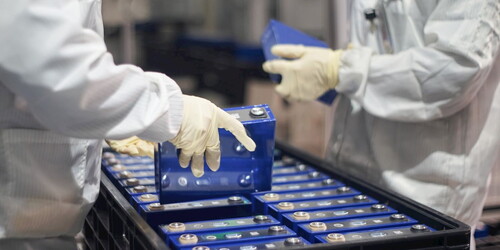
US President Donald Trump swept into office last year with the grand ambition, among others, of killing the vehicle electrification movement in its cradle. He did some damage, for sure, but the signs of his ultimate failure are already written in the rising activity within the domestic EV battery manufacturing industry. Somewhat ironically, the latest development involves a Canadian firm, the Vancouver, BC graphite supplier Graphite One. More Graphite For EV Batteries In The US New EV battery formulas have been surfacing in recent years. However, much of the changeover in materials involves the battery cathode. Graphite still remains the material of choice for anodes. As a graphite industry stakeholder, Graphite One is happy to explain why the demand for graphite among battery manufacturers is large now, and likely to remain so for the foreseeable future. “Despite research into silicon, lithium metal, and other alternatives, none have yet matched graphite’s combination of, cost, and manufacturability,” the company enthuses. “While cathode chemistries (where lithium, nickel, cobalt, and manganese are used) are evolving rapidly, the anode side remains dominated (>95%) by graphite,” they emphasize. That’s all well and good for the graphite industry, but the complicating factor is the dependence of US battery manufacturers on overseas suppliers, particularly China. That is about to change. In addition to emerging synthetic graphite alternatives, the US could mine enough graphite within the 50 states to fill demand, though probably at a higher cost according to one recent study, The potential expense doesn’t seem to bother Graphite One. Last fall the company confirmed the presence of graphite at its Graphite Creek property, located in Alaska north of Nome. Expense aside, there certainly is plenty of graphite to be had. The company cites a report from the US Geological Survey, identifying the property as the largest graphite deposit in the US, and among the largest in the world. If all goes according to plan, the graphite will be shipped to a forthcoming processing facility in Ohio, thereby onshoring the supply chain, avoiding tariff entanglements, and practically eliminating the risk of geopolitical complications, too. Yet Another Sign That EVs Are Here To Stay Graphite One outlined its plans for its new anode active materials facility in May, after it acquired a site in the city of Conneaut, located in the northeast corner of Ohio in Ashtabula County. Further cementing the Canadian connection, Graphite One will occupy the property through an agreement with Bessemer and Lake Erie Railroad Company, a branch of Canadian National Railway. Interesting! Among the advantages of the location, Graphite One cites rail shipping connections through Canadian National and the site’s existing power infrastructure, with proximity to Lake Erie and the Great Lakes shipping corridor icing the cake. The site also provides space for the company to expand operations, indicating that Graphite One is among those seeing a rebound in EV sales. “The expansion would further position Graphite One as a potential domestic supplier of active anode materials at a time when North American supply chains continue to seek localized sources of critical battery inputs,” the company explains. If all goes according to plan, the expansion will get underway while the first phase of operations is running. In Phase I the company anticipates completion of construction late next year, in Q4 2027, with an initial capacity of 10,000 metric tons per year. Phase II will follow right behind, with construction completed in Q3 2028 at a capacity of 25,000 metric tons per year. For the record, Conneaut’s gain comes at the expense of Warren, Ohio, where Graphite One was previously considering a site for the new facility. EV Battery Stakeholder Preps For The Next Wave Of EV Sales Not waiting for the ink to dry on the agreement for the Conneaut site, in May Graphite One also announced that it has already provided anode materials to three A-list EV makers and three battery manufacturers, too, while simultaneously discussing off-take agreements with some of those who are evaluating samples. Though financing for the project is still apparently a work in progress, on June 18 the company indicated that plans for the Conneaut site are firming up with the engagement of an engineering firm to handle the manufacturing equipment. The name of the firm is under wraps at this time, with Graphite One only stating that it is a “leading global engineering and production line integration provider” and a “highly experienced production integration team.” “The engineering team will provide Production Line Integration services, ensuring the seamless coordination and optimization of the equipment that will form the backbone of Graphite One’s Ohio manufacturing operations,” Graphite One emphasizes. Everybody Loves EVs If the pace of EV battery manufacturing in the US ends up disappointing Graphite One, the company can always fall back on the demand for graphite in stationary energy storage systems, particularly in regards to the exploding data center industry. However, odds are that Graphite One and other EV battery materials firms will not be disappointed. EV sales in the US did fall dramatically after US President Trump and his Republican allies in Congress pulled the plug on the all-important $7,500 EV tax credit last fall, but the damage was not absolutely catastrophic, at least not for some EV makers. Additionally, signs of activity have emerged among automakers that dialed back on their near-term EV plans last fall. Ford is among the dial-back group, but the company has persistently affirmed that its new LFP (lithium-iron-phosphate) EV battery formula will support the production of more affordable EVs in the coming years. The startup Rivian is another example, with work progressing on a new factory in Georgia, supported — somewhat oddly — by a $4.5 billion loan from the US Department of Energy. Another sign of life has appeared in the self-named US Department of War. Under its previous iteration as the US Department of Defense, the agency has been extremely cautious about deploying EVs in war zones, with battery fire hazards being one limiting factor. However, the Army is inching closer with the introduction of battery-powered anti-idling kits, which power onboard equipment while saving diesel fuel. Cabless, autonomous EVs could also widen the vehicle electrification window for military applications, by removing driver and passengers from battery safety risks, so keep an eye out for more activity in that space. Photo: The Canadian firm Graphite One has a plan in the works to onshore the graphite supply for EV batteries and other energy storage applications, with a mine in Alaska and a processing facility in Ohio (cropped, courtesy of Graphite One).