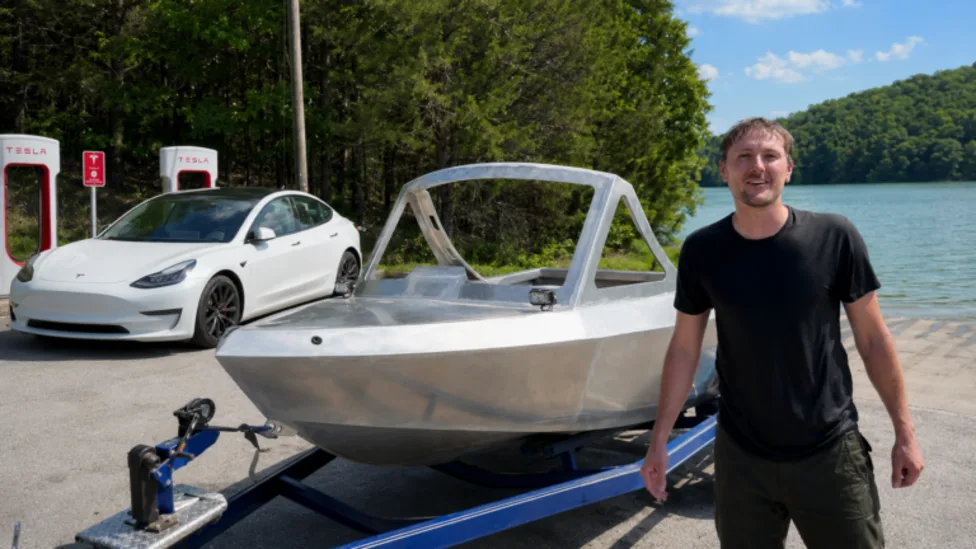
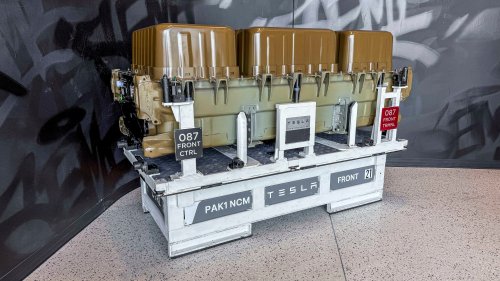
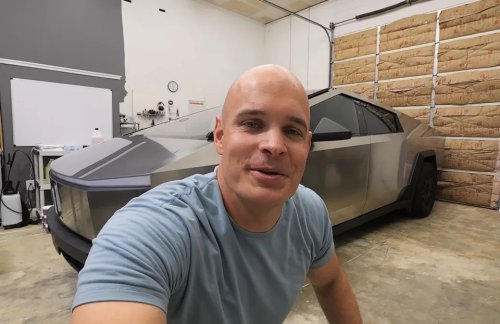
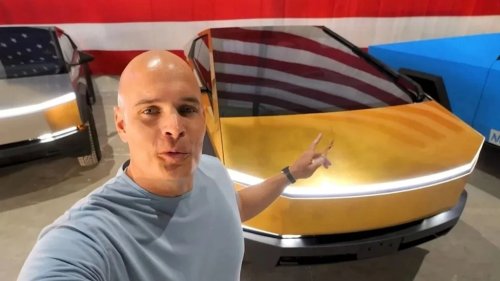
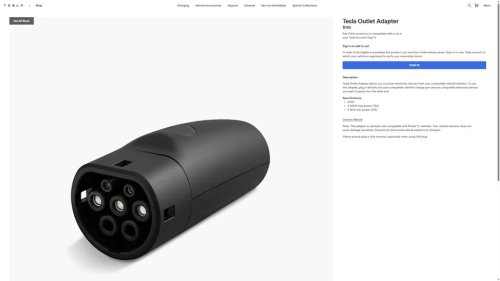
He Turned a Tesla Model 3 Into a Handbuilt Aluminum Jetboat—and It Actually WorksTyler Fever, a YouTuber, dedicated three years to gutting a 2021 Tesla Model 3 and transplanting its drivetrain into a handbuilt aluminum hull, producing what he calls the world's first miniature jetboat powered by a Tesla. A summary video hit YouTube recently, pointing viewers to a full build series streaming free on Tubi."Today we're building the world's first Tesla powered mini jetboat. And it might just be the coolest thing I've ever built," Fever says at the top of the video. He went into it by his own admission with zero EV background: "I'm starting this project with no EV experience, just a goal to learn as much as possible."The Engineering Problems Were ConsiderableDropping a Tesla motor into a jetboat isn't a bolt-in swap. The Model 3's motor runs through a 9:1 gearbox reduction, which kills the RPM range the jet pump impeller actually needs to move water. To solve this problem, Fever machined a custom output shaft from scratch, one that skipped the reduction stage altogether and linked the rotor straight to the pump, all without disrupting the motor's internal oil circulation system. He prototyped the parts in 3D-printed plastic first, then had them machined locally.AdvertisementAdvertisementFitting the battery pack into the hull required considerable problem-solving. Sourced from a standard-range Model 3 – a deliberate choice given its smaller size compared to the long-range variant – the pack was disassembled into four individual modules, each weighing roughly 150 lbs, and then oriented vertically inside two custom laser-cut enclosures designed to conform to the boat's interior. Fever also fitted an EV charge port to the exterior of the boat, so it could theoretically pull up to a public charger like any electric car."Oh yeah, first mini jetboat with a EV charger in the side of it," he notes, apparently pleased with himself.The factory Tesla control electronics refused to cooperate. After months of work, the battery management system and the motor controller wouldn't communicate properly, forcing Fever to scrap the OEM setup and buy an aftermarket Orion BMS along with a third-party inverter – a costly detour that also required partially disassembling the battery packs again. He doesn't shy away from acknowledging the serious risks the project carries, warning: "This is an extremely dangerous project where we are modifying high voltage systems that cannot be turned off and have a lethal voltage all the time."The first water test, predictably, did not go smoothly. The boat floated and the motor turned, but degraded battery cells – which had sat in storage for much of the three-year build – triggered BMS warnings under load. A water pump failure cut the session short before the boat could get up on plane. Despite the imperfections of the maiden voyage, Fever considered the outcome a success, summing up his satisfaction plainly:AdvertisementAdvertisement"It doesn't sink. It doesn't start on fire. It stays dry. It doesn't burn to the ground. I'm pumped, dude."The Tubi series spans a minimum of four episodes, documenting additional modifications, an initial successful run on a lake, and a later journey to Nashville for continued trials. Whether the boat ever becomes a usable watercraft is, apparently, the whole point of watching.