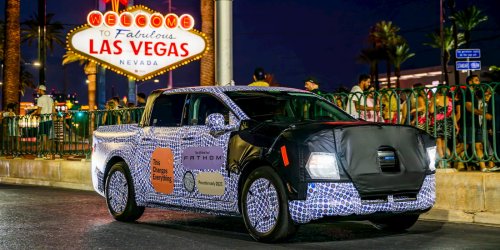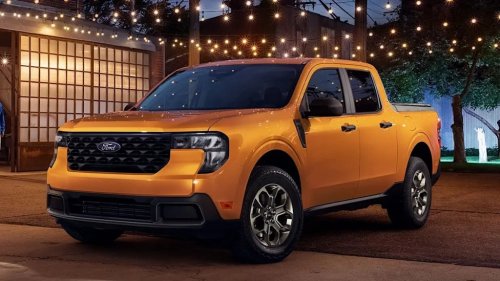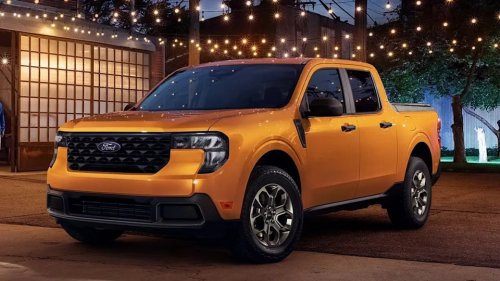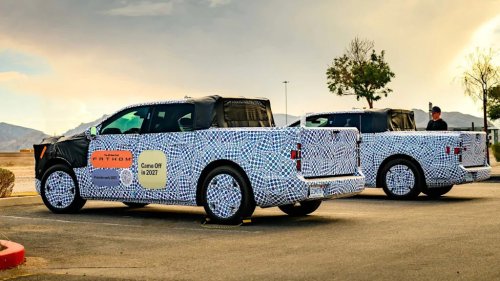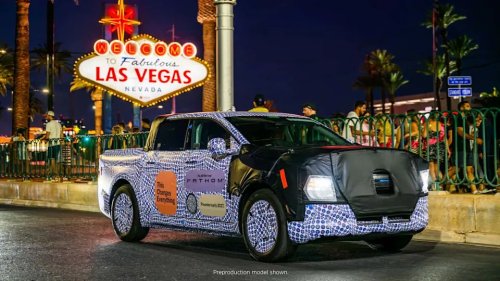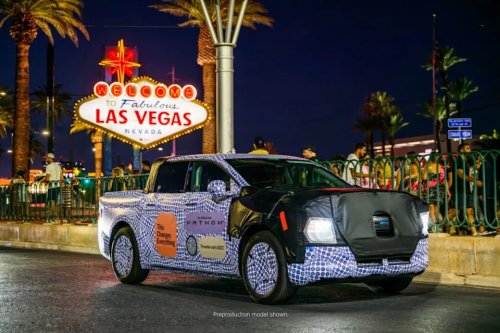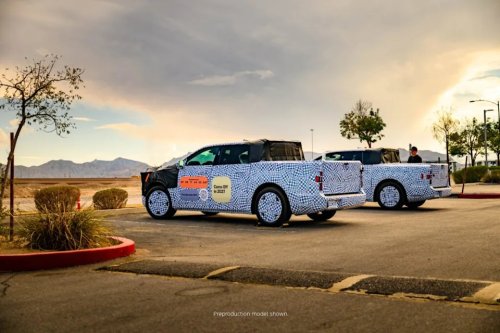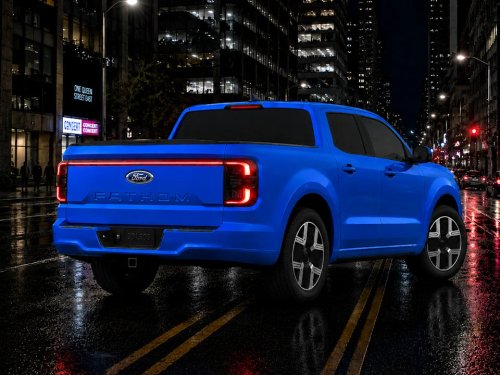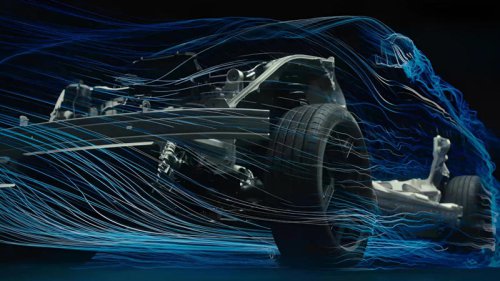
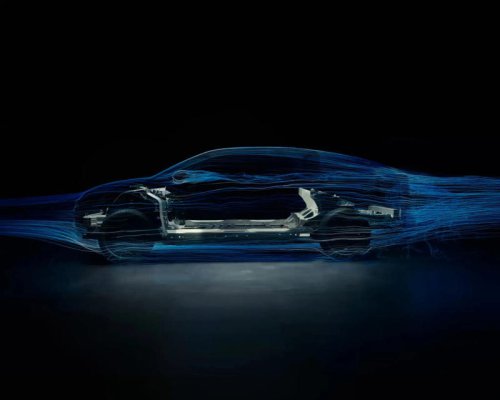

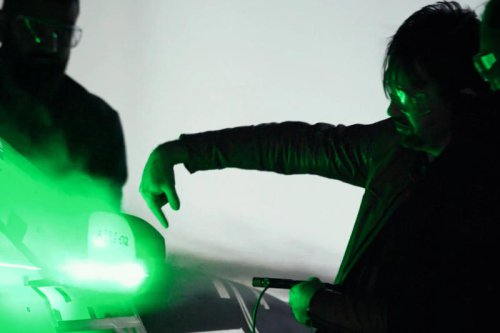

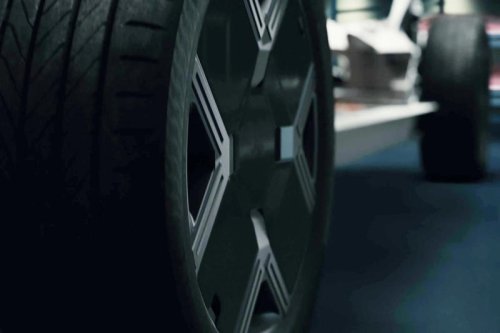




















As the product of bounty-hunting and Formula 1 expertise, the Blue Oval’s UEV promises to best other pickups with its efficiency and aero. Race car chassis with rear tire shown in airflow simulation lines. Last fall, Ford announced that it would be shaking up the electric segment by launching a new Universal Electric Vehicle (UEV) platform and production system. In doing so, the brand would be able to develop a series of battery-powered vehicles that could finally compete with gas-fed rivals — both in terms of their price and their range performance. The first offering to be launched as part of the initiative was confirmed to be a sort of pickup-like silhouette combining the interior space of a Toyota RAV4 with the utility of a frunk and a truck bed. Moreover, with a target MSRP of around $30,000, it’s already been made out to be quite the value proposition. The UEV brings a teardrop-shaped aerodynamic profile — it doesn’t cut through the wind like other trucks. Needless to say, Ford is employing some serious talent to bring this UEV to life. To ensure that the project will keep to its intended price point, this means designing the truck for affordability down to the very inch. Reducing battery size Per the Blue Oval, much of the challenge has to do with battery size. In order to counteract range anxiety, most manufacturers have adopted a “bigger is better” approach. Ford says that wind tunnel testing started almost as soon as designers had pen to paper. However, by doing so, they’re adding weight, expense and complexity. Based on Ford’s findings, EV batteries account for upwards of 25 percent of the vehicle’s weight and somewhere around 40% of the total cost. Accordingly, in the pursuit of engineering its forthcoming Universal Electric Vehicle platform to be widely accessible, Ford is focusing on overall efficiency rather than absolute capacity. It requires a fresh cost-cutting strategy that breaks from traditional design practices. Ford likens it to a bounty system, as engineering decisions are tied to exact values. As such, if the aerodynamics or the interior team wants to make a change in the roof height, they know that adding even 1mm could result in $1.30 in additional battery cost or a range reduction of .055 miles. Ford’s development team is prioritizing efficiency from a smaller battery through slippery aerodynamics. In practice, it makes for a unified front yielding more optimized compromises. There’s a common objective across departments to design for maximum performance and mechanical simplicity while reducing powertrain expense. Improving aerodynamic efficiency Beyond calculated price-conscious design decisions to reduce battery cost, Ford is obsessing over the truck’s efficiency in the wind. For this reason, more than half of the aerodynamics team has a background in Formula 1. This mirror design yielded a 1,5-mile improvement in range. It’s experience that’s informed the development process, as the wind tunnel has been made central to the pickup’s design process. Moreover, by utilizing a modular “LEGO-like” test vehicle, the team can make continuous and incremental changes based on objective data. Ford calls it a “fail fast, learn faster” mentality, and it’s already yielded some impactful results. Along with a sleek, teardrop-shaped aerodynamic profile, the truck boasts 20-percent smaller mirrors that add an estimated 1.5 miles of range, as well as an underbody sheath that guides air sound the wheels for a further 4.5 miles of range. On the road, these minor changes add up to big differences, and the team’s expertise has yielded a truck that is more than 15 percent more efficient in testing than any other pickup being sold today. That amounts to a 50-mile range improvement, and highway figures are more promising still — Ford claims a 30 percent increase in efficiency. Ford’s UEV truck is reportedly 15-percent more efficient than any other truck on the market, thanks to its F1-backed design. More to come At this stage, Ford hasn’t announced any concrete specs or an exact price. However, the progress that it’s making with its UEV platform shows that it’s still committed to developing all-electric alternatives, even if the recent discontinuation of the F-150 Lightning might suggest otherwise. As ambitious as it is, things do bode well. Ford has brought the vehicle charging ecosystem completely in-house, and the UEV will be the first all-electric offering in its lineup to be built on its own distinct architecture. About the Author: Gray is an associate editor at Gear Patrol, covering cars, motorcycles and anything else with wheels. When he’s not chasing the latest industry news, he’s probably wrenching on one of many projects. For better or worse, he believes classics make perfectly practical daily drivers. Want to stay up to date on the latest product news and releases? Add Gear Patrol as a preferred source to ensure our independent journalism makes it to the top of your Google search results. add as a preferred source on google