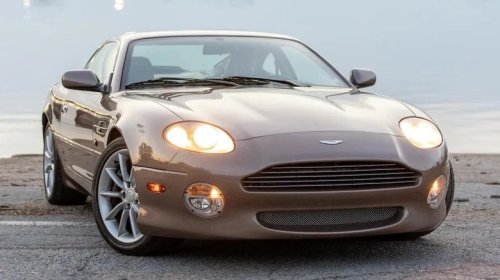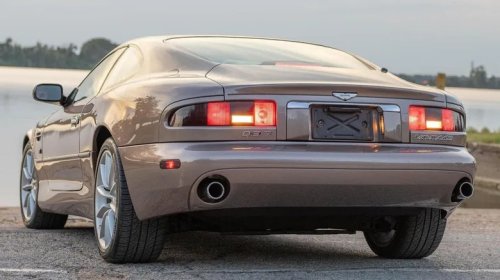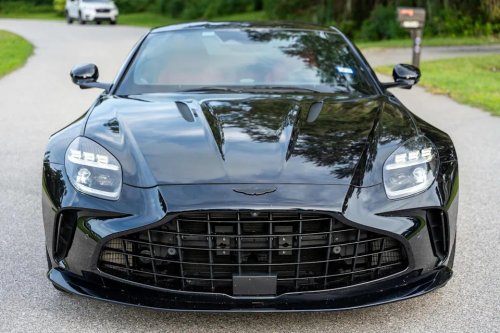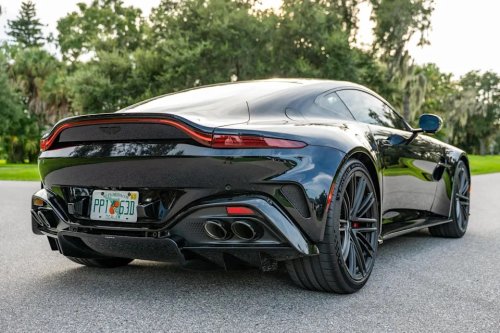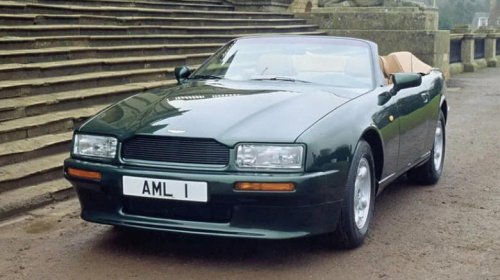
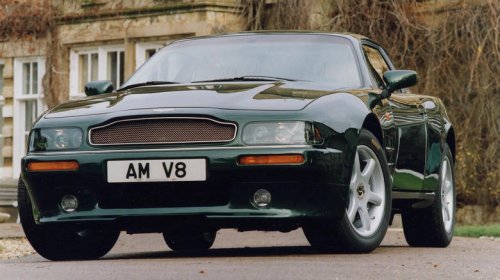
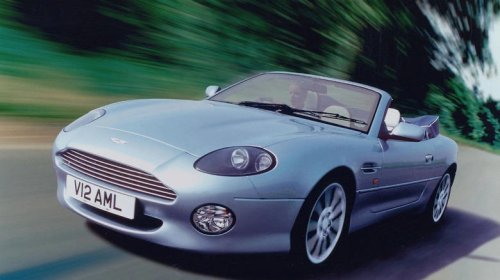
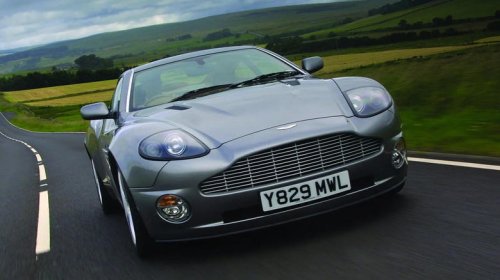
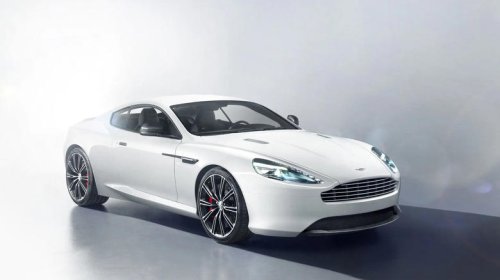


















V8 VirageThe first new Aston model in over two decades, the V8 Virage was released in 1988 with the boxy, flat-front styling Aston Martin had been running with at the time.The engine was a version of Astons long-running 5.3 liter V8, and the most major change was new cylinder heads and the inclusion of four valves per cylinder. The hope was that the additional valves would help counteract the apparently "inevitable" loss in power that came about from catalytic converters to meet emissions standards. And make power it did, at about 330 hp and 350 lb-ft of torque, all of which it needed given its not-insignificant weight of 3,946 pounds.Two years after it first launched, Aston Martin launched an open-top version of the Virage, called the V8 Virage Volante in 1990, replete with the same engine from the 1988 version. Then in 1992, a newer version of the Virage launched with ABS, as well as a 6.3-liter V8 engine, flared wheel arches, and an optional rear spoiler. After the 1992 Virage's launch, some of the Volante versions from 1990 were converted to the bigger 6.3-liter engine from the ABS version. Customers who bought one of these beauties could opt for an upgrade package from Aston Martin Works that added improved brakes, more customization, a modified suspension, and better wheels.V8 Coupe and V8 VolanteArriving in 1997, this was originally supposed to be a second generation Virage, but it became its own model during the development cycle. Aston had clearly run out of fancy names beginning with a V because it just called it the "V8 coupe." It was also available as a Volante version later, simply called the V8 Volante. The Virage and the V8 coupe laid the foundation for the modern-gen Vantage, which was Astons bread and butter. The V8 coupe was announced in 1996, and used a variation of the same 5.3-liter V8 engine that the Virage debuted with, though now it produced 369 lb-ft of torque and 350 brake horsepower, versus the Virage's 330 hp and 350 lb-ft. The engine was mated to a four-speed oddball gearbox that had two additional drive modes, called "touring" for long distance travel, and "sport" for, well, sport. The V8 Coupe is not really a car that one would imagine being important, but it remains a high-value collectors item, given its heritage. A year after the Coupe launched, a long wheelbase Volante variation of it debuted at the London auto show, and had a little under 8 inches (20 centimeters) more legroom than the coupe version. The Volante used virtually the same V8 engine as the Coupe did, but made 1 hp less, at 349 hp.DB7 VantageGiven the success of the straight-six DB7, Aston launched a new version of it, powered by not a V8, but a thundering monstrous six-liter V12 engine. It confusingly named this thing the DB7 Vantage, and there was also a Volante version released alongside it, which was among the first instances of the Volante being unveiled with the coupe. The DB7 Vantage was released in 1999 at the Geneva Motor show, meant to replace both the erstwhile DB7 and the second-generation Vantage that had been running from 1992. It had more common with the DB7 than the Vantage, and overall was a rather pretty car, with the only sore point being the ugly fog lights at the front. At launch, the DB7 Vantage came with a five-speed manual gearbox (the infamous touchtronic was added later), or a six-speed manual. The car made 420 hp, 400 lb-ft of torque, had a top speed of 185 mph, and rocketed from 0 to 60 in exactly 5 seconds. In terms of styling updates we got a bigger grill at the front, new indicator lights, 18-inch rims and now-standard Bridgestone tires. You could also choose interior trim options that were either real wood veneer, or carbon fiber. Four years after it launched, Aston Martin released a special edition, called the DB7 Vantage "Jubilee" to commemorate the golden jubilee of Queen Elizabeth II, of which 24 units were made. 19 of those 24 units were for U.K.-based customers, who got a fancy watch alongside their cars, all delivered at a special event at Thornbury Castle.V12 VanquishMost people probably know about the Vanquish nameplate after hearing about Aston Martin bringing it back 2024. However, the original V12 Vanquish launched in 2001 and was in production till 2007, and is famous for effortlessly becoming one of the most iconic grand touring Astons of all time. Also, it was a V12 Vanquish that starred in the epic James Bond movie "Die Another Day," and came with many internal and external improvements over the DB7 and DB7 Vantage, though they looked rather similar. It came with a bonded aluminum chassis, updated styling, and a six-liter V12 engine that made 400 lb-ft of torque and 460 hp, while weighing 4,046 pounds. As a result of that behemoth power plant, the not-so-light V12 Vanquish could still do 0-60 mph in 5 seconds flat, and had an impressive top speed of 190 mph. The Vanquish S, launched in 2005, used the same engine, but made 425 lb-ft of torque and 520 hp, and actually weighed more than the standard Vanquish, at 4,133 pounds. However, it did 0-60 mph in 4.8 seconds, and had a top speed north of 200 mph. You could have the Vanquish S in either a two-seat (2+0) or four seat configuration (2+2). Both the Vanquish and Vanquish S would come with the same six-speed automatic gearbox, but had a mode called "Auto Shift Manual" (ASM) that would simulate a manual gearbox.DB9Any time a new DB model is released, it always makes headlines, and the Aston Martin DB9 was no different in this regard. It came with updated styling, a much more powerful engine, and all the tech bells and whistles of the time. Launching shortly after the DB7 Zagato, the car was designed to be the next model in the DB range. The DB9 was the first car produced and built at the Aston Martin factory that had just opened in Warwickshire. It was such a generational leap forward from the aging DB7 that calling it the DB8 was considered inappropriate.The DB9 was launched at the Frankfurt Motor show in 2003, and Aston Martin followed up with a cabriolet Volante version one year later. The prototype for the DB9 was tested in virtually every region you can think of, over a million miles, from the arctic circle to the arid death valley in the States, and even included tests at Volvo's safety center. It came with a six-liter V12 unit that now output 457 lb-ft of torque and 510 hp, which led an impressive top speed of 183 mph and 0-62 mph time of 4.6 seconds. The engine, called the "AM11" was mated to a unique rear-layout six-speed gearbox, and had a finicky shift-by-wire system. But all that paled in comparison to the car's looks. It somehow looked like it was flowing even when it was standing still — no wonder it's still an icon today.