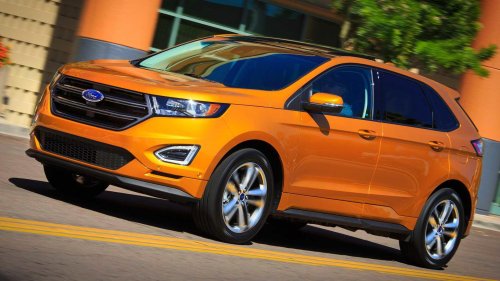
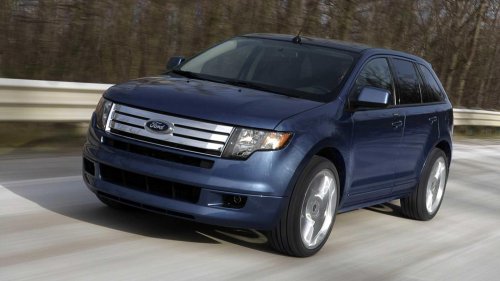
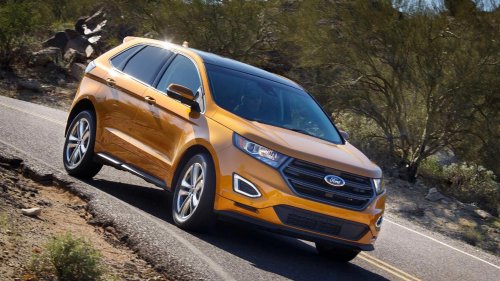
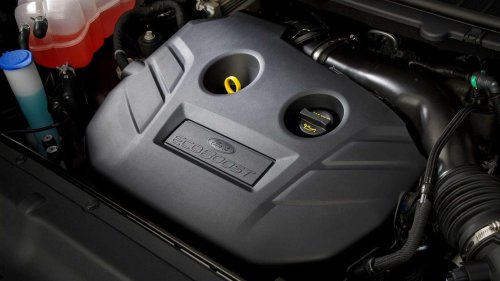
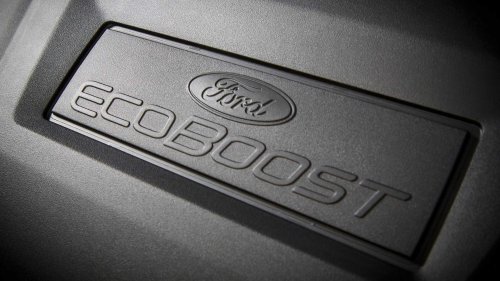
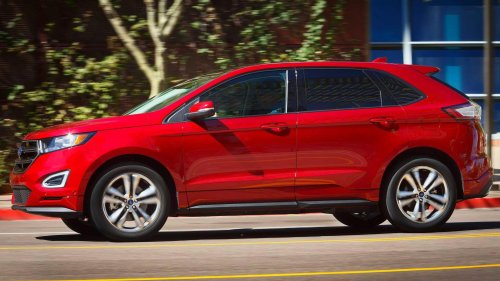
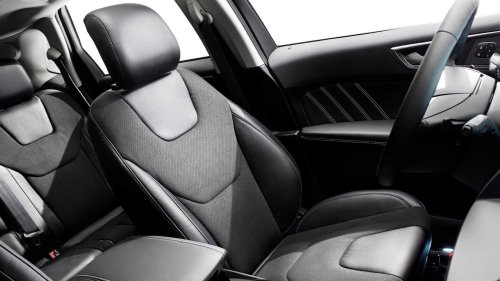
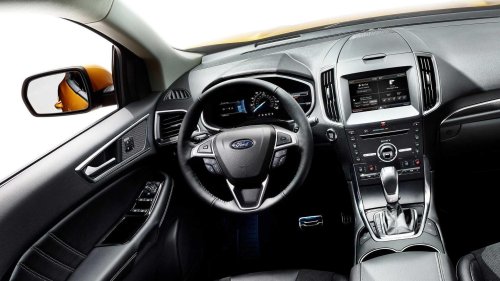
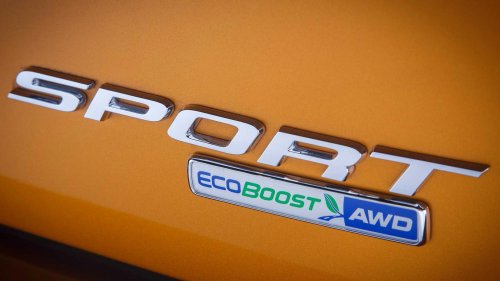
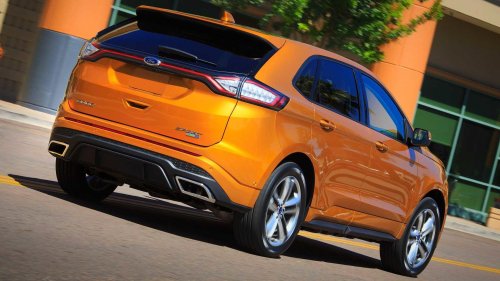
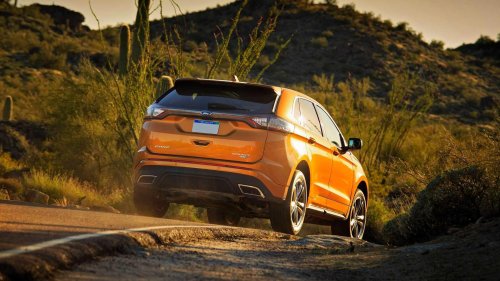
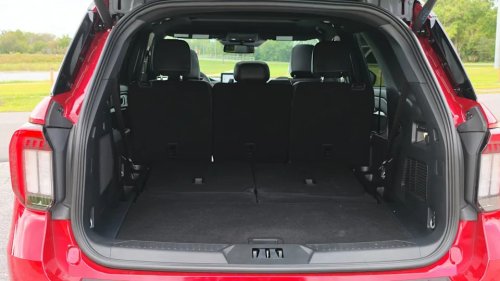
If you asked someone what a performance SUV was 25 years ago, you'd probably be given some confused looks. However, these days, it's an increasingly popular segment. You can partly attribute the rise in popularity to the performance SUV's indirect effect on the hot hatch segment in the United States. Not to mention, more folks are choosing to combine their vehicular desires, such as quickness, space, and practicality. The performance SUV can have all of that in varying degrees.However, most new performance SUVs tend to carry hefty price tags. For example, the 2026 Acura MDX Type S costs roughly $75,850 before destination fees or taxes. For a lot of folks, especially those with families to think about, that's a high price to pay. However, a used Ford may be your answer. Specifically, the 2018 Edge Sport. It boasts a twin-turbo V6, well over 300 horsepower, and enough space to haul a good bit of cargo. Right Under The Radar FordFord's SUV lineup was due for a change in the mid-2000s. At the time, the Blue Oval was interested in bridging the SUV gap between the Escape and Explorer, as the latter was edging toward full-size status. Ford figured that, with the Explorer now boasting an optional third row and the Escape being, well, tiny, another model was needed to sit right in the middle.The new model was the Edge, which would officially enter production in January 2006. It went on sale a few months later as a 2007 model and boasted a base sticker price of about $25,320. Sales were immediately positive, with Ford reporting 130,125 sales for its first model year, exceeding the Detroit Giant's initially projected sales target of 100,000 units. The 2008 version was also a good year for the Edge, with approximately 110,798 sold. Enter The Sport Ford However, come 2009, Ford decided to up the Edge's ante a bit. That year, the automaker unveiled the Edge Sport. It could be considered a proto-performance SUV, as the trend hadn't caught on very much in the mainstream car market. Regardless, Ford unleashed it into the American market with generally positive acclaim. Much of its sportiness came from its 3.5-liter V6, which could pump out 265 horsepower and 250 pound-feet of torque.Come 2011, the Edge was granted a major refresh. Its front and rear fascias, along with its wheel options, were updated. Inside, its interior also received a major overhaul. The Sport grade carried over into the facelifted iteration, too. The hot Edge was granted an all-new, 3.7-liter V6 engine, bumping power output up to 305 hp and 280 lb-ft of torque. Two Turbos Help The Engine FordThe aforementioned 3.7-liter V6 remained as the Edge Sport's sole powerplant for the remainder of the first generation. Come 2015, though, Ford was ready to introduce a major change.When the second-gen Edge debuted in late 2014 as a 2015 model, it brought a pair of new engines: a 2.0-liter twin-scroll-turbocharged inline-four and a 2.7-liter twin-turbocharged V6. The latter found its way under the hood of the new Sport grade, which, despite the revised look, retained much of its original spirit, just with more power, 10 more horsepower to be precise. It was also capable of producing much more torque.Ford The mill itself is part of Ford's EcoBoost engine family. More specifically, the 2.7-liter belongs to the "Nano" subfamily, which also consists of a 3.0-liter unit. It's built to be extremely durable, having the upper half of its block composed of compacted graphite iron (CGI). Underneath the CGI is an aluminum alloy, meant to help keep the engine's weight to a minimum.Ford In addition to its robust casting, the 2018 Edge Sport's 2.7-liter EcoBoost V6 also features integrated exhaust manifolds built into the cylinder heads. The advantage of the design is that it allows for faster turbo spooling and reduced turbo lag. Components such as its water pump and oil filter are housed within a specially designed integrated front cover that is structurally integral to the unit.Ford As for the rest of the '18 Edge Sport's mechanical makeup, it uses a six-speed "SelectShift" automatic transmission with the internal designation 6F50. All-wheel drive is the standard drivetrain setup. Its suspension is tuned for a firmer, more responsive feel over the standard Edge. Its steering ratio is also quicker than standard, making the Edge Sport feel a bit more nimble. A set of 20-inch wheels with low-profile tires adds to the performance-oriented appearance. Reliability Concerns FordOf course, most of you probably twinged a bit when reading the name EcoBoost, and there are some reasons for concern. The first-gen 2.7-liter EcoBoost V6 is known for coolant intrusion into the combustion chambers, which can be catastrophic if not caught in time. Oil leaks are also common, along with turbocharger boost loss due to bad seals. How Good Of An SUV Is It? FordSure, it's sporty, but the 2018 Edge Sport needs to be reasonably capable of acting like an SUV when it has to. It's reasonably spacious, for starters. In its cargo area, Ford reports a maximum load volume of 39.2 cubic feet. That ties the 2018 Honda CR-V at 39.2 cubic feet, and beats the 2018 Toyota RAV4 at 38.4 cubic feet.With the second-row seats folded, the Edge Sport offers up to 73.4 cubic feet of cargo space. Again, referencing the 2018 CR-V and RAV4, the latter ties it and is just slightly beaten by the former, losing out to 75.8 cubes.The Edge Sport isn't all too bad at towing, either. According to Ford, the 2018 model can tow up to 2,000 pounds safely when properly equipped. The 2018 CR-V manages to tow just 1,500 pounds in its properly equipped configuration. Conversely, the RAV4 can eke out a lead here, with a maximum towing capacity of 3,500 pounds when outfitted with a trailer hitch and Toyota's Dynamic Torque Control AWD. However, neither of these midsize, mass-market crossover SUVs produces anywhere close to 315 hp without skipping a beat. Standard And Optional Features FordWhoever bought a new 2018 Ford Edge Sport received a litany of standard features, many of which were only available on the top-spec Titanium grade. For starters, it comes equipped with heated front seats. The driver's seat boasts 10-way power adjustment, and there are faux-suede inserts for the front and rear seats as well. Ford's SYNC 3 infotainment software is wired right into an 8.0-inch screen. A premium 390-watt sound system from Sony features 12 speakers and a subwoofer.Ford While a lot does come standard, there are a few optional upgrades, too. Ford offered the "Equipment Group 401A" that includes heated and cooled front seats, heated rear seats, voice-activated navigation, and blind-spot monitoring. The Technology Package has adaptive cruise control and lane-keeping assist. Original buyers could spring for 21-inch wheels, a dual-pane, powered-sliding moonroof, and summer tires, too. How Much Will It Cost You? FordAll that may sound good, but price will ultimately be the deciding factor for anyone looking for a fast SUV on a budget. According to current market trends, the 2018 Ford Edge Sport's average used-market price is $12,201 for an example in average condition with average mileage. When you think about it, that's not a hard number to swallow, especially when you consider what you're getting for just $12k of your hard-earned money.The CarBuzz Marketplace (below) shows a higher average price for a 2018 Edge Sport at $17,196. The tool bases its valuation on the last 90 days of sales. Verdict FordWhile there are potential reliability issues stemming from its 2.7-liter V6, the 2018 Ford Edge Sport offers a great blend of practicality, sportiness, and a splash of style for an extremely agreeable price.