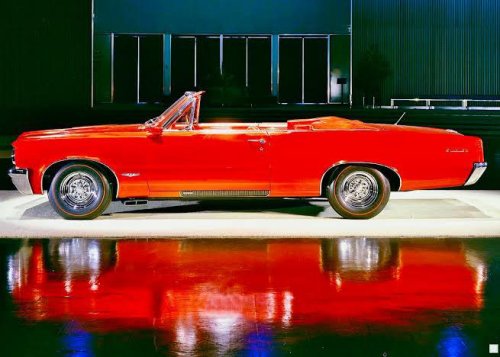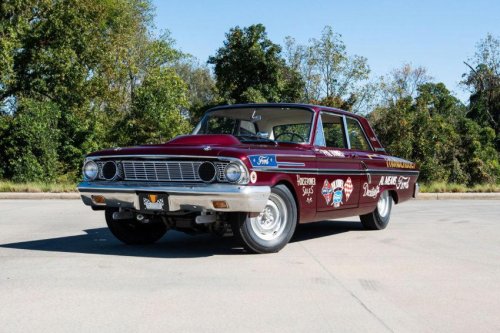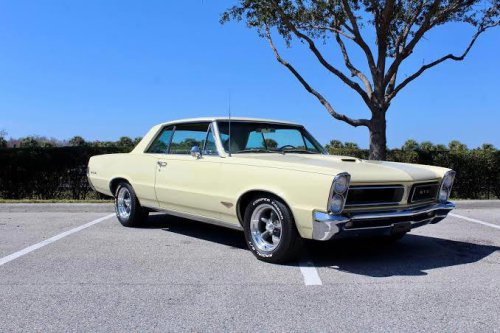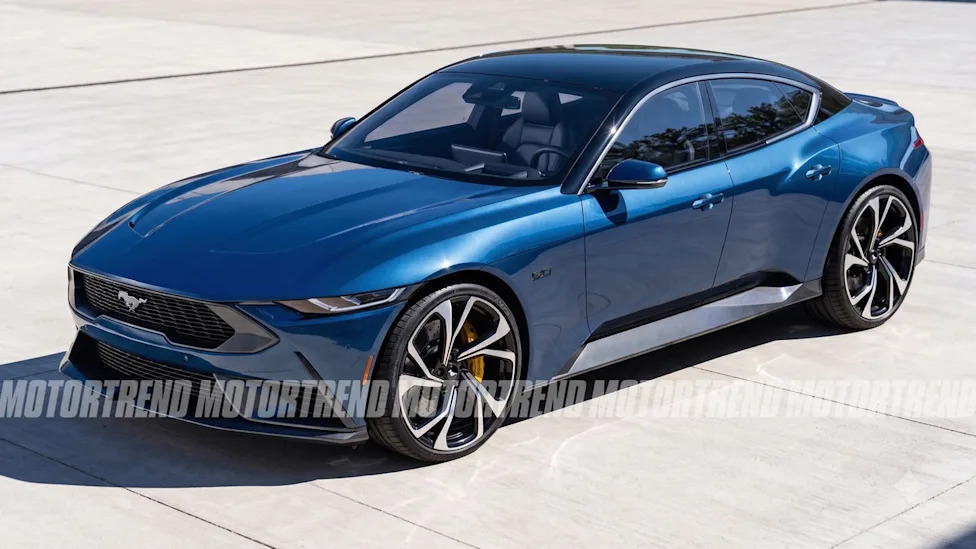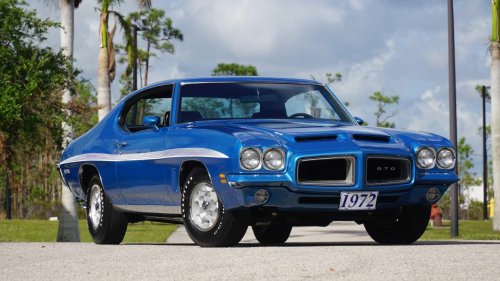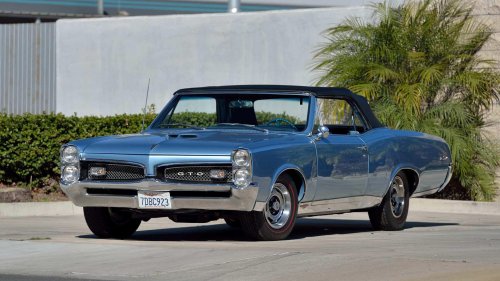
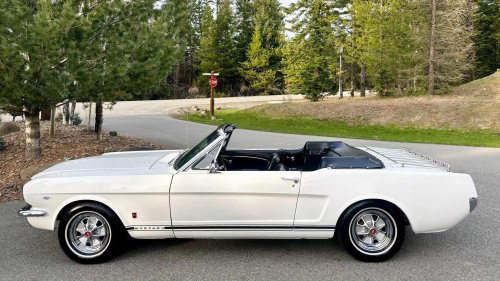
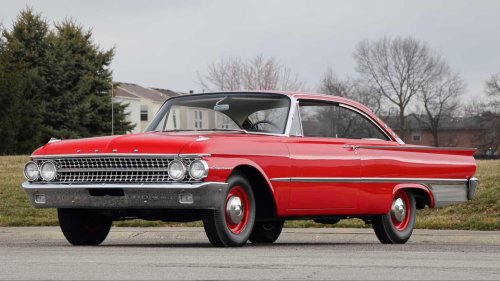
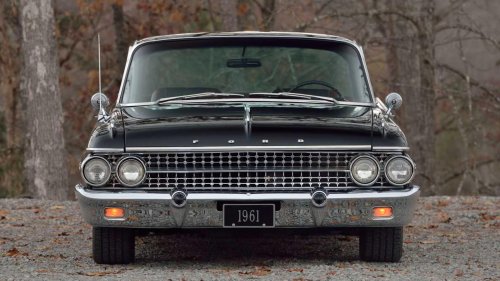
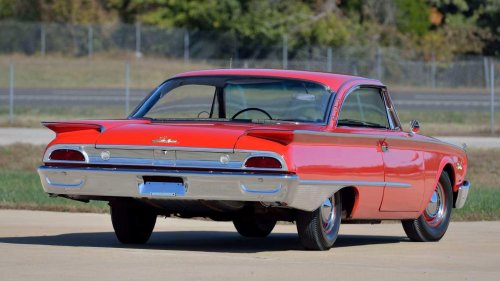
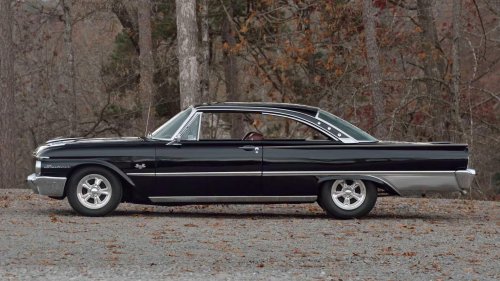
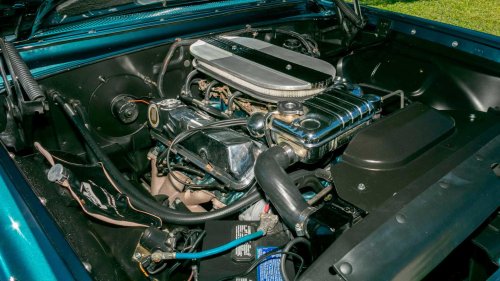
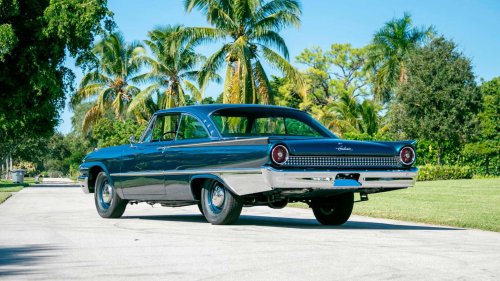



















The muscle car origin story is just like any other super hero's. There was a wasteland of nothingness, and then, "kapow" the muscular hero arrives to save the day and bring excitement to the dreary world. The muscle car genre arrived in a similar way, bringing a V8-powered slice of rock and roll to a stagnant segment that systematically churned out dull cars that our sensible parents would drive. But was the muscle car story quite like that? Not quite. Before one hero car came and invented a whole new segment single-handedly, there was one two-door model that did a pretty good job of looking good with a powerful V8. It's just a shame a lot of people have forgotten it... The Muscle Car Was Born With The Pontiac GTO Mecum The story goes that the muscle car was born on a Saturday morning over coffee. Young hotshot engineers John DeLorean, Russ Gee, and Bill Collins would meet at the weekends at the Milford Proving Grounds to chat and brainstorm ideas. During one of these sessions, the group put a 1964 LeMans coupe on a lift to look at the mechanicals. At this point, Collins turned to DeLorean and said: “You know, John, it would take about 20 minutes to stick a 389 in here.” DeLorean's answer was "let's try it," and with those three words the Pontiac GTO was born. Since its launch in '64, the automotive world changed, and every manufacturer worth its salt scrambled to bring a two-door coupe to the market, fitted with a punchy V8 under the hood. Ford Quickly Established Itself In The Pony And Muscle Car Market via Bring A Trailer Ford's story also seemed to start in '64. The Mustang was also launched for that model year, albeit a few months after the GTO. The Mustang trail blazed the pony car, a slightly smaller model that (in the beginning at least) did without humongous big block engines. But while the Mustang was a runaway success—Ford shifted almost half a million in the first year—Ford wasn't new to this type of segment. While the origin of the muscle car genre is always somewhat open to debate, it could be argued that Dearborn had a car that fit the description pretty well, albeit going on sale a full four years before the GTO came and changed the world. It was called the Starliner. The Starliner Was A Muscle Car Before Muscle Cars Existed MecumIn the late '50s, everyone was going space mad. The October 1957 launch of Sputnik I had given the world a taste of travel outside our planet, and the shops and TVs were filled with space-themed everything. But there was another place that couldn't resist the pull of the celestial world: the boardroom. Marketing departments were falling over themselves to bring rocket ship travel to the everyday. Ford had the full-size Galaxie but wanted a fastback flagship version to give the line-up a bit of lift-off. The Starliner Has Out Of This World Styling Mecum The Starliner arrived for 1960 with the kind of styling (dubbed “Quicksilver”) that suggested it was on a trip to the moon, even if you were only going to pick up a loaf of bread. The Starliner hardtop, along with the Sunliner convertible, was the Galaxie Special Series with high-end trim and out-of-this-world styling. While these were big heavy cars—the bigger engine Starliners tipped the scales at 3,667 pounds—they could be had with serious power. While the fast Fairlane 500s and Mustangs are often talked about as Ford's first steps into the world of muscle cars, the Starliners had a hand in it too. The Starliner Was As Quick As It Looks Mecum 1960 Ford Starliner 352 Specs Source: Ford/ Independent testWhile Starliners could be bought with a thrifty 145-horsepower, 223-cubic-inch six-pot, the car deserved a V8. The eight-cylinder options were a 185-horsepower, 292-cubic-inch Y-block V8 (4.8-liter) or a 352-cubic-inch V8 (5.8-liter) with 235 or 300 horsepower. There was also a new 360-horsepower 352-cubic-inch FE-series big-block V8. Transmission choices were either a Borg-Warner three-speed manual, an overdrive version, or the Ford three-speed automatic. For 1961, Ford introduced a very different-looking Starliner with some excess weight removed (it now weighed 3,615 pounds).The 390-cubic-inch (6.4-liter) FE V8 was introduced, with a High Performance 390 pushing out 375 horsepower. There was even a dealer-installed manifold with triple two-barrel carburetors that took power up to 401 horsepower, designed for the drag strip. Motor Life tested a 360 horsepower Starliner and got a 14.81 seconds quarter out of it, which is pretty good for the early '60s. Here's Why People Forget The Starliner Mecum Ford produced an incredible 464,336 examples of the 1959 Galaxie but by 1960 that was down to 289,268, says Hemmings. Of that number, the Blue Oval created 68,641 of the new Starliner hardtop. When you compare that to the 45,333 Mustangs that were sold in 2025, you realize that the Starliner was actually a pretty solid seller, even if not that many people remember it. The problem was, this sales success didn't last. While Ford managed to shift 349,665 Galaxies in 1961 (Hemmings), just 29,669 of those were Starliners. Interest Waned In The Futuristic Starliner Mecum Perhaps it was the new more conservative styling, but interest in the Starliner was disappearing. Ford then made the drastic decision to drop the Starliner hardtop altogether after just two years. But within two years of the Starliner being dropped, Ford had a new style hero in the Mustang. This was a model so radical that it made everything else that came before it relegated to the history books. The Galaxie itself didn't die out, going on to be a big mid '60s bruiser itself. But these days the Starliner has found a new place in collectors' hearts. A Starliner Makes A Viable Muscle Car Alternative Mecum This isn't the bit where we say that Starliners are dirt cheap, but they are affordable. We could discuss all day whether or not the Starliner is a pre-muscle car muscle car or not, but the bottom line is that with the right engine it has all the style and rumble of legit American coupes of later in the '60s, just with its own opulent style. A Starliner with a 185-horsepower 292 under the hood is one of the cheapest ways into this market, with Hagerty saying a good-condition example will set you back $28,000.More power won't cost too much more money. The 1960 model with a 360-horsepower 352-cubic-inch will cost $41,100, while a 375-horsepower 1961 version with a 390-cubic-inch is even cheaper at $39,700. When you consider a 1965 Mustang coupe with a 271-horsepower 289-cubic-inch V8 costs $33,600, you realize that the Starliner is a lot of Ford for the money. For anyone looking to buck the muscle car trend in their search for a classic Ford, perhaps the Starliner is worth a look.Sources: Hagerty.com; Hemmings.com