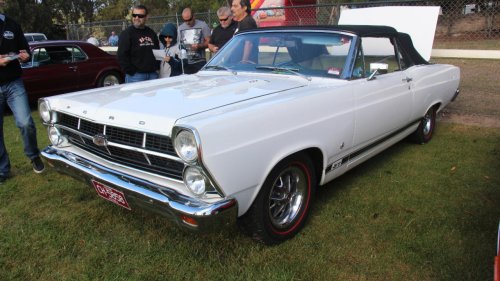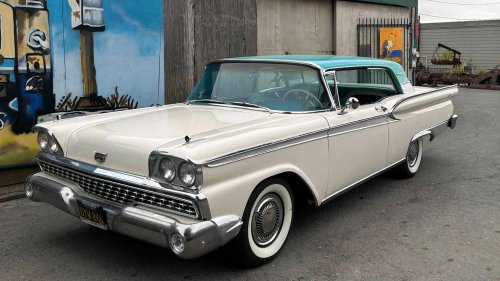
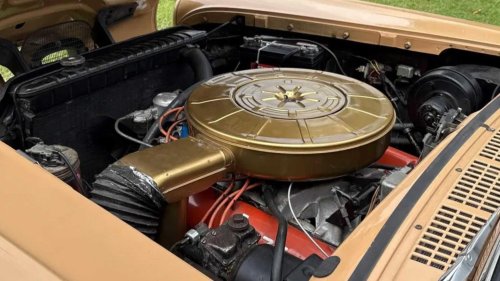
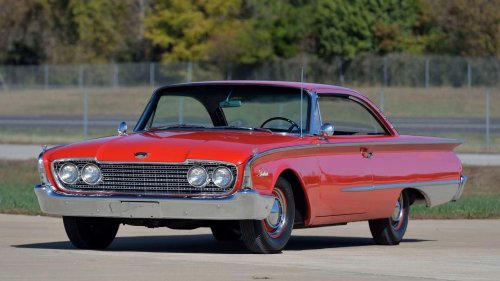
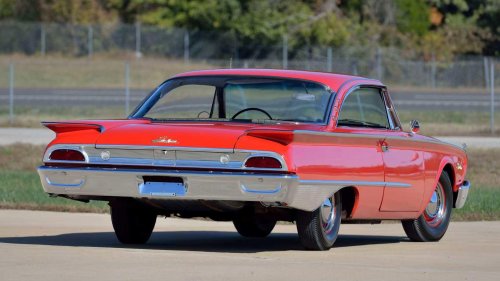
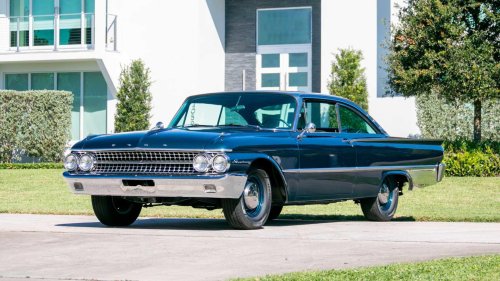
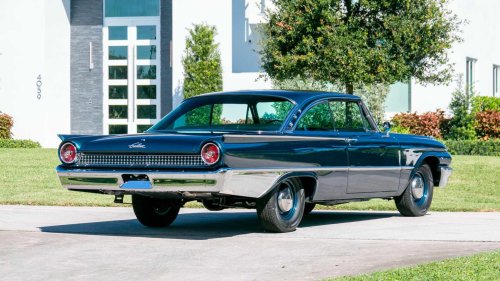
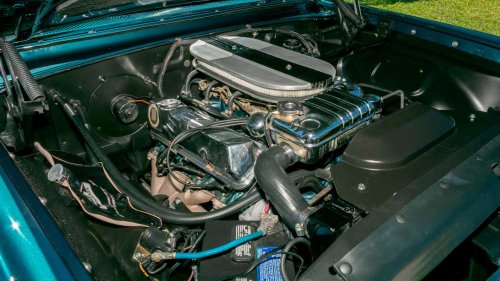
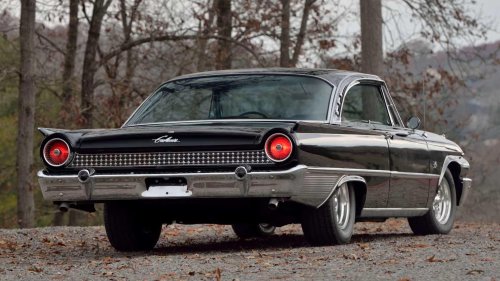
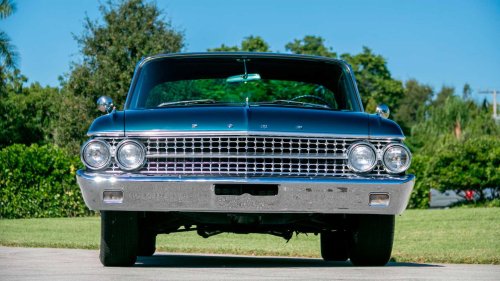
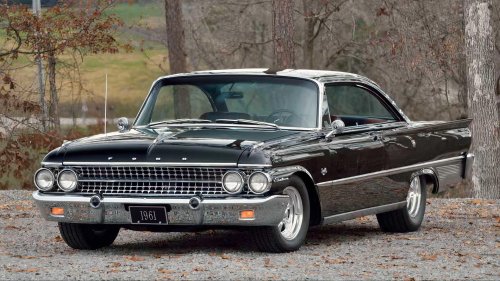
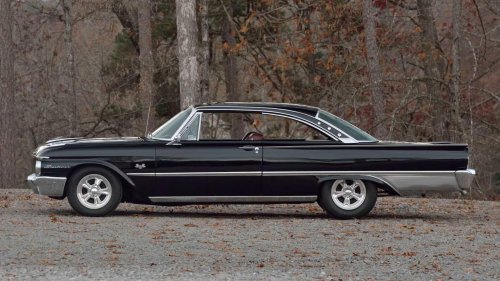
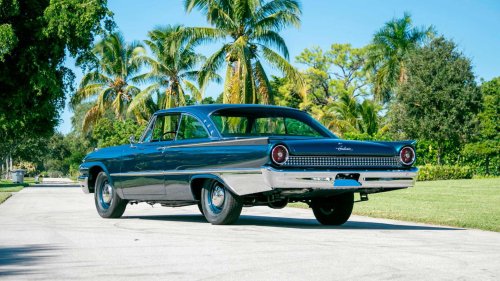
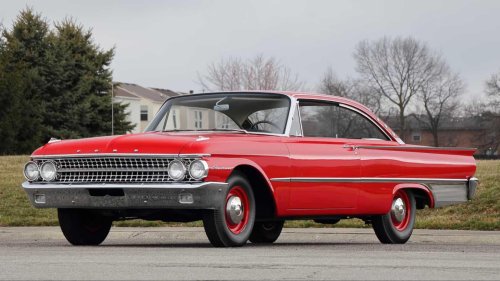

















The Blue Oval's muscle car legacy didn't start with the Mustang. Not even close. Instead, Ford's first proper muscle car came a solid four years before the pony car ever pranced out of Dearborn. It was at a time when Ford was locked into a grudge match against the Chevy Impala and cooked up one of its coolest and, frankly, boldest coupes and stuffed a big block V8 under the hood. It looked nothing like a Mustang, but it drove like a rocket, and NASCAR teams loved it for its slippery design and massive power.On the streets, owners could buy it with more power than even the '69 Ford Mustang Boss 429, at least on paper, which capped off the muscle car era almost a decade later. The weird part? Almost nobody talks about this legendary muscle car today. We're here to change that. Ford Has Fighting A Performance War Since The '50s Bring a TrailerAt HotCars, we're tired of hearing that muscle cars started in 1964. The term was coined in the '60s, sure, but the muscle car wars trace their roots all the way back to the late '40s and early '50s, when post-war prosperity and cheap gas allowed Detroit to crank the power up to the max.The first muscle car was arguably the 1949 Oldsmobile Rocket 88, which won NASCAR races left and right with its combination of a high-compression 303 V8 and a light body. Chrysler followed with the mighty FirePower Hemi V8s in 1951 and the 300, which was already pushing 300 hp by 1955. That same year, Chevy dropped their legendary small block V8. Meanwhile, Pontiac answered their 389 with Tri-Power carbs. The Birth Of Ford's First Proper Muscle Car Engine Bring A Trailer By the late '50s, things were heating up fast. Ford found itself locking horns with Chevy and its ridiculously popular full-sized Impala models as well as Pontiac and its Catalinas that were already pushing serious power. Ford's old Y-series V8s were running out of breath keeping up. So the brand came out with the FE-series V8 in 1958 (short for Ford Edsel) and offered it in 332 cubic-inch and stroked 352-cube versions. With four-barrel carbs, aluminum intakes, and solid lifters, these engines were pushing up to 300 hp early on. Now, they just needed a hip new car to go against the Impala.Space exploration was all the rage in the late '50s after Sputnik, and Ford decided to cash in on the hype in a big way with the model name. So, it put these engines in the new and more upscale "Galaxie" in 1959, which sat above the Fairlane in the lineup. The Galaxie was a smashing success, and the brand sold a staggering 464,336 units that same year, almost matching Chevy's Impala's 473,000 units.Still, the base full-sized car wasn't really living up to the kind of envelope-pushing high-performance spacecraft image Ford needed to stay relevant among younger buyers, even in the late '50s. That push set the stage for what came next, and man, it was fun while it lasted. The Forgotten Ford Starliner: Ford's Early Muscle Pioneer Mecum In 1960, Ford's full-size Galaxie received its sleek two-door coupe version dubbed the Starliner. The nameplate actually came from a long range of "liners," before it, the Crestliner, Sunliner, and Skyliner, but it fit the car perfectly. Compared to most other cars on the road, the Starliner was a rocketship for its era. The combination of a sloped fastback roof and massive horizontal rear fins made it look like it was doing 100 mph standing still and gave it the kind of presence that turned heads when parked next to your average boxy '50s car.NASCAR teams loved it due to this slippery design, and it helped Ford secure 15 wins in 1960 alone. More importantly, it checked virtually every important muscle car box before anyone even knew what a muscle car was.Mecum When it debuted in 1960, it featured Ford's 352 FE under the hood with a range of options up to 360 hp thanks to the HiPo 4-barrel version that was introduced mid-year. Available only with a manual transmission, it was the spec to have in 1960.It was Ford's most powerful muscle that year, even beating the bigger Thunderbird 430 by some 10 hp and marking the first time a Ford V8 pushed over 1-hp-per-cubic-inch. That would become the benchmark for muscle car engines in the '60s and '70s. But Ford was just getting started. 1961 Galaxie Starliner: Ford's Peak Muscle Car Before The Mustang Mecum For 1961, the Starliner carried the same name, but it was a completely different beast. First off, Ford completely redesigned the coupe: cleaning up the grille, reducing the proportions, and shaving off about 100 lbs. The massive horizontal fins were replaced by even cooler-looking afterburner tail lights. The only thing that remained the same was that fastback roof that made it stand out in the first place.Mecum More importantly, buyers in the know optioned these with Ford's new bored and stroked-out 390 FE, which pushed 375 hp and 427 lb-ft of torque. However, power-hungry buyers could also have these "Z-code" engines with a special manifold with triple two-barrel carburetors that bumped the power up to 401 hp. You could have it with a Borg-Warner T-10 four-speed transmission for extra fun, and it would easily run 13-second quarter miles.Mecum For example, Car Craft magazine clocked a 401-hp example with a 4-speed manual at 13.24 seconds and 107 mph over the 1/4 mile in their October 1961 issue. Meanwhile, Les Ritchey also took the car through the 1/4 mile finish line in just 13.33 seconds at the 1961 NHRA Winternationals. How The Starliner Stacked Up To Other '60s Muscle MecumThe '61 Starliner hung right there with lighter cars of the same years and even later, when the muscle car wars were heating up. Gearheads who knew laughed when Chevy finally dropped the 409 in the Impala SS late in the year just to keep up. But even then, the Impala SS 409 would just run 15.2-second 1/4 miles.The only way you were beating a 390 FE Galaxie Starliner in 1961 was with a Pontiac Catalina Super Duty 421, with period tests showing 12.5-second ETs.The Starliner continued to outrun other full-size muscle cars well into the late '60s, including the Chevelle SS 396, which managed a 14.9-second 1/4 mile time. Heck, it was faster than Ford's Pony car, including the 1969 Boss 429 version, which ran the quarter-mile in 14.09 seconds.Mecum You keep hearing about cars like the Mustang Boss 429 and the LS6 Chevy Chevelle SS today, but the Z-Code 390 Starliner was quicker than most of them, and it was roaming the streets almost a decade earlier. Mix that in with the Starliners cool spaceship-inspired looks, and it's almost a crime that this ride never pops up in muscle car conversations today. Which brings us to our next point. Why The Starliner Vanished From The Muscle Car Conversation Mecum Despite massive success in NASCAR and serious performance credentials, the Starliner was a rarely ticked option among Ford buyers. The brand moved a total of 68,641 units in 1960 and 29,669 in 1961. Fewer than 9% of all Galaxies produced were Starliners that year. Those production numbers ultimately sealed the Starliner's fate.In 1962, Ford switched to a formal Thunderbird-style roof on the Galaxie and killed the Starliner nameplate. About a year later, the Blue Oval realized it had made a big boo-boo and brought the fastback roof back, as the newer Galaxies had lost much of their competitive edge in NASCAR without it, securing just five wins in 1962, three times less than in 1960. The Galaxie did end up being successful in NASCAR after that, but the Starliner, however, was never to return.Mecum In 1964, the muscle car spotlight moved on to the lighter cars like the Mustang and GTO, and full-sized Ford coupes looked like your grandpa's car to the young buyers. There was simply no more room for a Starliner in Ford's lineup ever again, as Ford had already found a winner in the Mustang.Fewer than 100,000 Starliners ever left Ford's factory between 1960 and 1961, but only the 1961 models offered the incredible 390 Z-Code big block V8s that truly gave the Starliner muscle car status. Most estimates agree that only a small fraction of the '61 models produced were optioned with this package. The number of examples that included the floor-shifted 4-speed manual is even tinier. Estimates put the total at just 100 to 120 examples, making this one ridiculously rare muscle car.Despite the rarity, Galaxie Starliner, even the 390 ones, are surprisingly overlooked and underrated today. Which means discerning collectors will have no trouble finding some serious bargains out there. Ford Galaxie Starliners Are Massive Bargains Today Mecum Depending on which model year and trim you land on, the average price you can expect to pay for a Galaxie Starliner can vary wildly, but they are all surprisingly affordable. For the purpose of this article, we'll assume you're only in the market for the V8-equipped Starliners with either the 352 or the 390 FE V8.On the cheaper end of the spectrum are the 1960 Galaxie Starliners with the 352 V8 pushing 360 hp, which are worth around $18,000 to $26,000 in good condition. Expect to pay about five grand more for 1961 models with the same engine in good condition. Meanwhile, the cream of the crop Starliners, 1961s with the optional 390 Z-Code V8, will set you back around $37k in good condition. Here's a gorgeous red one that went for $38,500 courtesy of Barrett-Jackson. That's a borderline insane value for a clean 375-hp muscle car.Mecum Keep in mind, while production numbers are extremely hard to pinpoint, this combination was only ever available during the second half of the 1961 model year for the Starliner, and they truly were rocket ships. Of course, examples in pristine condition command up to six figures. One without the manual transmission still managed to fetch a staggering $92,500 at a Richmond Auctions. Needless to say, if you manage to find a Starliner that was optioned with the floor-shifted manual and the 401-hp Z-Code V8 for a fair price, don't let it go.Sources: Ford, Hagerty, Hemmings, Barrett-Jackson, Richmond Auctions, Car and Driver.