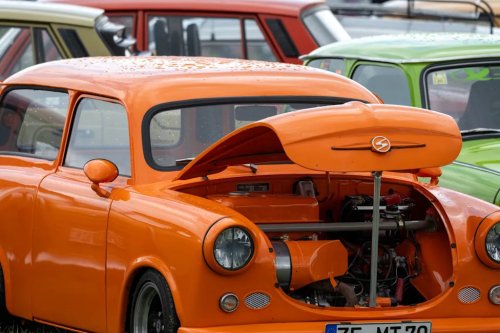
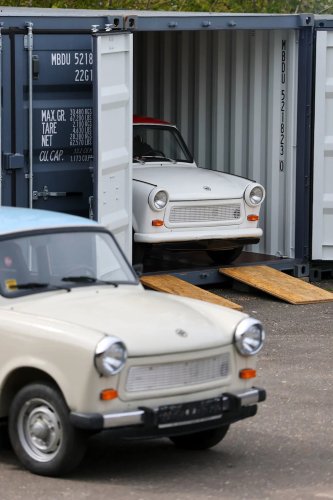
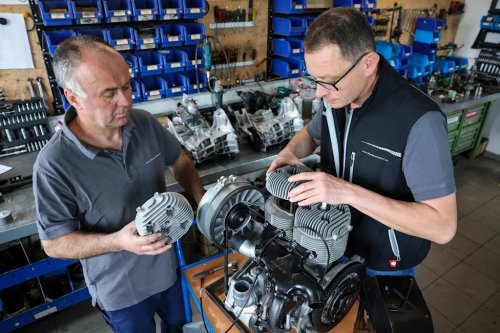
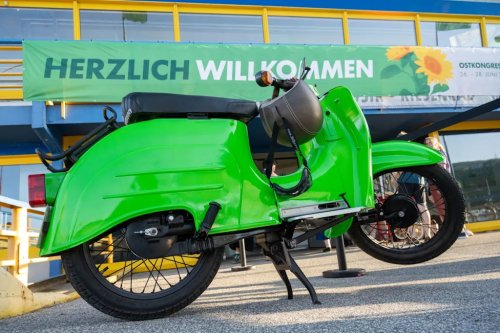

















A Trabant, made in the GDR. Stefan Sauer/dpaThey just keep rolling on. Cars and motorbikes made in former communist East Germany have not disappeared from roads as many people predicted after the Berlin Wall came down in 1989. In fact, their numbers are growing.The production of Wartburgs and Trabants, with their spluttering, oil-burning engines came to a halt 35 years ago while the Simson moped and motorcycle models only lasted until 2002.Official figures in Germany show that tens of thousands of these aged vehicles are still rattling around the country, leaving clouds of toxic blue smoke in their wake.AdvertisementAdvertisementThere are more around these days, as cars and motorcycles once deemed moribund are restored after all. Yet while they may remind people of times past, they are certainly not environmentally friendly.The Trabant is notorious for the intense, smoky and pungent smell of its exhaust fumes, caused by the need to mix oil directly into the petrol as a lubricant for the engine.The Simson uses the same kind of basic two-stroke power plant albeit smaller. As historic vehicles, they are all exempt from strict vehicle emission laws.Be that as it may, in order to keep moving, these cars and two-wheelers need spare parts.AdvertisementAdvertisementThe nippy Simson mopeds have a cult following of their own, so demand is high for components to keep them running properly.The affection for these old bangers is partly due to the ease of fixing them, says Enrico Martin, who heads the Automobile Welt Eisenach foundation. Wartburg originated in that city and Martin is a fervent fan of the marque.He says many east German families associate the cars with the times they nurtured them through the lean years and often helped each other out in order to do so.This was in a country where people had to wait decades before being allowed to buy a new car. The yearning for the past has also not been diminished by the realisation that the former communist government was among the most repressive in Europe.AdvertisementAdvertisement"With East German vehicles, the repair manual was included in the sale. And a huge number of spare parts were produced," says Martin. car and motorbike enthusiasts can still draw on that vast supply of items today.For practical reasons, many parts were made to fit different vehicles – Martin cites windscreen wiper switches as an example.In the erstwhile German Democratic Republic (GDR), spare parts for Wartburgs, Trabants or Simson mopeds were often stockpiled. "You never know when they might come in handy" was the motto.Many parts are still being rediscovered today in cellars, garages or barns. "There's still a great deal of stuff out there," says Martin.AdvertisementAdvertisementGDR classic cars are also an economic factor and a well-established dealer scene has emerged in Germany, with many online shops as well as major suppliers."We can supply almost any part," says Frank Hofmann, manager of Trabantwelt Zwickau. His company is one of the larger suppliers. He buys Trabi spare parts from original old stock, but manufacturing new parts plays a bigger role.Hofmann, who is delighted that registration figures for the oldtimers are rising, has been running his company in Zwickau – the home of the Trabi – for 23 years.According to the Federal Motor Transport Authority, 41,862 Trabant cars built at the Sachsenring in Zwickau up to 1991 were registered at the start of the year. Following a low point in 2014, when there were 32,311 Trabants on the road, the number has recovered significantly.AdvertisementAdvertisementThe Trabant was a humble car but many owners now also value exclusivity and add extras not available in years gone by. There is also a thriving tuning scene. Hofmann says there are also still thousands of unused Trabants still waiting to be restored.An estimated 1 million or so Simson mopeds from Suhl are still on the roads, mainly in eastern Germany. There are currently no official figures, as not all of these vehicles are subject to registration.Mopeds with attractive names such as the Schwalbe (swallow), Star and Sperber (sparrowhawk) have achieved cult status, particularly among young people.This is partly due to an agreement reached after German Reunification which allows them to be driven at up to 60 km/h on public roads rather than the statutory 45 km/h, provided they were registered for use in the former GDR.AdvertisementAdvertisementAccording to Martin from Eisenach, the Wartburg, with around 9,100 units, is something of a niche vehicle but the supply of spare parts is secure.Registration figures for the slightly more upmarket GDR car have been rising since 2015 – slowly but steadily.Martin hopes that today's 16-year-olds will start out on a "Simme," as the bikes are affectionately known, and progress to driving a Wartburg or Trabant as adults.A Trabant 601 S. GDR classic cars such as the Trabant, whose production ended in 1991, are still on the road in their tens of thousands; most recently, registration figures have risen again. Jan Woitas/dpaFrank Hofmann (right), head of Trabantwelt Zwickau, and master mechanic Gunter Höfer are replacing the cylinder heads on a two-stroke engine for a Trabant 601 in the spare parts dealer's workshop. The company has been one of the leading suppliers of Trabi spare parts for 23 years. Some of these parts still come from original stock, but the production of new parts plays a greater role, the managing director says. Jan Woitas/dpaAn iconic Simson Schwalbe, a moped made in the GDR and lovingly restored. Stefan Sauer/dpa