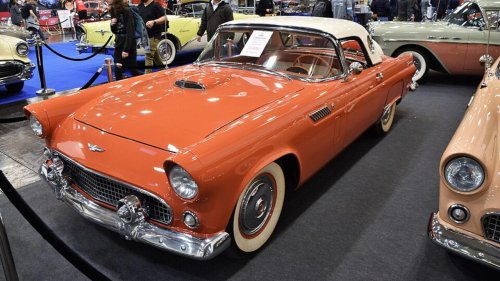
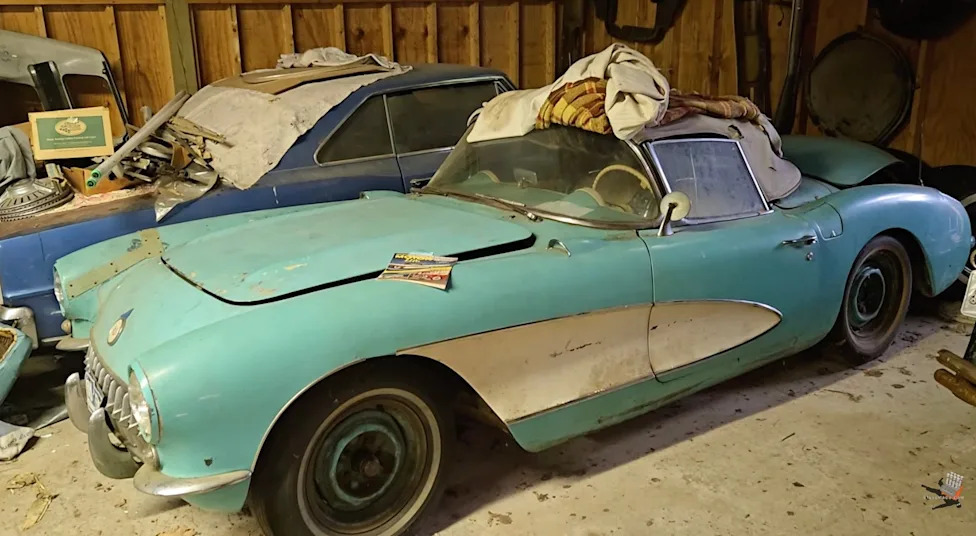
Dual-Quad Survivor: An Unrestored 1956 Corvette Hiding in a Massachusetts CollectionFinding Old CarsJohnny PuckettMon, September 14, 2026 at 3:47 PM UTCAdd us on GoogleDual-Quad Survivor: An Unrestored 1956 Corvette Hiding in a Massachusetts CollectionMost surviving 1956 Corvettes have been restored at least once. This one has not, and the details it still wears make it far more interesting than a fresh coat of paint ever could.Classic car documentarian Steve Magnante turned it up at the Happy Days Collection in Granby, Massachusetts, during a recent run through New England that also produced a remarkably complete 1928 Pierce-Arrow Model 81 rumble-seat coupe. The Corvette is a genuine survivor: roughly 68,000 miles on the clock, original upholstery, original carpet, and a right front fender that somebody patched with screwed-down fiberglass decades ago and never bothered to finish properly.The Expensive Option Nobody Expects to FindUnder the hood sits the reason this car matters. Chevrolet's 265-cubic-inch V8 made 210 horsepower with a single four-barrel in 1956. Order the dual-quad setup, a pair of Carter WCFB carburetors on a progressive linkage, and output climbed to 225 horsepower for an extra $172. Magnante puts the take rate at 1,570 cars out of the 3,467 Corvettes built that year.AdvertisementAdvertisementThe linkage is worth understanding. The rear carburetor handles normal driving on its own, and the front one only joins in once the rear is wide open. It is a simple mechanical answer to the drivability problem that plagues multi-carb engines, and this car still wears its original carburetors with the tags attached.This one also carries the two-speed Powerglide automatic, a $188.50 option and a cast-iron-cased unit that would not switch to aluminum until 1963. That matters because the four-speed manual did not arrive until late in the 1957 model year. In 1956, buyers chose between a three-speed stick and the Powerglide, and nothing else.Early-Production FingerprintsSeveral details date this car to the opening weeks of 1956 production:Painted headlight rings. Standard cars got chrome. These are body color, an unusual sight and a strong early-build indicator.Two-bolt exhaust manifolds. Later 1956 cars used three bolts at the collector flange.Door-post VIN. The tag is riveted inside the door post rather than atop the steering column. Chevrolet moved it mid-year after factory painters kept coating over it, or removing it and losing it entirely.AdvertisementAdvertisementElsewhere, the car has a tach-drive distributor running off the back of the generator, since alternators did not arrive until 1963. There is a factory AM radio with the antenna positioned to keep ignition noise out of the reception, and no ignition shielding at all. That came for 1957.A Landmark Year for the Design1956 introduced the body that carried through 1957 before quad headlights arrived for 1958, and it brought the side cove that has been shorthand for Corvette ever since. The finned aluminum valve covers were new for the year too, replacing the stamped-steel pieces used in 1955.A quirk most people miss: the Corvette body is fiberglass with exactly two steel exceptions, the cowl vent door and the fuel filler door. The wheels are 15x5 units painted body color, as all of them left the factory. Full wheel covers were available, though dual-quad and big-brake cars often wore small baby hubcaps instead.Pricing tells its own story. Magnante cites a $3,120 base price on this car, putting it $31 below a base Thunderbird, its direct competitor and, for the first few years of the Corvette's life, the car that was winning. The engine itself was a short-lived proposition. The 265 served 1955 and 1956 only before growing into the 283 for 1957, and in 1955 a buyer could still order a Corvette with a six-cylinder engine, though very few did.Restore It or Drive It?The interior has suffered. Moisture got to it, and it shows. But the waffle-pattern seat inserts are intact, the trunk is tidy with what may be the original spare still under its plywood cover, and the power top motor is still in place. Every Corvette was a roadster until the coupe body arrived for 1963. Someone was diligent about maintenance, too, with original Getty and Gulf service stickers still stuck in place.AdvertisementAdvertisementMagnante's own verdict is that the patina has earned its keep. Sort the fluids, get the mechanicals and electrics right, put it back on the road, and let people work out what they are looking at. It is a familiar fork in the road for anyone weighing a survivor against a restoration or a restomod, and with a car this well documented and this early, originality is almost certainly worth more than perfection.Watch the Full WalkaroundMore from the archive: a widebody Corvette C3 sealed inside an abandoned garage for 19 years, a dust-caked 1958 Biscayne with a mystery engine, and a 1957 Chevrolet 210 wagon waiting on a second life. Thinking about a project like this one? Start with our step-by-step barn find inspection checklist.


















 +24 others