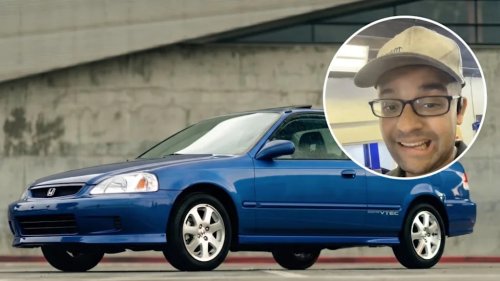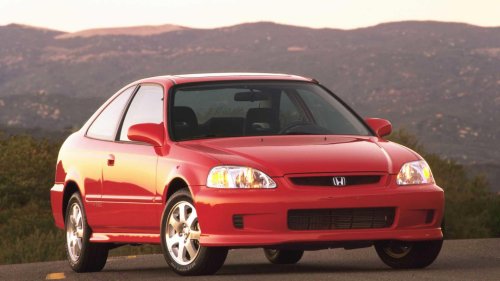
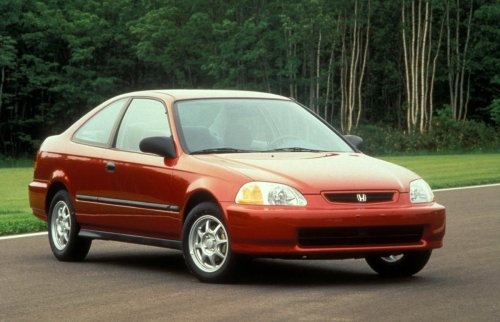
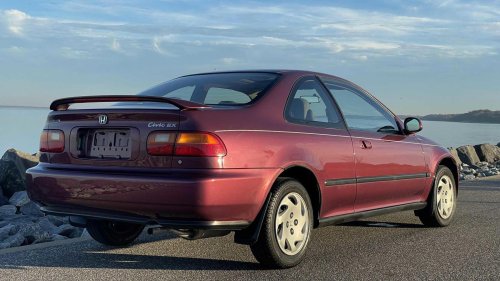
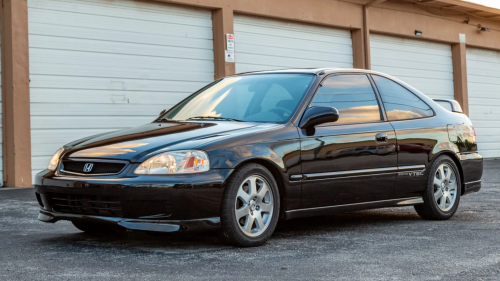
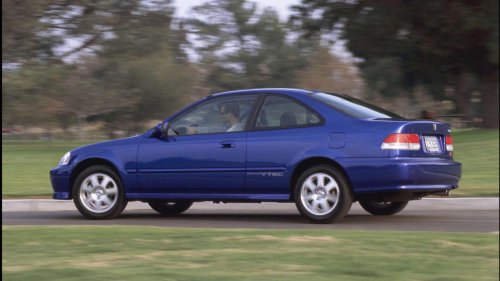


















It can be tough to predict the future when looking at vehicle values. Sometimes you think that a new arrival could definitely become a collectible for one reason or another, but at other times, you'd scoff at the idea of a simple or boring car fetching good money in the future. But the car business does have a way of turning expectations on their head, and sometimes the most boring cars can become a future classic.Such appears to be the case with the humble Honda Civic Coupe, which many considered for most of its life to be the less serious Civic. Enthusiasts would usually buy used hatchbacks first, leaving commuters or thrifty students to buy the Coupe instead. But today, clean 1990s Japanese cars are increasingly in demand, which means people are indeed starting to take a much closer look at this unassuming car. The Civic Coupe Is A Future Classic HondaThe Honda Civic Coupe combines many of the things collectors typically love. It's compact, light, durable, and easy to understand. Plus, this is a very simple car, but it is tied to a golden era of Honda engineering. In some respects, the model represents a lost way of making cars.These 1990s coupes came along before modern vehicles became heavier, safer, quieter, and much less intimate. Some of the best coupe generations, like the 1993 to 1995 (known by the internal moniker EJ) and the 1999 to 2000 Si grade (known as the EM1), are particularly interesting with their honest front-wheel-drive balance and high-revving, small-displacement Honda engines. Collectors may no longer be treating these cars as just lesser-known Civics, but as smart future-classic buys that are hiding in plain sight.Honda introduced the Civic Coupe in 1993 as a US-made model, adapting its Civic formula for North American tastes. However, it still preserved the basic values that made the Civic such a hit in the first place, many of which revolved around efficiency. The best Civic Coupes stand somewhere in the middle of the market.The hatchback has already become the obvious enthusiast darling, while the sedan is certainly the practical workhorse. In between sits the coupe with its cleaner proportions than the sedan and almost as much usability as the hatchback. There's certainly no hype surrounding the two-door as there often is with Civic hot hatches, but the smart money may still be moving toward the coupe. The Hatch Gets The Glory, But The Coupe Drives Great Too Honda It's difficult to know why the entire hot-hatch movement happened and why this enthusiast segment seemed to favor thatbody style alongside their performance aspirations. Maybe it's because the hatchback simply looked lighter or more European while the coupe, by comparison, tended to look more polished and mainstream. But in reality, there wasn't too much of a difference between the coupe and the hatchback when it came down to basics.In the 1993 to 1995 generation, the DX coupes shared the same essential Civic virtues that made the platform such a hit, featuring a 1.5-liter 102-hp engine in the DX and a 1.6-liter VTEC in the EX, with 125 hp. That was reasonable performance for a small front-wheel-drive two-door from that era, and it made both cars feel reasonably alert rather than sluggish. The EX also had a powered moonroof, air conditioning, and four-wheel disc brakes with ABS by the time 1995 rolled around.For all its relative simplicity, a good Civic Coupe could still be quite entertaining. The car didn't need much to make it come alive, and, mechanically, the driver felt quite connected to the machine. The visibility was good, and the driving position was low, and a driver could build up enough momentum to make any back-country journey feel fun. The 1993 Generation Coupe Nailed The Honda Formula Bring A Trailer The sweet spot for overlooked Civic Coupes is probably the 1993 to 1995 batch, when the coupe body style first appeared in the Civic lineup in America. This car came with a straightforward cabin, a crisp design, and the revered 1990s Honda drivetrain. The EX version also featured a lot of equipment for its humble trim, including a cassette stereo, cruise control, and a tempting 7,200-rpm tachometer.Collectively, this car seems to have everything enthusiasts are looking for today, and many folks now wonder why they didn't buy one back then when they were cheap, especially as the market is now starting to notice the EX coupe in the modern era. A 1995 version with low mileage sold for more than $27,000 on a major collector platform a few years ago, and that’s solid money indeed for a simple vehicle. It shows that these vehicles are increasingly being judged as collectible objects rather than throwaway clutter. The EM1 Si Made The Coupe's Case Very Strong Bring A Trailer While the early coupes established the ground rules, the 1999-2000 Civic Si was probably the model to win the game. This version first arrived in 1999, featuring a 1.6-liter B16A2 DOHC VTEC four-cylinder that produced 160 hp. Honda dressed the car up with stiffer springs, a front strut tower brace, a thicker front anti-roll bar, a rear anti-roll bar, and four-wheel disc brakes. And all of that made the EM1 Civic very interesting, built around that particular engine. This certainly wasn't just an engine swap with badges.Independent tests suggested a 0–60 mph time of 7.1 seconds for the 1999 car, and even though it wasn't brutally quick, this was a respectable number for a car that weighed only around 2,600 lb. Its combination of a 160 hp naturally aspirated VTEC engine, five-speed manual, and a low curb weight started to move this car into the realm of a hot coupe.Today, this particular Civic Coupe is no longer hiding from the collector market at all. One changed hands for more than $40,000 at a leading auction last summer, and it's far from unusual to find vehicles trading for more than $24,000 across the country. Of course, much would depend on condition, mileage, and originality, and not every specific coupe could be a gold mine. Still, the best ones certainly seem to have moved from the used-car underground to collectibles. Why Ordinary Coupes Could Still Make Sense Before Things Change Honda Given recent trends, the market may move more aggressively around Civic Coupes, which could bring the more ordinary versions into collectors' focus. You don't necessarily need an EM1 in a rare paint color to name your price, as the clean DX, LX, and EX coupes all share the basic core virtues. They're light, compact, and feature Honda build quality, with plenty of cheap parts and a huge enthusiast knowledge base.Honda also continued to sell its Civic Coupes well into the modern era and retained the body style on its North American Civic through the tenth generation. That means the coupe idea was never a novelty but became a meaningful branch of the Civic family, and it only gradually vanished as the market shifted towards hatchbacks, four doors, or crossovers.When looking for a good Civic Coupe, remember that originality matters. Many previous owners may have modified these relatively cheap cars, and others may have driven them into the ground, so you need to look closely for aftermarket parts and a good history. Having said that, the opportunity is still there when clean fifth- or sixth-generation Civic Coupe in good condition are still being overlooked. The market may be fully aware of the existence of the best EM1 Si’s, but others may still view those “lesser” vehicles as simply old Civics.While the 1999-2000 Honda Civic Coupe Si may become a recognized collectible in its own right, the broader lineage deserves more attention than it is currently getting. After all, the best 1990s versions are very capable machines with crisp controls, lightweight, high-efficiency engines, and compact dimensions, which is what makes the car very interesting. They’re “ordinary” Civics to the average person, but they may not stay ordinary much longer. And as future classics often seem to start in the humblest of environments, the Civic Coupe could be getting ready to make its move.