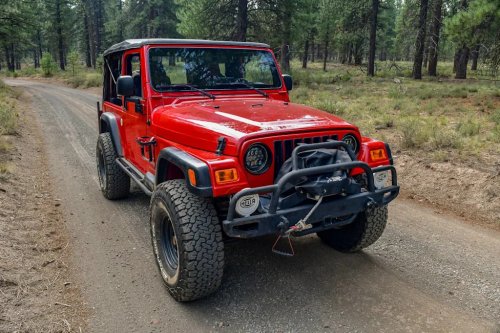
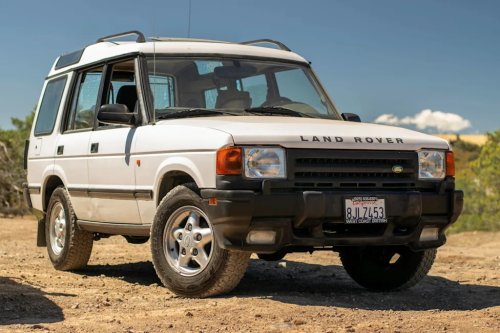
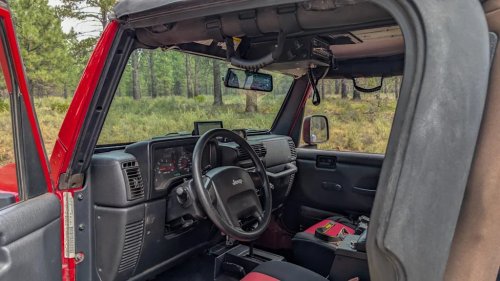
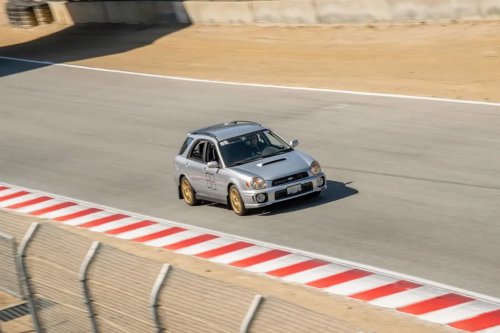
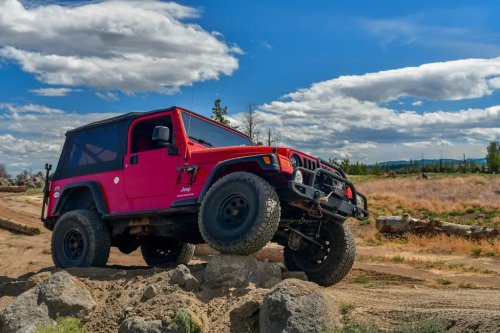
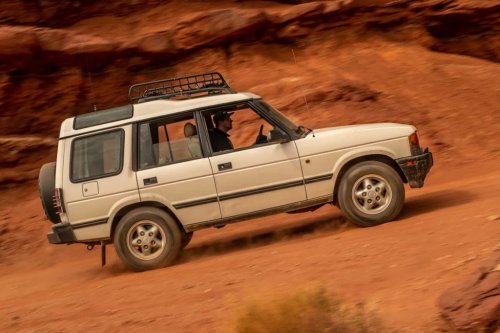



















Autoblog and Yahoo may earn commission from links in this article.Since I started reviewing cars full-time, my driveway has been a revolving door of the latest and greatest. I get a shiny, brand-new vehicle delivered every single week—which means I've tested well over 100 cars by now. But there's a distinct downside to this constant rotation: the four old cars my husband and I actually own tend to sit, collect dust, and occasionally harbor spider colonies. To keep them from rotting away, I make a point to rotate through them once a week. And without fail, every time I turn a physical key, I walk away thinking: Man, they just don't make 'em like they used to.Kristen BrownView the 2 images of this gallery on the original articleAdvertisementAdvertisementOur "modern" garage benchmark is my 2011 Subaru Forester. From there, we go back in time: a 2006 Jeep Wrangler LJ, a 2002 Subaru WRX wagon, and my husband's 1996 Land Rover Discovery. Not a single one of them has a backup camera. There is no blind-spot monitoring, no lane-keep assist, no parking sensors, and no adaptive cruise control (my Jeep doesn't even have regular cruise control, but the Land Rover does, go figure).Kristen BrownView the 2 images of this gallery on the original articleWhen I'm behind the wheel of our personal cars, there is no digital safety net. I have to constantly remind myself that I am the sole buffer between the asphalt and an insurance claim. It forces me to be a better, more present driver. It reconnects me to the mechanical soul of the machine. New cars boast some of the coolest engineering feats I've ever experienced, but old cars require your undivided attention. And that's exactly why I will always keep a spot for them in my driveway.Related: Road Ethos Launches: The New Automotive Lifestyle Site You Should ReadThere's a lot less to distract you in an old carModern cars do a lot of the heavy lifting for you. The 2026 Mercedes-Benz EQS 400 I recently tested, for instance, has Google Gemini built into the dash and can practically park itself. By contrast, the biggest technological leap in our personal fleet is the aftermarket Android Auto head units we spliced into the dashes. Beyond that, I am entirely on my own. I have to do all the parking, steering, and merging myself. Without a wall of glowing screens competing for my attention, the cockpit becomes a remarkably quiet place to think. Because Android Auto relies entirely on voice commands through my phone for navigation, there is zero reason for my eyes to leave the road.Kristen BrownAnd because I don't have blind-spot intervention or parking radar, my mirrors actually have to be properly adjusted at all times. There are no memory seats, so I have to physically dial in my driving position every single time I get in. Old cars force you to turn these basic checks into active habits. It builds a muscle memory that makes you a safer, sharper, and more alert driver.No computers. No AI. Driving is simple, engaging, and more personalMy husband bought his WRX long before we started dating; he's owned it for 14 years now (admittedly, being a Subaru Master Technician has helped keep it alive). There is a reason neither of us will ever sell it: it is just pure, unadulterated fun. It possesses a distinct personality that completely overshadows its total lack of convenience features. It has exactly what you need—ABS, basic cruise control, a window defroster, A/C—and absolutely nothing else. We tailored the rest ourselves, adding a cleaner stereo with a subwoofer, rally-style wheels, upgraded springs and shocks, and refreshed wiring.AdvertisementAdvertisementBut it's the five-speed manual paired with the EJ20 under the hood that gives the car its heart. It's an incredibly punchy, reliable engine. We added braces to the infamous "glass" transmission case to boost our confidence, and it paid off—we tracked it at Laguna Seca, and it performed flawlessly. Aside from a hint of brake fade after the third 30-minute session, we were able to lap the track, go grab groceries, and drive them home in the exact same car on the exact same day.Kristen BrownMy husband always says he prefers old cars because there's simply "less to break," and that rings incredibly true for our old girl. Beyond our modifications, the only major mechanical overhaul she's needed is a clutch. Everything else has just been routine maintenance. When I drive that wagon, even just to the grocery store, I am reminded of what uninterrupted, unassisted driving actually feels like. And goddamn, does it feel amazing. It is my favorite reminder of what driving should be: a mechanical dialogue between you and the road, completely free of buzzing sensors, blinking lights, or computer intervention.Related: How the Subaru WRX Has Changed Over 23 YearsI prefer basic off-roaders for the same reasonI've had the privilege of testing some seriously formidable modern off-roaders: the Land Rover Defender, the Jeep Wrangler Rubicon, the Ineos Grenadier, and the Toyota 4Runner. They are insanely capable machines, but their capability is largely written in software code. While I appreciate features like an electronic sway bar disconnect, I quickly tire of the cameras and sensors doing the thinking for me.AdvertisementAdvertisementMy 2006 Wrangler LJ doesn't have a single line of off-road code. I have to physically get out into the dirt to disconnect the sway bars myself. It has a mechanical lift, taller tires, and 4.88 differentials front and rear, but the most advanced computer onboard is still just the radio.Kristen BrownI prefer it that way. Without a traction-control algorithm saving me from my own mistakes, the only thing keeping that Jeep on the trail and shiny-side-up is raw skill. When I hit the end of a tough trail, the high is unmatched because I know a computer didn't get me there. I did. Yes, there is a lingering sense of dread knowing the safety ratings of a 2006 Wrangler are practically non-existent by today's standards, but that just ups the ante. When my LJ and I conquer a trail, the victory belongs entirely to us.Driving old cars builds characterIn the San Francisco Bay Area, a 2010 Forester or a clean TJ Wrangler is still a fairly common sight. But rolling around in a 2002 WRX wagon or a 1996 Land Rover Discovery is bound to turn some heads. They refuse to blend into the endless sea of identical gray crossovers clogging California's major highways. If I spot another enthusiast at a gas pump or a grocery store parking lot, there's an 80% chance we're going to strike up a conversation. This fleet has connected me to amazing communities, leading me to subreddits and Facebook groups full of people who share the same irrational love for older metal.Kristen BrownThere is a unique joy in standing out. Don't get me wrong—I can deeply appreciate the engineering of a brand-new RAV4 or the blistering performance of the latest BMW. But a modern digital exhaust note will never hit the same as the iconic, unequal-length rumble of a Subaru boxer engine. It can't replicate the wide-eyed look of a Jeep purist realizing my Wrangler is a rare, long-wheelbase LJ, or the sheer delight of a British car nerd spotting a 30-year-old Discovery that looks like it rolled right out of a time capsule.AdvertisementAdvertisementRelated: I Bought a 30-Year-Old Land Rover. Worth The Headache?Final thoughts: I love all cars—but old cars help remind me of where I came fromI still vividly remember when my dad bought his first-ever brand-new car in high school. It was a 2006 Ford Explorer Eddie Bauer edition, packing the same 4.6-liter V8 found in the Mustang GT at the time. It was his absolute pride and joy. Before that vehicle, the newest thing my dad had ever owned was from 1975.When I first met my husband, he was already wrenching on his 2002 WRX, and I was putting around in a 1999 Toyota Corolla. I grew up in the passenger seats of old cars, dreaming of one day becoming the next Richard Hammond—telling grand stories from the driver's seat of the world's greatest new machinery. I may not be Top Gear material, but I managed to fulfill the second half of that dream.Driving these new cars pays the bills, and they deserve every bit of praise they get for their safety, efficiency, and luxury. But climbing back into my personal garage is what keeps me grounded. My old cars remind me where I came from, how far automotive engineering has traveled, and, most importantly, that driving is meant to be an experience—not just a commute.AdvertisementAdvertisementThis story was originally published by Autoblog on Jul 5, 2026, where it first appeared in the Features section. Add Autoblog as a Preferred Source by clicking here.