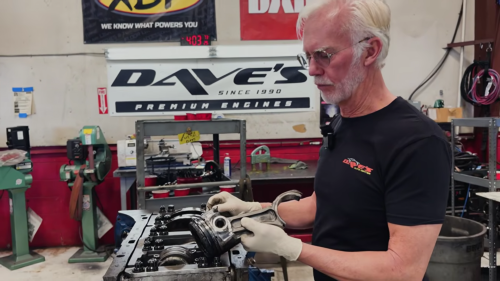



















Diesel Shop Replaces Customer’s Engine After Discovering $20,000 Mistake That Caused it to ExplodeA Utah diesel shop tore down a customer's destroyed compound-turbo engine expecting to find proof of abuse. What its owner found instead was a step his own builder had skipped – one small enough to miss during assembly, catastrophic enough to detonate the entire motor two years later.Dave's Auto Center, a family-run operation out of Centerville, Utah that's been turning wrenches since 1990, had built a heavily modified diesel for a customer named Eric. Compound turbos, performance pistons, ARP hardware, race bearings – the kind of build where you invoice the customer up front that nothing is warrantied, because extreme cylinder pressures can destroy parts through no fault of the shop's labor. When the engine came back in pieces roughly two years after delivery, the shop's working assumption was fair: Eric had over-boosted it. The system could theoretically hit 100 PSI. The carnage inside the block looked like a grenade had gone off. Nobody was rushing to hand out a free engine.The shop charged Eric to pull the motor and began tearing it down methodically, half-expecting to close the file as a customer-caused failure.One Missing Hole Changed EverythingDuring disassembly, a technician noticed something wrong with one of the connecting rods. The rod bearings specified for the build were of a gun-drilled design, which incorporates a small internal channel bored through the connecting rod to deliver pressurized oil from the crankshaft journal directly to the wrist pin bushing. The bushing had been installed correctly. The hole through the bearing to actually feed it with oil had never been drilled.AdvertisementAdvertisementFloating wrist pins require pressurized oil delivery to maintain their extraordinarily tight two-to-three ten-thousandths-of-an-inch clearances – and without it, the pin ground to a halt inside its bushing. The rod couldn't move. The engine's own torque bent the connecting rod, fractured components throughout the block, and punched a hole through the casing. The shop owner's assessment on camera was blunt: "The builder overlooked drilling a hole. This racing bearing, all he had to do was drill a hole in that… and this motor wouldn't have failed."The builder in question had already left the shop more than a year before the teardown. That detail didn't change anything for the owner's decision. He called Eric live on camera, apologized, and told him directly: "You'll get a brand new motor built, no charge."Eric's response, for what it's worth: "Thanks for honoring your work. I appreciate that."The Standard the Owner Set for His ShopThe replacement build swaps in a different connecting rod specification that routes wrist pin lubrication through splash oiling via dedicated squirters rather than gun-drilled passages, cutting off the failure mode entirely. The teardown also turned up cracked rocker pedestals and broken rocker bolts throughout the stock valve train – a separate issue the owner attributed to increased valve spring pressure from the performance build – so the replacement gets a Jessel valve train system as well. Before going back in the truck, the completed motor will run on the shop's sim-test machine and then get load-tested on a chassis dynamometer.AdvertisementAdvertisementThe shop owner used the incident as a live case study while announcing the promotion of engine builder Mikuel – on staff for about a year and a half – into a formal builder role. His stated top qualification for the position had nothing to do with machining credentials. "Who would you trust to make a $20,000 mistake and cop to it?" The answer to that question, he argued, determines whether a shop grows or eventually chokes on its own corners."When you screw up, don't fear it. Lean into it. Admit it, learn from it." And less charitably toward shops that operate otherwise: "You cannot hide this stuff. First off, it's wrong. And the most important thing is you'll never be successful because you will choke on your standard."Thirty-six years in business is a reasonable sample size for that philosophy.