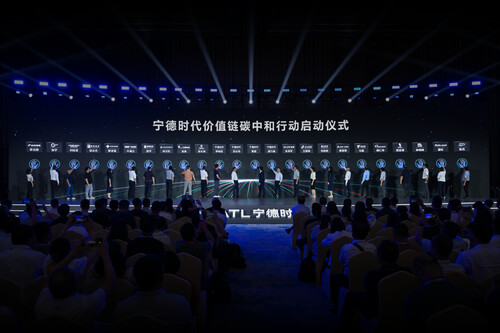
CATL Chairman and CEO Robin Zeng at the event. Credit: CATL Understand China EV’s Market Real-time notifications when critical EV data is released All important data in one place 2,000,000+ data points Become a member At the Core Operational Carbon Neutrality event held today, battery giant CATL officially announced that it has achieved carbon neutrality in its core operations as of the end of 2025. This makes CATL the only battery enterprise globally to achieve core operational carbon neutrality while maintaining a TWh-level shipment scale. During the event, CATL also systematically disclosed its action path for value chain carbon neutrality aimed at 2035. Zero-carbon manufacturingSince launching its zero-carbon strategy in 2023, CATL has been pursuing core operational carbon neutrality by 2025 and full value chain carbon neutrality by 2035. By the end of 2025, 20 of the company’s battery factories received ISO 14068-1 certification as zero-carbon factories, with the proportion of zero-carbon electricity used in core operations reaching 100%. In 2025, CATL produced 748GWh of batteries. From 2022 to 2025, its lithium-ion battery sales increased by 2.3 times, maintaining its position as the global market leader. To support this growth sustainably, the company developed the “CATL Carbon Chain” management tool in 2022, auditing nearly 40 production processes and upstream materials to create over 1,000 product and raw material models. Key performance indicators since 2023 include: Cumulative zero-carbon electricity usage: Over 18 billion kWh. Energy efficiency: Unit energy consumption at production bases decreased by 28% compared to 2022. Emission intensity: Carbon emission intensity dropped by approximately 77% over two years. Total reduction: Cumulative carbon reduction exceeding 10 million tons of CO2 equivalent. “Zero carbon is not only a mission for CATL but also a capability formed through practice and a massive development opportunity,” stated Robin Zeng, Chairman and CEO of CATL. He emphasised the company’s commitment to becoming a leading global zero-carbon technology company. The goals was first announced by CATL on 2023. Challenge for 2035Having secured its own operations, CATL is now shifting its focus to the broader value chain. Currently, over 80% of the carbon emissions in the full life cycle of CATL products originate from the supply chain, with total supply chain emissions exceeding core operational emissions by more than five times. To address this, CATL has built the lithium battery industry’s first full-link carbon data traceability platform, covering mineral mining, raw material refining, material synthesis, and component manufacturing. This platform has already completed carbon data accounting for over 100 core Tier-1 suppliers. CATL’s roadmap for 2035 focuses on four key areas: raw material R&D, raw material production, logistics transportation, and recycling. As part of this initiative, the company will release a Green Procurement Guide, incorporating carbon footprints, renewable energy proportions, and unit energy consumption into supplier admission and audit criteria. Huang Bin, Head of the CATL Procurement Centre, announced a zero-carbon supply chain empowerment plan, starting with deep collaborative emission reductions with 30 core suppliers. Additionally, CATL has proposed the establishment of a “Global Lithium Battery Industry Zero-Carbon Ecological Synergy Platform” to drive shared standards and technical collaboration. Launch ceremony for CATL value chain carbon neutrality action. Context: The EU’s “Green Gate” for batteries CATL’s aggressive push toward value chain carbon neutrality is largely driven by tightening international regulations, most notably from the European Union’s Regulation Concerning Batteries and Waste Batteries. Between 2027 and 2028, the EU is expected to implement carbon footprint limits as a mandatory prerequisite for batteries entering its market. Last year, China’s Ministry of Industry and Information Technology (MIIT) announced a pilot program requiring NEV power battery manufacturers to report the carbon footprints of their products starting in 2026. The EU’s requirements are exhaustive, demanding detailed disclosures of a battery’s total carbon footprint, supporting documentation via accessible links, and comprehensive data covering four critical life-cycle stages: raw material extraction and pre-processing, production, distribution and transport, and collection and recycling. Under these rules, achieving carbon neutrality is no longer an optional corporate social responsibility goal but a “mandatory ticket” for market access. With transition periods between implementation phases lasting only 18 months, the window for compliance is narrow. Acknowledging this pressure, Meng Xiangfeng, Assistant to the Chairman of CATL, stated during the 2023 World Power Battery Conference that compliance is the baseline for international expansion. However, he emphasised that as an industry leader, CATL aims to go beyond mere compliance by actively participating in the research and formulation of global carbon standards and policies. CATL is significantly ahead of its competitors in the battery sector, its domestic EV battery market production share reaches 50.1% in Q1 2026, according to the China Passenger Car Association. According to statistics from the international agency SNE Research, in the first half of 2026, CATL’s share of global lithium power battery installations reached as high as 39.9%, ranking first in the world for the ninth consecutive year. Most important news in your inbox. Recaps · scheduled All you need, in one email. Instant alerts · real-time Ping me when an article goes live. 0 of 27 topics selected Bundle into one email per day — instead of one email per article No spam · Unsubscribe with one click · Change settings anytime