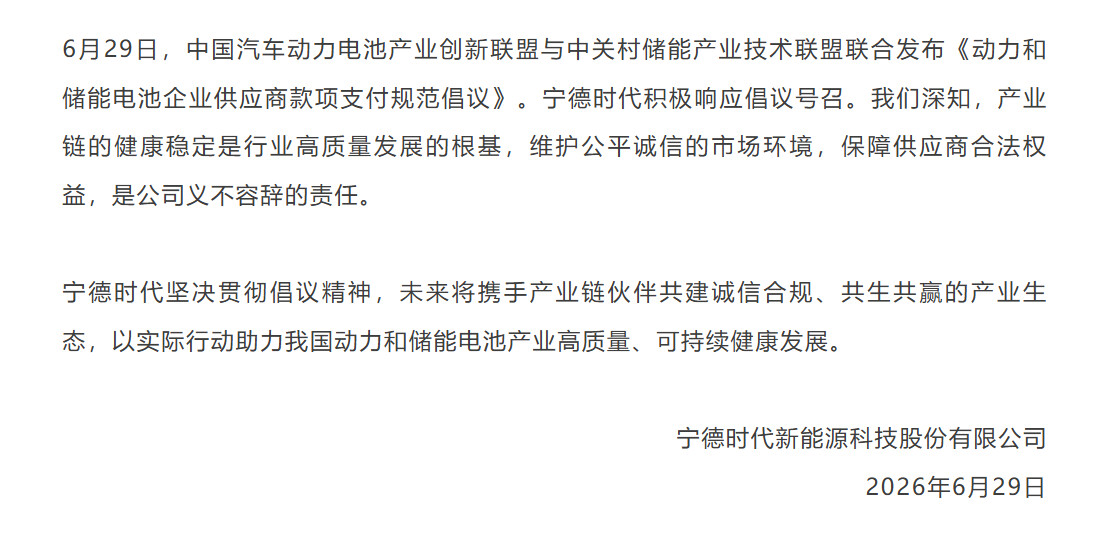
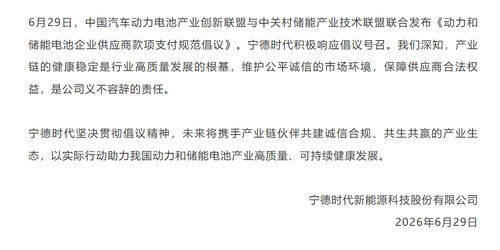
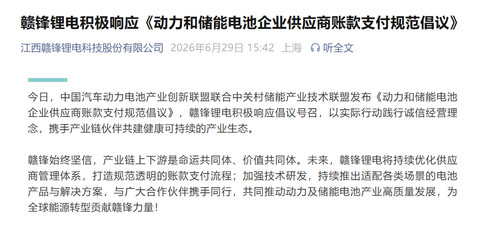
Gasgoo Munich- On June 29, China Automotive Battery Innovation Alliance (CABIA) and the China Energy Storage Alliance (CNESA) jointly issued the "Proposal on Supplier Payment Norms for Power and Energy Storage Battery Enterprises." The move aims to enforce regulations protecting small and medium-sized enterprises (SMEs) and foster a win-win supply chain. CATL and Ganfeng Lithium were quick to back the initiative, pledging through official channels to build an ecosystem rooted in integrity and shared success.The proposal sets forth requirements covering general principles, order management, delivery acceptance, payment settlement, and contract terms. Core principles emphasize equality, voluntariness, fairness, and honesty. Companies are urged to comply with laws and refrain from using their market dominance to infringe on supplier rights, ensuring the industry's sustainable health.Regarding order confirmation and changes, the proposal mandates that procurement transactions be backed by formal contracts or orders. These documents must detail product specifications, delivery cycles, acceptance rules, settlement methods, and liability for breach of contract. If an active order requires alteration or cancellation, mutual consent is required. If a unilateral change causes losses, the responsible party must compensate accordingly.For delivery and acceptance, suppliers must deliver goods as agreed and complete factory inspections. Upon receiving materials or components, the buyer must complete acceptance checks—principally within 7 working days. For testing equipment or services, acceptance cycles must be clearly defined in the contract, with a certificate of compliance issued immediately upon completion. If acceptance fails, the supplier must rectify the issue within a specified timeframe; liability follows the contract terms.On payment settlement, if the supplier is an SME, the payment period starts from delivery or acceptance and must not exceed 60 natural days, extending over holidays if necessary. For non-SMEs, parties may agree to monthly reconciliation, with the payment period starting from the reconciliation date. The buyer must verify accounts for accepted goods at least once a month. Cash payments—such as bank transfers or wire transfers—are encouraged. If bank acceptance bills are used, terms must be explicit, and the use of commercial acceptance bills and electronic payment vouchers should be phased down. For SME suppliers, full cash payment is advocated.Additionally, the proposal encourages buyers and suppliers to sign long-term framework agreements on top of single contracts to bolster supply chain stability.Image Source: CATLCATL responded positively, stating in a declaration that a healthy supply chain is the bedrock of high-quality industry growth. Safeguarding supplier rights is a corporate responsibility, the company said, adding that it will implement the proposal's spirit to support the sustainable development of the power and energy storage battery sectors.Image Source: Ganfeng LithiumGanfeng Lithium also threw its weight behind the initiative. The company stated it has always viewed the upstream and downstream supply chain as a community of shared destiny and value. Moving forward, Ganfeng Lithium plans to optimize its supplier management system and create a transparent payment process, acting on its commitment to honest operations and a sustainable industrial ecosystem.Image Source: EVE EnergyEVE Energy has already responded: "To fully support the Proposal, EVE Energy will continue to optimize supply chain payment management and maintain a healthy market environment, building a collaborative and win-win ecosystem with partners across the chain!"Full text of the proposal follows:To drive the implementation of the "Regulations on Guaranteeing Payment of Accounts Payable to Small and Medium-sized Enterprises" among power and energy storage battery companies, and to jointly build a cooperative and win-win industrial ecosystem, the following norms are proposed regarding payment terms in procurement transactions between power and energy storage battery enterprises and their suppliers, based on full consultation:I. General PrinciplesUphold the principles of equality, voluntariness, fairness, and honesty. Comply with national laws and regulations and enforce the requirements of the "Regulations on Guaranteeing Payment of Accounts Payable to Small and Medium-sized Enterprises." Do not use the dominance of large enterprises to infringe on the interests of suppliers. Work together to build a fair, just, honest, compliant, and win-win industrial ecosystem, promoting the high-quality, sustainable, and healthy development of the power and energy storage battery industry.II. Order Confirmation and ChangesWhen Party A (power and energy storage battery and system integration enterprises) and Party B (supplier enterprises) conduct procurement transactions, they shall sign standardized and effective procurement contracts or purchase orders. These must clearly define core terms such as product specifications, quantity, quality standards, delivery cycles, acceptance rules, settlement methods, payment periods, and liability for breach of contract. If an active procurement contract or purchase order requires change, suspension, or cancellation, it must be agreed upon by both parties. If unilateral changes or termination of cooperation cause losses to the other party, the responsible party shall provide compensation in accordance with laws and regulations.III. Delivery and Acceptance1. Party B shall deliver goods to Party A in accordance with the procurement contract, purchase order, or delivery notice. Before delivery, Party B must complete factory inspections of the goods to ensure they are defect-free and that packaging meets Party A's requirements.2. For materials and components, Party A shall complete acceptance promptly after receiving the goods (in principle, no more than 7 working days). For testing equipment, machinery, and other goods or services, the maximum acceptance cycle must be specified in the contract or order. A certificate of acceptance shall be issued immediately upon completion.3. If acceptance fails, Party A shall promptly notify Party B. Party B shall respond within a specified time and complete re-inspection, return, exchange, or replenishment. Liability determination and compensation for resulting losses shall be handled in accordance with the contract.IV. Payment and Settlement1. If Party B is an SME, Party A's payment period shall be calculated from the date of delivery or acceptance by Party B, and must not exceed 60 natural days. If the payment date falls on a statutory holiday, it shall be extended to the following working day.2. If Party B is a non-SME, upon consultation, the parties may conduct centralized reconciliation over a certain period, with the payment period calculated from the date of reconciliation. Party A shall conduct centralized reconciliation at least once a month to verify the quantity of accepted goods and the corresponding accounts since the last reconciliation date.3. Party A and Party B shall negotiate the payment method. The use of cash (bank transfer, wire transfer, etc.) is encouraged. If bank acceptance bills are used, clear and reasonable terms must be stipulated in the contract, and the proportion of commercial acceptance bills and electronic payment vouchers should be gradually reduced. If Party B is an SME, full cash payment is advocated.V. Contract DurationParty A and Party B are encouraged to establish long-term stable cooperation. It is recommended to further sign long-term framework agreements on the basis of current procurement contracts or purchase orders to guarantee supply chain stability.The above proposal content represents general requirements for relevant contract terms between Party A and Party B. Other matters shall be agreed upon separately by Party A and Party B based on actual conditions.