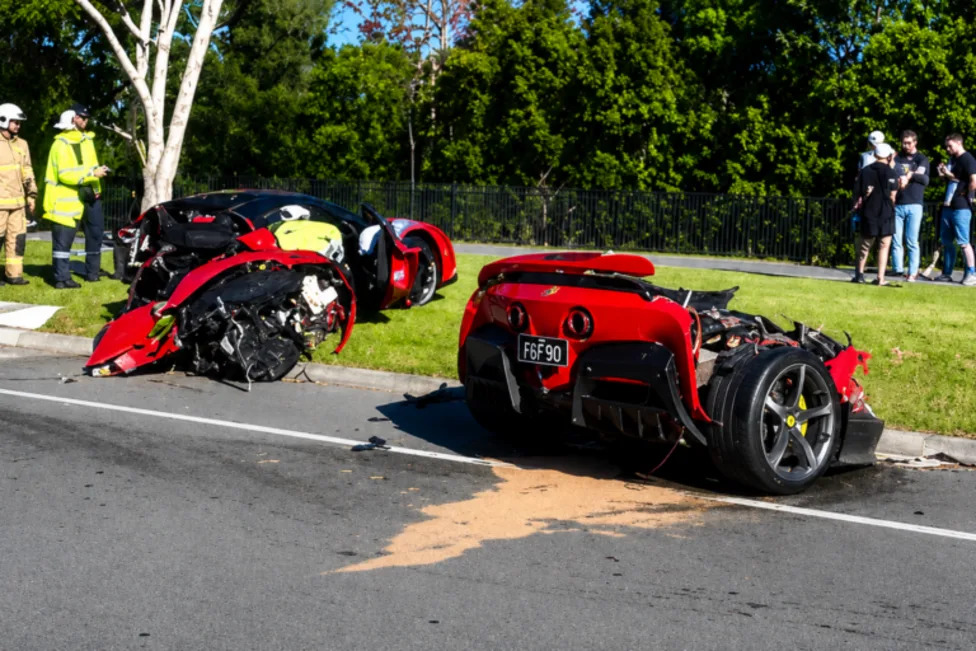



















Australian Property Developer Walks Away Unharmed After $1M Ferrari SF90 Splits in Half on the Gold CoastGold Coast property developer Sam Gordon escaped without a scratch this week after his Ferrari SF90 Stradale was destroyed in a crash so severe the car broke apart. Photos of the wreckage show the vehicle split into sections – the kind of imagery that makes it hard to believe the driver walked away at all. He did.The Ferrari SF90 ranks among the most powerful road cars the Italian manufacturer has produced, pairing a twin-turbocharged 4.0-litre V8 engine with three electric motors to generate a total of 986 hp. The car tips the scales at approximately 3,527 lb, launches from zero to 60 mph in just two seconds, and retails new in Australia for close to $1 million. Whatever Gordon paid for his, the insurance claim is going to be uncomfortable.Why the Car Coming Apart Is Actually the PointThe instinct when you see a car split in two is to assume catastrophic failure. In this case, it was closer to the opposite.AdvertisementAdvertisementThe SF90's architecture centres on a carbon-fibre tub that forms an extremely rigid protective cocoon around occupants – a design philosophy borrowed from racing – while purpose-built crumple zones at both ends of the car are engineered to absorb and dissipate impact energy. The outer sections are designed to crumple and break away precisely because doing so absorbs and disperses the force of a high-speed impact. The goal is to ensure that as much force as possible gets used up destroying everything outside the cabin before it has any chance of reaching the person inside.Ferrari's Head of Body-in-White, Andrea Baldini, has described the SF90's carbon-fibre architecture as "the best component in the car," and noted it was "the first time we have used carbon fibre in the body of a regular production Ferrari." According to Ferrari, that single-material integration saved four kilograms compared to aluminium while delivering significantly greater rigidity in side impacts.Formula 1 engineering pioneered the development of survival cells and crumple zones over many decades, with those advances eventually transferring from the racetrack to production road vehicles. Research featured in ScienceDirect identifies two critical factors that determine whether a driver survives a high-energy collision: a rigid central cell that maintains its shape under extreme force, and surrounding crumple zones designed to progressively absorb impact energy until they reach their structural threshold and fail completely.In photographs of the Gold Coast wreck, that principle is visible. The outer structure is gone. The core, where Gordon was sitting, held.AdvertisementAdvertisementIt is a horribly unsettling thing to look at – a million-dollar car reduced to fragments spread across the road. But the fact that the driver walked away from it is less miraculous than it seems. That outcome was engineered in.