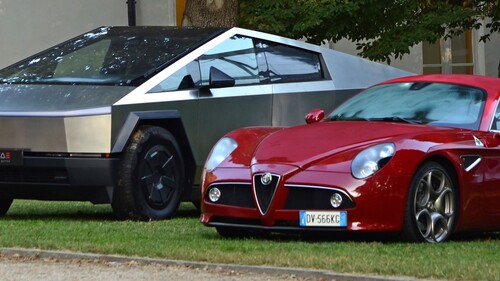
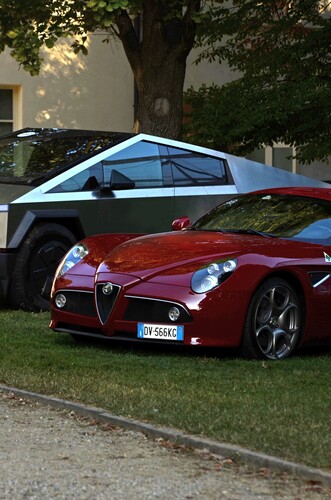
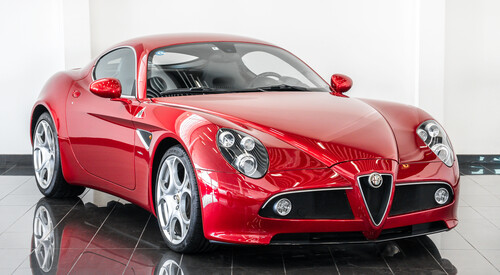
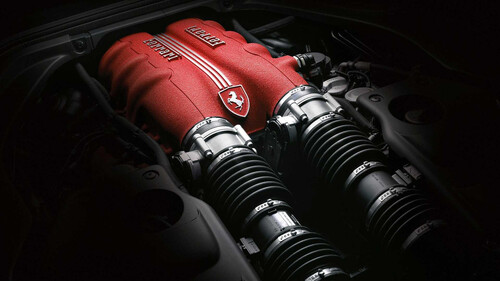
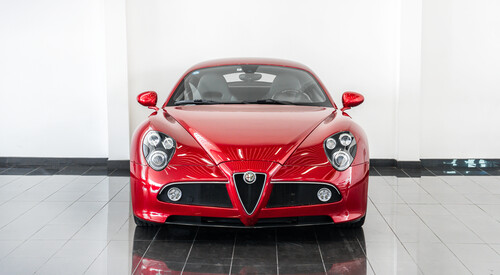
That car is the Alfa Romeo 8C Competizione, launched in 2007 and dropping jaws ever since. It isn’t just a pretty face, either, as it comes with carbon-fiber construction, a Ferrari-sourced V8, and limited production numbers, all of which give it instant blue-chip credentials. And yet, against all odds and market logic, values haven’t skyrocketed the way you would have expected, which makes this Italian stunner something of a bargain on the used market today.Prices were accurate at the time of writing but are subject to change. The Start Of A Brand Revival Alfa Romeo Key Facts To Know First shown as a concept in 2003 Borrowed Ferrari-built V8 powertrain (F136 family) as in Maserati GranTurismo Spawned an 8C Spider convertible In the early 2000s, Alfa Romeo was on a mission to transform itself into a true premium brand, one that could sell head-turning cars with sporty, rear-wheel-drive chassis and powerful engines. This was seen as necessary for a successful return to the lucrative US market after an absence following a 1995 exit. Alfa, working under the guidance of Fiat – which also owned Ferrari at the time – knew it needed something special to shake off the lingering memories of the 164 sedan, the last model it had sold in America.That something special arrived at the 2003 Frankfurt Auto Show in the form of the Alfa Romeo 8C Competizione, unveiled as a concept. The reaction was immediate and electrifying, and Alfa went all-in to turn it into production just four years later. The process was smoothed by a decision to borrow the platform and engine from the original Maserati GranTurismo. Ferrari built the V8, a design derived from the legendary F136 family found in cars like the F430 and California, giving the 8C a heart that could roar with exotic credibility while wearing the unmistakable Alfa badge.Although reviews were generally positive, there were criticisms that the car’s performance felt more in line with a grand tourer than a hard-edged supercar. That was especially true of the steering, which wasn’t as quick or communicative as what you’d get from something wearing a Ferrari badge. Shift speeds were also a touch slower than the razor-sharp setups of the day, and the suspension – tuned firmly – offered no adjustment to tailor the ride or handling.You’ll forget all of those qualms every time you look at it, though. Every angle, every curve, every proportion of the Alfa Romeo 8C Competizione is pure Italian poetry in metal. From the long, swooping hood to the sensuous rear haunches, it’s the kind of car that stops people mid-step and makes them forget the world for a moment.Alfa Romeo That beauty also helped Alfa Romeo charge what was, at the time, the highest price tag the brand had ever issued. The coupe started at $265,000, and the 8C Spider convertible, which followed in 2009, climbed even higher, to $299,000. Those figures made the 8C Competizione significantly more expensive than the Ferrari F430 and Lamborghini Gallardo on sale at the time.Nevertheless, Alfa sold all 500 planned coupes, though the Spider, also intended for a 500-car run, ended production after 329 examples. You can blame the global financial crisis for that. The downturn also stalled Alfa Romeo’s broader US return. The 8C arrived here for the 2008 model year, and Alfa was expected to follow it with existing models like the 159 sedan. Instead, American Alfisti had to wait until the 2014 model year for the arrival of the 4C sports car and the 2017 model year for the Giulia, the first true volume model in the brand’s long-awaited return to these shores. Prices Have Gone Nowhere Alfa Romeo Given all that’s going for the car – plus the exclusivity of just 85 coupes officially sold stateside and 35 Spiders – you’d think prices would have appreciated significantly by now, the way so many other exotics have, even relatively new ones. However, you’d be wrong. The 8C Competizione has been a terrible bet for anyone hoping to turn a profit, as recent US auction data makes painfully clear.Looking at price action over the past year, roughly half a dozen examples traded hands, with an average sale price of about $288,000, or barely above the MSRP from nearly two decades ago. The bargain of the bunch brought $165,000 for a car showing 50,000 miles, an eye-popping figure for collectors in this segment, and a likely explanation for the soft bidding. At the other end of the spectrum, the top sale landed around $368,000 for a time-capsule example with just 115 miles on the clock.Alfa Romeo Those figures apply to the coupes. As for the 8C Spider, auction results over the past year show an average sale price of roughly $298,000, or almost dead on its original MSRP. Such price action is even worse when you take inflation into account.Now consider a car like the Lexus LFA, which was built in a run of 500 cars and launched just after the 8C. Like the Alfa, the LFA wasn't immediately praised, with dealers initially struggling to sell some. Today, however, LFAs regularly sell for more than double the original $375,000 MSRP, with the average price being about $815,000.Similarly, Porsche's Carrera GT, of which around 1,200 were built, is another car that was overlooked early on by the supercar crowd, mainly because of its finicky manual transmission and lack of stability control. Today, it averages close to $1.8 million, or four times its original sticker. Why The 8C Competizione Stalled Alfa Romeo While it’s impossible to say with certainty why the 8C Competizione hasn’t become a hit with collectors, a few factors loom large. One of them is the platform. Beneath that achingly pretty carbon-fiber skin sits a shortened version of the platform underpinning the original Maserati GranTurismo, itself derived from the previous-generation Maserati Quattroporte. That architecture was never engineered to reset performance benchmarks, and it shows. The 8C is quick, but it's definitely more grand tourer-like than bare-knuckled supercar, and modern GTs rarely appreciate dramatically in value. A proper manual gearbox might have helped demand, with aftermarket conversions today offering a solution to that flaw.Then there’s the Alfa brand itself. Alfa Romeo has endured more than its share of corporate turbulence over the past two decades and has struggled to gain meaningful traction in the US, where the brand is largely unknown and when it is, it often carries a reputation for spotty reliability. A recent flirtation with an electric future – since walked back by parent company Stellantis – only added to the brand’s identity wobble. If badge cachet makes it tough to move $50,000 Giulia sedans and Stelvio SUVs, the pool of buyers ready to drop six figures on a low-volume halo car shrinks accordingly, even when that car looks like the 8C.Alfa Romeo The 8C also started on the back foot, shedding value aggressively in its early years before eventually leveling off. That initial plunge reset market expectations, anchoring the car’s perceived worth lower than its rarity and beauty might otherwise justify, and once a narrative of depreciation takes hold, it’s difficult to reverse. Buy The Drive, Not The Return Alfa Romeo In the end, the Alfa Romeo 8C Competizione may never join the blue-chip stratosphere occupied by Carrera GTs, LFAs, and limited-edition Ferraris, and that's perfectly fine. Not every supercar needs to double as an investment. For buyers willing to prioritize emotion over returns, the 8C remains a rare chance to own one of the most breathtaking modern designs ever penned, complete with a Ferrari-bred soundtrack, for basically what it cost new.Sources: Alfa Romeo