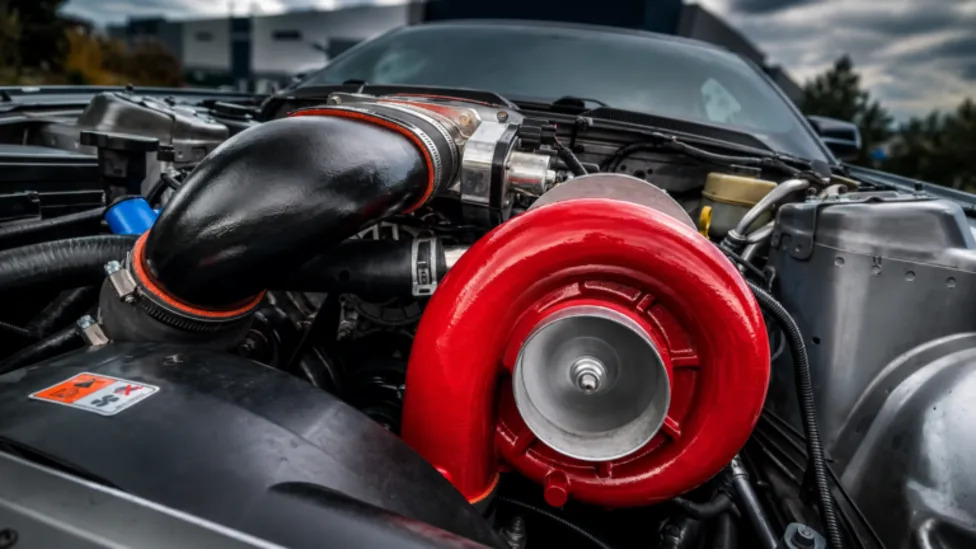






















611-WHP Mustang Loses Power After an Intercooler Install — Here’s Why That’s Actually a WinWhen YouTuber Four Eyes bolted an air-to-air intercooler onto his supercharged 2007 Ford Mustang GT, the dyno spat out a number smaller than the one before it. Peak output fell from 611 wheel horsepower to 590. On the surface, that looks like $1,000 worth of plumbing and fabrication going in the wrong direction. The boost pressure figures tell a different story entirely.Prior to the intercooler installation, the Mustang operated at 9.5 psi of boost and produced 459 lb-ft of torque, while intake air temperatures reached 141°F on the dyno and exceeded 170°F under actual driving conditions. Once the intercooler was installed and the tune was updated, boost pressure came down to 6.2 psi and peak output measured 590 whp – however, intake air temperatures dropped to 84°F on the dyno and stayed within a 104°F to 108°F range during street driving.The motor produced almost identical power figures while running 3.3 psi less boost and delivering charge air that had dropped roughly 80 degrees in temperature. According to Ford Muscle's reporting on this project, the 4.6-litre three-valve stroker engine is generating approximately 30 horsepower for every pound of boost it receives. That is an efficiency gain, not a loss.Why Boosted Engines Overheat Their Own AirA centrifugal supercharger builds power by forcing more air into the engine than it could breathe on its own. The problem is thermodynamic: compressing air raises its temperature, and according to Engineer Fix, 10 psi of boost alone can heat intake air by 100 to 150 degrees Fahrenheit above ambient. Hot air is less dense than cool air, which means fewer oxygen molecules available per combustion event. It also brings the charge closer to its auto-ignition point before the spark plug fires – the condition known as detonation, or knock. An engine detecting knock will pull ignition timing, run a richer fuel mixture, and shed power to protect itself. The result is an engine that looks impressive on a single dyno pull but degrades in real use as heat builds.AdvertisementAdvertisementFour Eyes' Mustang had no intercooler between its centrifugal blower and the throttle body. An intercooler functions much like a radiator for compressed air – the hot charge from the supercharger passes through a finned core, ambient air moves across it from the front of the car, and the charge temperature drops before the air ever reaches the intake manifold. Denser, cooler air means more oxygen, better combustion stability, and the ability to run more aggressive ignition timing without risking engine damage. Per ProCharger, that's the core value: achieving equivalent power levels with less boost pressure, which is exactly what the Mustang ended up demonstrating.What the Install Actually InvolvedGetting the intercooler onto the car was not a straightforward afternoon job. Four Eyes pulled the hood, front bumper, fender liners, radiator cover, and crash bar foam to access the front of the chassis. The coolant had to be drained, the throttle body came off, and the factory supercharger intake was removed.The intercooler kit routes hot compressed air – carried through a red hot-side pipe – from the supercharger outlet through a front-mounted finned core, then returns cooled air via a blue cold-side pipe back toward the throttle body. Four Eyes disliked the kit's default routing, which relied on two recirculating bypass valves and complicated plumbing, so his fabricator friend David welded a 3-inch MAF sensor flange onto the cold-side pipe and a 50mm blow-off valve flange onto the hot side.A TurboSmart blow-off valve was fitted to vent to atmosphere. The supercharger volute was also reoriented to point its outlet downward, threading the hot-side pipe between the oil filter and crank pulley – a tight, awkward path. The factory coolant reservoir lost its home to the new piping, so Four Eyes drilled into the pinch weld near the strut tower and fabricated new brackets for an aftermarket unit. The whole setup added roughly 30 pounds to the nose of the car.AdvertisementAdvertisementThen came the tuning, which turned out to be almost as involved as the fabrication. Moving the MAF sensor from a 4-inch housing to a 3-inch one reduced the tube's cross-sectional area by around 44 percent. That smaller diameter increases air velocity across the sensor, and if the tune isn't corrected, the ECU misreads airflow and dumps in too much fuel. Four Eyes cut his MAF scalar values by 25 percent before the first start, but the initial data logs still showed the car running 15 to 20 percent richer than target.He street-tuned his way toward the correct numbers through moderate pulls, then hit a harder limit: the original MAF sensor maxed out at 53 lb/min around 5,000 rpm. An SCT BA5000 sensor, built for higher air velocities, replaced it, and another full day of drivability tuning followed.The first dyno session after the install produced 558 whp and only 6.0 psi – a result that looked alarming until the logs revealed the air/fuel ratio was still sitting around 11.3 and timing was still conservative. After corrective tuning, the numbers settled at 590 whp, 453 lb-ft, and 84°F intake temperatures at 6.2 psi. The planned race against a Dodge Viper never materialized – the Viper spun its crank bearings and is currently being rebuilt – so Four Eyes took the Mustang out on a cool December afternoon instead. A 50-to-140 mph data pull confirmed what the dyno suggested: intake temperatures that used to exceed 170°F on the street stayed between 104°F and 108°F. Per CarWorship, many supercharged engines ideally want intake temps below 150°F. The Mustang now gets there comfortably.The intercooler was not a power upgrade. It was a foundation upgrade. Four Eyes has already noted plans to fit a smaller supercharger pulley, which will spin the blower faster and recover boost pressure – and the engine will handle that additional load from a much safer thermal baseline than it had before.AdvertisementAdvertisementThe 21-whp drop on the dyno is a footnote. An engine that runs cooler, pulls timing less often, and still makes 590 wheel horsepower on 6.2 psi of boost is one that's ready for the next step. The one making 611 whp on 9.5 psi and baking its own intake air was not.