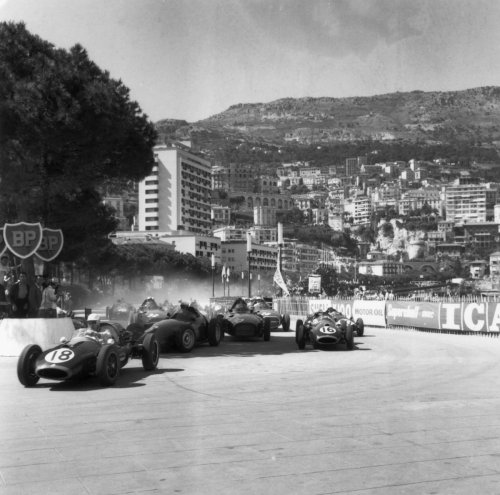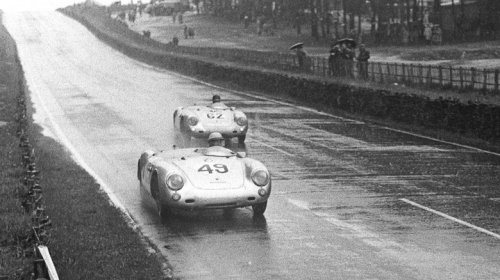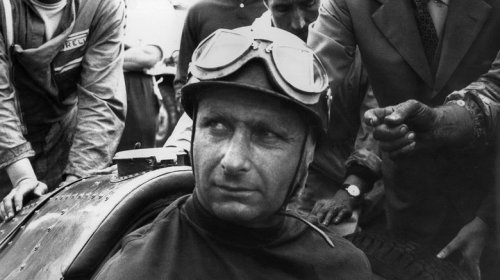
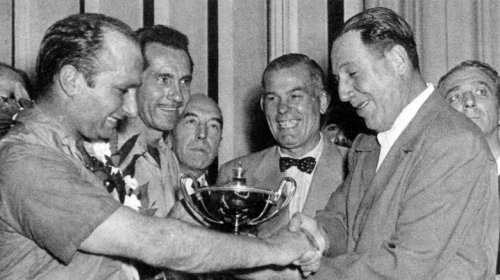
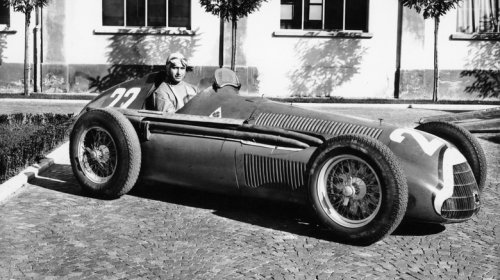
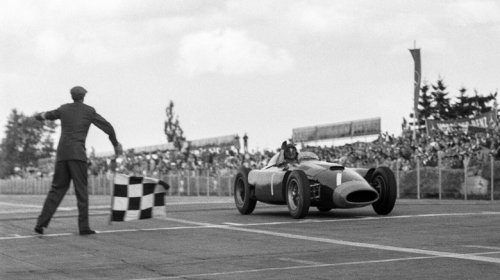
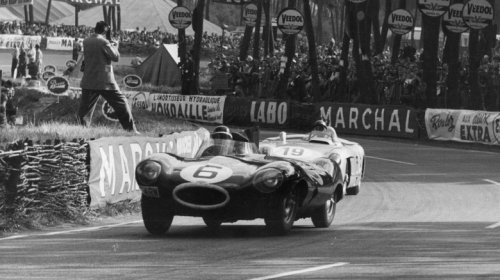
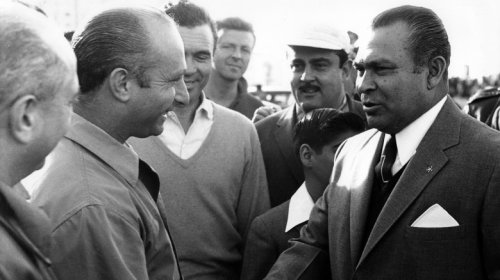


















Bernard Cahier/Getty Images Juan Manuel Fangio is generally considered one of Formula 1's all-time greats, and his five driver's championships are a big part of his resume. His first came in 1951 – the second year of the Grand Prix driver's championship – and he then ran off a string of four consecutive driver's titles from 1954 through 1957. Only Lewis Hamilton and Michael Schumacher have more championships today, with each owning seven. The thing is, one glaring difference between Fangio, Hamilton, and Shumacher is their total number of Formula 1 race wins. Fangio has 24, which puts him between Niki Lauda (25) and Nelson Piquet (23) in 12th place on the leaderboard. Hamilton and Schumacher, on the other hand, have 106 and 91, respectively. Now, at first glance, Fangio's number of victories may seem impressive but perhaps not exactly "great." What elevates him into that category is how relatively short his Formula 1 career was. Fangio won his five F1 titles in eight seasons of racing, from 1950 through 1957 — although he did participate in a few races in 1958. Looking at the pair mentioned above, Hamilton has been at it for 20 years and — when he's not drifting his Ferrari F40 around Tokyo with Kim Kardashian– remains active. Schumacher had 19 seasons of racing. The bottom line is that Fangio won an incredible 47.1% of the 51 F1 Grand Prix races he entered. Of course, that was no doubt helped by qualifying on the front row in an even more amazing 94.1% of those races. Meanwhile, Hamilton has entered a whopping 394 F1 races and counting, and Schumacher started 307 Grands Prix. And here are a few more Fangio fast facts for you to consider. His racing career was once funded by a controversial Argentinian politician El Grafico/Getty Images Fangio actually had a long and successful history in racing well before he entered his first European Grand Prix. It's just that a lot of it transpired in South America. One important milestone came in 1940, when he drove a Chevrolet to victory in the Gran Premio Internacional del Norte, a two-week, 5,600-mile jaunt across Argentina. That kind of result soon came to the attention of Juan Perón, the Argentinean president. It was some time after World War II, while he wasn't busy helping war criminals flee justice, that Perón had the idea of putting motorsports into the service of politics. With that in mind, Perón directed the Automobile Club of Argentina to start buying and importing dedicated racecars for drivers like Fangio. Some sources go as far as saying Perón and the club eventually funded Fangio's move to Paris and gave him his own Maserati to get his European racing career off the ground. He would go on to drive for the Maserati team in 1949, during which he took home his first two Grand Prix victories. Remember, many races were and are called "Grands Prix," without being part of the Formula 1 calendar. He didn't start his first modern Grand Prix until he was 39 Heritage Images/Getty Images The son of Italian immigrants, Fangio was born in Balcarce, Argentina, on June 24, 1911. If you do the math, that means he was some 39 years old before he started his first modern-era Grand Prix race. For some random context, Alain Prost retired at 38, Sebastian Vettel at 35, and Jackie Stewart — who once taped a wrench to his steering wheel for safety — at 34. Schumacher's first retirement also was age 38, and while he did return to racing for three years with Mercedes, it's worth pointing out that he didn't win any races with the German team. Fangio, in fact, won all five championships after he turned 40. He retired at the top of his game, too, as his final title and race wins came in his final full year of F1 competition. That was in 1957, but only after he put on what's considered one of the most amazing comebacks in all of motorsports. Fangio had naturally started on the pole — as he did in 57% of his Formula 1 races — and got out to a lead of about 30 seconds over the rest of the field. That, however, was before a pit-stop fiasco that left him third place and well behind the new leaders once he got back on the track. What followed was a methodical masterclass in driving that saw Fangio break multiple Nürburgring records as he slowly but surely reeled in the Ferraris of Mike Hawthorn and Peter Collins. It took him to the final lap, but Fangio overcame both to win the race by four seconds –- securing his final title in the process. He won championships for 4 different teams Bernard Cahier/Getty Images A further example of Fangio's greatness is that his five F1 driving titles came for four different teams -– so it wasn't like he was simply a byproduct of one manufacturer's engineering advantages. Hamilton won his first title for McClaren, but his six others came for Mercedes-Benz. It was a similar story for Schumacher, who won a pair of titles for Benetton before capturing five with Ferrari. Fangio, though, started making his first impact on European racing in 1949 as a driver for Ferrari. There are conflicting sources, but both point to typically Fangio-esque results. Some say he won nine of the 18 races he entered in the Ferrari 125, while others put his record for the year at six victories in 10 events. Yet, despite those numbers, he moved to Alfa Romeo for the 1950 racing season — finishing second in driver's points that year and winning his first title in 1951. A serious accident left him with a broken neck in 1952, but he was back on top by 1954. Splitting time between Maserati and Mercedes, he won a second championship that year. He claimed the driver's trophy again in 1955, still driving for Mercedes, but that year was marred by one of the worst crashes in motorsports history, which we'll touch on next. Mercedes withdrew from F1 after that, leaving Fangio to find his next ride — and title — back with Ferrari in 1956. Fangio retired from Formula 1 racing in 1958, but only after taking home a title with Maserati in 1957. He was nearly caught up in the deadly 1955 crash at Le Mans Bert Hardy/Getty Images In an alternate universe somewhere, the 1955 race at Le Mans is best remembered for a weird car that looked like a pair of torpedoes and was powered by a German motorcycle engine. In our timeline, however, the event encompassed the deadliest motorsports crash ever — and Fangio was directly behind the racers involved. The race had become a battle between Fangio — co-driving for Mercedes with Stirling Moss — and the Jaguar entry of Mike Hawthorn and Ivor Bueb. At one point, running low on fuel, Hawthorn realized he had to give up the fight long enough for a pit stop. He was running with a group that included both Fangio and a second Mercedes, driven by Pierre Levegh, and seems to have committed to the stop just after passing slower traffic — which meant getting on the brakes hard right after the pass. The car behind him, driven by Lance Macklin, had to suddenly pull out around Hawthorn, and he ended up directly in the path of Levegh and Fangio. Riding Macklin's car like a ramp, Levegh's Mercedes was launched into the crowd and disintegrated, its hood spinning off like a blade, decapitating race fans, and its engine also tearing away from the car and flying into the audience. The car's magnesium body work ignited into a ball of fire as well. More than 80 people were killed and more than 120 were injured as a result. Yet, in the seconds before impact, Levegh had raised a hand in warning to Fangio, and that was just enough to alert him to the danger — Fangio slipped through the wreckage to continue racing. He was once kidnapped by Cuban revolutionaries Bernard Cahier/Getty Images Fangio was also slated to compete in another race that had tragic consequences for spectators but missed the event for a rather surprising reason: He had been kidnapped at gunpoint from the lobby of his hotel. This was in Cuba, in 1958, at a time when Fidel Castro was trying to overthrow the military dictatorship of Fulgencio Batista — who didn't want a little thing like that to interrupt his plans for the Cuban Grand Prix. Castro's crew had different ideas, of course, and when the F1 circus came to Havana, Fangio was snatched away to help bring attention to the revolution. Batista wasn't having it. He decided the race would go on as planned. It's kind of like Qatar swearing it's safe enough to host F1 this year. We don't know how that will turn out, but Fangio was released unharmed after the Cuban Grand Prix, and he seems to have had a relatively comfortable time in captivity. There's evidence he even sympathized with the revolutionaries' goals. But the results of the race were far more deadly. After one driver's broken oil line left the surface in a dangerously slippery condition, another lost control and plunged his Ferrari directly into the crowd — killing seven and injuring more than 30.