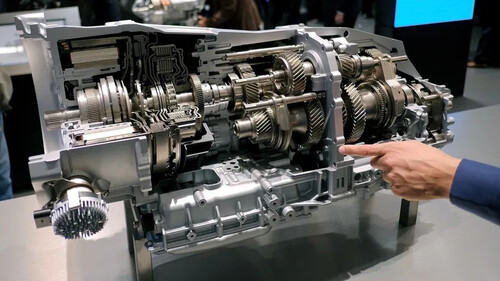
The planetary gear set is the core of an automatic transmissionThe planetary gear set, also known as an epicyclic gear set, is the brain of automatic transmissions, allowing the system to smoothly upshift and downshift while you're driving. At the core are three main parts– the sun gear in the middle, several planet gears that orbit it, and the outer ring gear, also known as the annulus.The sun gear, located at the center, is usually hooked up to the engine's output shaft and spins around its axis. Surrounding it are the planet gears, which loop around the sun gear while spinning on their own axes. These planet gears are mounted on a carrier, which is typically all connected to the transmission's output shaft. The ring gear, which is the largest gear with inward-facing teeth, meshes with the planets and sends power to the wheels.Automatic transmissions can get a wide range of gear ratios and speeds by selectively engaging different combinations of the sun gear, planet gears, and ring gear. This is done through a series of clutches and brakes that control which parts of the gear set are free to rotate or are held stationary. How these gears are arranged and controlled determines whether the output turns in the same direction as the input (for forward gears), goes in reverse, or spins at a different speed for various gear ratios. This allows the vehicle to have multiple speed settings, or gears, that can be utilized based on the driving conditions.Automatic transmissions use a torque converter, not a clutchA torque converter has three main parts that make it work: the impeller, which is attached to the engine, the turbine, which is connected to the transmission, and the stationary stator in the middle. When the engine runs, the impeller spins and pushes transmission fluid between the parts. That fluid movement makes the turbine spin, too, transferring the power to the transmission. The stator helps redirect the fluid flow coming back from the turbine to the impeller. This makes the power transfer more efficient, resulting in better acceleration. It recycles the fluid to squeeze more torque out of each spin rather than just letting it splash around. In the end, it all works together to get the engine power into the transmission smoothly.Another cool thing the torque converter does is multiply the engine's power when you first hit the gas when you start from a stop. This gives your vehicle a boost to get moving quicker. Moreover, many torque converters these days also have a lock-up mechanism (clutches) that rigidly connects the engine and transmission at highway speeds to improve fuel efficiency and performance.While torque converters let automobiles shift gears smoothly and without any jerks, they do have some drawbacks in efficiency. The impeller connected to the engine and the turbine hooked to the transmission gears aren't physically locked together — they use fluid to transfer the power — so there's always a little bit of slippage happening in there. As a result, automatics use more gas than manuals since some of the engine's effort is lost in the fluid. Still, torque converters help give you smooth driving without the fuss of a clutch pedal.Automatic transmissions rely on a hydraulic systemYou know that slick, liquidy feel when you shift an automatic transmission from Park to Drive? That's the hydraulic system hard at work behind the scenes. This powerful fluid network is the beating heart that makes your transmission work smoothly.The transmission relies on a pump to draw automatic transmission fluid (ATF) from the pan and generate hydraulic pressure. This pressurized fluid performs crucial functions. It applies the clutches to engage different gear ratios through careful hydraulic pressure application. It also provides pressure to keep the bands — which hold gears and components securely during operation — tightened.Moreover, the hydraulic system lubricates and cools the transmission's moving parts by circulating the ATF throughout internal components. Hydraulic pressure is controlled by a complex valve body containing channels, ports, and solenoids routing pressurized ATF as needed depending on vehicle speed, throttle position, and gear selector position.The hydraulic system in an automatic transmission also relies on accumulators to store backup hydraulic muscle to keep things running smoothly. They are designed to prevent sudden changes in hydraulic pressure, which can lead to harsh gear shifts. By storing and releasing pressure, they ensure a smoother transition between gears.Your automatic car creeps when it is idlingHave you noticed that when you take your foot off the brake in Drive or Reverse that it just starts creeping forward or backward even though you're not on the gas pedal? That's called idle creep.Idle creep has a couple of handy benefits. First, it makes taking off from a stop super smooth, which means that you don't have to constantly feather the gas pedal in bumper-to-bumper traffic or tight spaces. Second, it helps you maintain control when parking or moving at low speeds. Being able to roll a bit without hitting the gas prevents you from stalling out and lets you guide the vehicle where you need it to go with more gentle control. It's pretty useful for parking lot maneuvering or squeezing down tight city streets.The speed at which your automobile creeps forward at idle can vary a bit depending on factors like make, model, and transmission. Usually, it's around the speed of a brisk walk, although some cars really noticeably creep along, while others are pretty subtle. Either way, the basic idea is the same — it lets you roll a bit without always having your foot on a pedal in traffic or waiting in a line.