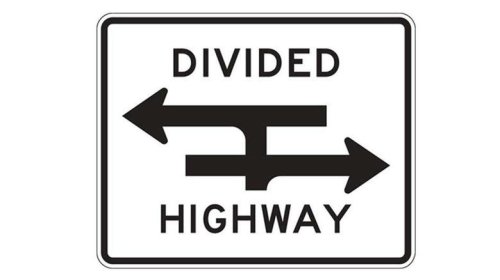
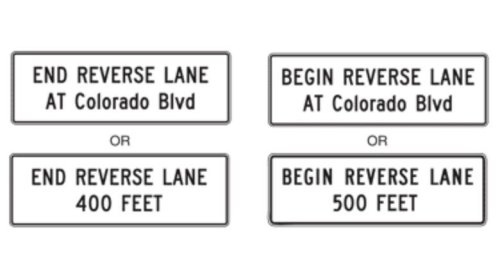
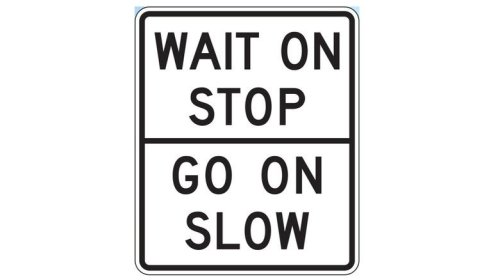
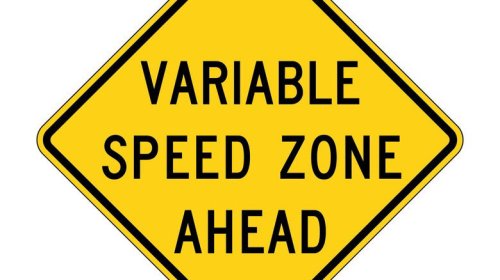
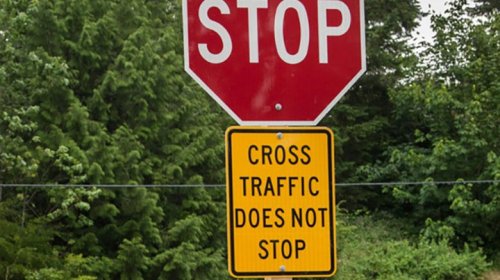
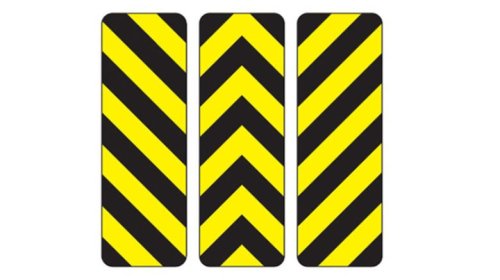


















Divided highwayWhen driving on the highway, you have to be aware of other drivers traveling the same direction, obstructions and oncoming traffic from the opposing lanes. In addition, there are sometimes permanent objects punctuating the roadway that you'll need to be aware of. Divided Highway signs let drivers know when opposing lanes of a highway are separated by a physical barrier of some kind, typically a paved island, row of trees, or barrier island.Divided Highway signs come in a couple of varieties. The first is black and white, featuring diverging horizontal arrows with a vertical line running through them. This sign indicates that a divided highway is about to begin. The other version is black and yellow, featuring opposing vertical arrows curving around a gumdrop-shaped object.If the arrows are at the bottom with the gumdrop barrier on top, that indicates that you are entering a divided highway. By contrast, if the gumdrop is underneath with the arrows on top, that means the divided highway is about to end.Begin or end reverse laneOn many major roads, there's a directional imbalance in traffic patterns, especially during morning and evening rush hour periods. Traffic typically moves toward cities and activity centers in the morning and away from them in the evening. That means that a couple of times a day you have heavy traffic in one direction and almost no traffic heading the other way.Reversible lanes seek to solve that problem by borrowing capacity from those relatively empty lanes during periods of heavy traffic, and that doesn't just mean rush hour. Reversible lanes are also useful during construction, if a car accident or other emergency blocks a lane, and during high population events like sporting events. There are reversible lanes outside sports stadiums in Texas which traffic engineers use to relieve the flow of guests after big games.Despite their utility, reversible lanes can be complicated in practice, and there aren't very many of them. There were fewer than 100 reversible lane systems in operation in the U.S. as of 2010. Clear signage, including Begin Reversible Lane and End Reversible Lane signs, is important for reversible lanes to work, especially since most people have never encountered them before.Wait on stop/go on slowDuring road construction lanes sometimes have to be closed temporarily. If a road has several lanes running in each direction, you can usually get away with some pylons and a little caution, without disrupting the flow of traffic too much. However, if capacity is already limited, with a single lane in each direction, road maintenance can cause real problems.During these scenarios, traffic is managed by taking turns running cars in each direction on the same lane. You can do that with a couple of construction workers, walkie talkies, and stop signs, or you can use an AFAD. Short for Automated Flagger Assisted Device, AFADs let a flagger control traffic while staying safely out of the flow of cars. A single flagger could even control AFADs at multiple locations if needed.Whether automated or human, the flagger switches a sign with Stop written on one side and Slow written on the other. By swapping back and forth, traffic can flow both ways in a single lane. It's an elegant solution to an inconvenient problem, but it only works if drivers know what's going on. Wait on Stop/Go on Slow signs are typically placed ahead of an AFAD or human flagger to let drivers know how to proceed.Variable speed zone aheadSpeed limits are based on engineering speed studies, a scientific evaluation which takes into account the typical speeds of existing traffic, traffic volume, type of road, roadway features, sight distances, pedestrian activity, crash history, and more. Once set, the speed limit on most roads changes very rarely. Some roads, however, have speed limits which change throughout the day.Digital speed limit signs allow traffic managers to update the speed limit based on traffic trends or real-time driving conditions. They tend to show up on roads with variable traffic rates, higher than usual accident rates, or frequently poor weather. They are commonly seen on mountain roads where weather can vary wildly.Often, digital variable speed limit signs are paired with road sensors which can detect driving conditions and adjust the speed limit appropriately. Drivers should see a Variable Speed Zone Ahead sign in advance of the digital speed limit sign to let them know that speeds may be unpredictable.Cross traffic does not stopThe only way for multiple drivers to safely operate on a roadway at the same time is if everyone knows what to expect. Most of the time, basic rules of the road and some common sense are enough to get you where you're going, but sometimes you'll hit an intersection that isn't what it seems. Traffic warning notices like the Cross Traffic Does Not Stop sign are used to prevent potentially dangerous situations at confusing intersections.There are several different versions of the Cross Traffic Does Not Stop sign, often used in combination with a Stop sign. They are used in areas where an intersection may be construed as an all-way stop, to let drivers know how to safely proceed. You'll see it either in advance of a Stop sign or on the same post, letting drivers know that they need to stop but that cross traffic doesn't.Cross Traffic Does Not Stop is the standard version of the sign, but it may be modified with more specific language like "Traffic From Left Does Not Stop" or "Oncoming Traffic Does Not Stop," if it more accurately and clearly describes the situation. In any event, if you see this sign, take an extra moment to check your surroundings before proceeding through.Object markers (right, left, and chevron)These are some of the most common street signs you'll see on the road, but it's not immediately clear what they're communicating. They are usually black with nine yellow retroreflectors at least 3 inches wide, angling downward at a 45 degree angle. Alternate versions of the Object Marker include diamond shaped signs of yellow and black or red and black, with 9 reflective circles.No matter the design, they are used to mark objects in the road or less than 8 feet from the shoulder or curb. Not only do object markers let you know there's a potential hazard to avoid, they also tell you how best to navigate around it.The direction of the lines tells you where the obstruction is and how to safely pass it. If the lines start on the right at the top and angle down toward the left, then you should pass on the left side. If they start on the left at the top and angle down to the right, you pass on the right. And if the lines are in a chevron shape, angling down in both directions, then you can pass on either side.