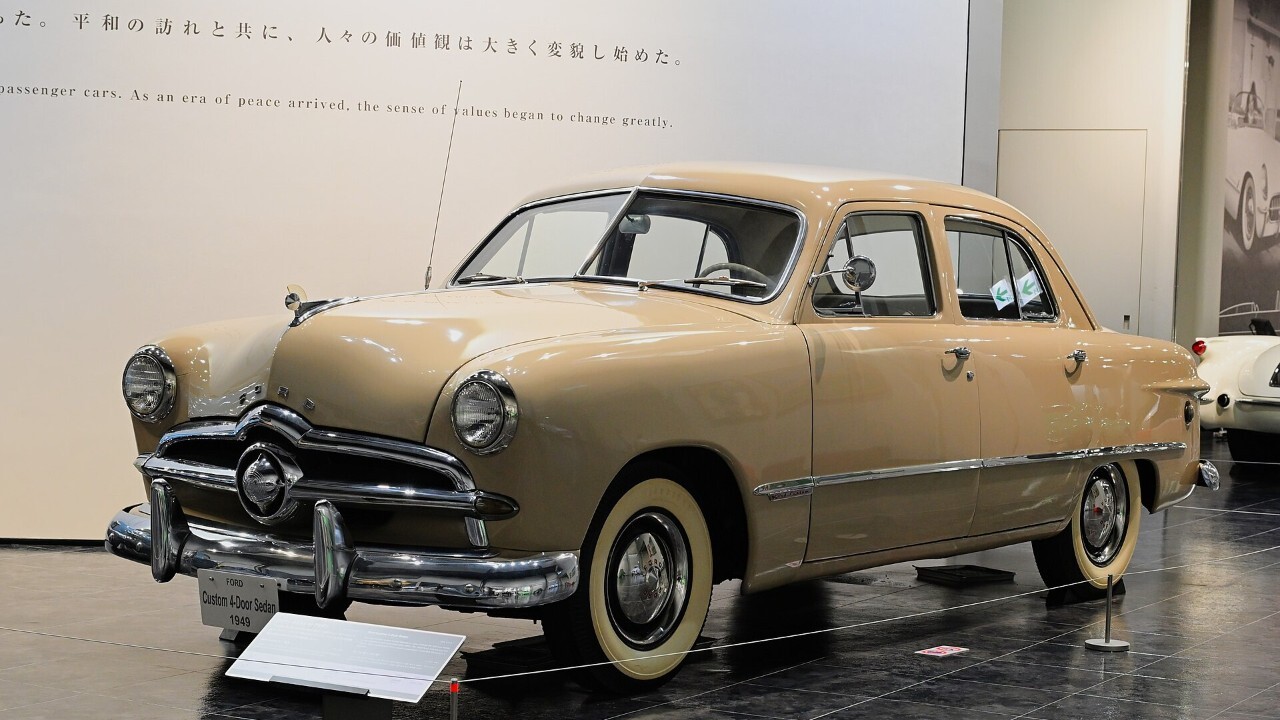
The Nash Airflyte looked like nothing else in a 1949 showroom, and one magazine writer joked that it was a contender for “Miss Upside-Down Bathtub of 1949.” That reaction sums up the decade. In our view, few decades changed American cars more than the years from 1940 to 1949. First came the last prewar models, then a hard stop for World War II. After that, carmakers restarted civilian production in 1946. Finally, a wave of all-new postwar cars arrived with flush fenders, unit bodies and fresh engines. The roads filled with families, wagons and small economy cars that had not existed before the war. These are our picks: ten American cars that, in our view, best show how driving changed across the 1940s. The figures come from the records, while the choices are our opinion. Some of them sold in huge numbers, and others barely made a dent. Either way, each one tells you something about where the country was heading. 1. 1949 Nash 600 Super Airflyte Nash did not just restyle its cars for 1949. It started over. Production of the new Airflyte began in October 1948, and the frame and body shell were welded into a single unit. That was an early form of the unit construction nearly every car uses today. During the war years, engineering chief Nils Wahlberg’s team tested a full-size plaster model in a wind tunnel. The payoff was real, too. According to Mac’s Motor City Garage, the Nash Airflyte needed significantly less power to hold 60 mph than a comparable Buick or Chrysler. The 600 was the junior model, on a 112-inch wheelbase with a 172.6-cubic-inch flathead six. Meanwhile, the enclosed front fenders made the front track five inches narrower than the rear. Then there were the quirks. A single “Uniscope” pod on the steering column held every gauge. For $39, Nash would also sell you reclining seats that folded into a twin bed. Our take: the Nash Airflyte was the decade’s boldest family car, and it pointed straight at the future. 2. 1947 Crosley CC Most postwar buyers wanted bigger cars. Powel Crosley bet that some of them wanted much smaller ones, and he built the Crosley CC in Marion, Indiana, from 1946 to 1948. Its CoBra engine was a 44.2-cubic-inch overhead-cam four with a copper-brazed block, and it made 26.5 hp. Crosley models in general weighed just 1,100 to 1,400 pounds. For a while, the gamble paid off. Crosley sold about 4,999 cars in 1946 and more than 22,500 in 1947. In 1948, the station wagon became the best seller, with 23,489 built that year alone. However, the CoBra engine suffered from corrosion and poor reliability under everyday maintenance. As a result, Crosley’s reputation took a hit, and a cast-iron engine replaced the CoBra for 1949. The last Crosley car came off the line on July 3, 1952. Still, in our view the CC deserves a spot here. It proved that some Americans would choose a tiny economy car decades before that idea caught on for real. If you buy one today, ask whether it still has the original CoBra or a later engine. 3. 1949 Ford Custom Fordor Ford unveiled its 1949 cars at a gala in New York’s Waldorf-Astoria Hotel in June 1948. It was the first all-new postwar Ford, and it beat Chevrolet and Plymouth to market. It was also the first Ford line to arrive after the deaths of Edsel and Henry Ford. So the company had a lot riding on it. The design dropped the running boards and blended the front and rear fenders into one slab side. That shape earned it the nickname “Shoebox Ford.” Underneath, Ford finally replaced its old transverse-leaf front suspension with coil-spring independent front suspension. Buyers could choose a 226-cubic-inch six or the 239-cubic-inch flathead V8. The Custom was the upper trim, and the Fordor was the four-door sedan. The public loved it. Ford sold 1,118,740 cars in 1949 and returned to first place among American makers. In our opinion, the Custom Fordor is the most honest way to experience that turnaround, because it was the everyday family version. Also, a four-door usually costs less than a convertible, which makes it a smart way into the hobby. 4. 1941 Ford Super Deluxe Woody Wagon The 1941 Ford arrived just before the war changed everything. Super Deluxe was the top of three trim lines, with extra chrome, leather seats and a wood-grain dashboard. That year also brought a new 226-cubic-inch six rated at 90 hp. In fact, it was Ford’s first six since the 1906 Model K. The 221-cubic-inch V8, also rated at 90 hp, stayed at the top of the range. Then came the woody wagon, with its wood body on a 114-inch wheelbase. Wagons like this carried families, luggage and gear in a way sedans could not. Later, the wartime shutdown arrived. Government orders halted civilian car production on February 10, 1942, so the 1942 model year lasted only four months. Ford kept wood bodies on its wagons until 1949, when steel replaced them. That makes the 1941 Super Deluxe woody a snapshot of the last carefree year before the war. Our take: few cars capture the early ’40s better. If you shop for one, budget for the wood, because restoring structural timber takes real skill and real money. 5. 1949 Chevrolet Styleline Deluxe convertible Chevrolet waited until 1949 for its all-new postwar body, and the Styleline Deluxe was the new upper model. Styleline meant a notchback, offered as a sedan, coupe, convertible and wagon. By comparison, the fastback Fleetline came only as a two- or four-door sedan. The 1949 Deluxe used the 216.5-cubic-inch “Thrift-Master” six, rated at about 90 to 92 hp. The convertible was the fun one, and it was the clearest break from the prewar look. To our eyes, it showed what Chevrolet thought the next decade should look like. Then, a year later, the brand added the Powerglide automatic and the larger “Blue Flame” six. That pair arrived in 1950, so a 1949 car still has you shifting for yourself. The 1950 Bel Air hardtop also started life as part of the Deluxe range. In our view, the 1949 Styleline Deluxe convertible is the bridge between Chevrolet’s war-era cars and the Bel Airs of the ’50s. If you want one, check the top mechanism and the floors, because open cars of this age often hide rust there. 6. 1946 Dodge Custom Dodge rolled back into civilian production with the D24 series in 1946, and the Custom sat at the top. It differed from the Deluxe only in its interior trim, seats, dual electric wipers and chrome window beading. Buyers could pick a four-door sedan, a Town Sedan, a seven-passenger sedan, a Club Coupe or a convertible. Every one used a 230-cubic-inch Dodge six. The clever part was Fluid Drive. This option put a fluid coupling between the engine and the drivetrain, so there was no metal-to-metal contact between them. A three-speed manual was standard. In our view, that made Fluid Drive a real help in stop-and-go traffic. Dodge made only minimal changes for 1947 and 1948, and it kept building the series until early 1949. That long run tells you how hungry buyers were for any new car after the war. Our take: the 1946 Custom is the car that got America moving again. It is solid, simple and easy to live with. Look for one with Fluid Drive, because that is what makes it feel special today. 7. 1949 Studebaker Champion Regal Deluxe Studebaker beat the big automakers to a fully postwar design. The redesigned Champion and Commander arrived for 1947, and the Studebaker National Museum credits their radical styling to Raymond Loewy Associates. The company’s slogan was “first by far with a postwar car.” For a few years, it was hard to argue. The Champion was the volume model. In 1947, it made up 65.08% of Studebaker’s total sales. Its 169.9-cubic-inch six made 80 hp that year, which was modest even then. In our view, its appeal was simple: it looked newer than almost anything else on the road. Regal Deluxe was the dressier trim, and the 1949 range included a Regal Deluxe convertible. Studebaker built these cars in South Bend, Indiana, where the museum now keeps the company’s story. In our view, the Champion is one of the most important cars on this list, because it forced everyone else to hurry. If you find a good one, pay attention to the trim and glass. Small parts are often harder to replace than mechanical ones. 8. 1948 Oldsmobile Futuramic 98 Oldsmobile gave the 98 completely new styling partway through the 1948 model year. That was the first time since 1940 that the brand had changed a car’s look within a single model year. The new shape became part of the “Futuramic” campaign, which carried into the 1949 Oldsmobiles. Even so, the biggest news was still a year away. That news was the Rocket V8, which arrived in 1949. So the 1948 98 sits right on the edge of a huge change in American engines. In the meantime, buyers already loved it. Oldsmobile sold a record 65,235 cars in the 98 series in 1948, more than the number of 90-series cars it sold in 1940. Our take: the 1948 Futuramic 98 is where Oldsmobile’s postwar future first showed its face. It came with the look before the famous engine. That makes it a little overlooked next to later Rocket-powered cars, which can work in your favor as a buyer. Check the electrical system carefully, as with any car of this age. 9. 1948 Packard Station Sedan Packard’s Station Sedan was a wagon in a tailored suit. It used ash and maple to turn the sedan body into a station wagon, along with birch framing on the outside. According to RM Sotheby’s listing for a 1948 example, Briggs Manufacturing added steel supports at the B- and D-posts. Power came from a 288-cubic-inch straight-eight. It was not cheap. When new, the Station Sedan cost $3,424, making it the most expensive of the short-wheelbase Packards. Packard built about 3,885 of them from 1948 through 1950, with most made in 1948. As a result, few survive today, and the wood makes restoration demanding. In our view, this car shows how the wagon moved upmarket in the late ’40s. Families wanted the space, but some of them also wanted a prestige badge. If you want one, insist on a detailed wood inspection before you buy. The example RM Sotheby’s offered at Hershey in 2024 sold for $57,750. 10. 1948 Chevrolet Fleetline Aerosedan The Fleetline Aerosedan was Chevrolet’s two-door fastback. From 1946 to 1948, it sat within the Fleetmaster range, while a four-door Sportmaster joined it. The sloping fastback shape was shared across GM products from 1942 to 1949. On the Chevrolet, though, it became a genuine sales hit. The numbers climbed every year. Chevrolet built 57,932 Aerosedans in 1946 and 159,407 in 1947. In 1948, production reached 211,861. By comparison, the four-door Sportmaster reached 64,217 that year. In 1947, the Fleetline line made up 31.86% of all Chevrolet sales. Our take: the Aerosedan was the prewar streamlined look at its most popular, just before the new 1949 bodies swept it away. It is also a great value play for you today, because so many were built. Look for solid floors and good chrome, then enjoy one of the best-looking shapes of the decade. Chevrolet kept the fastback roofline for 1949, but the redesign brought integrated rear fenders and a reduced body contour.

 Liked by Victoria Morgan, Lily Girard

















 Liked by Victoria Morgan, Lily Girard