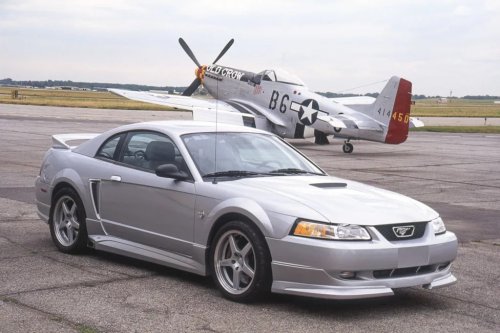
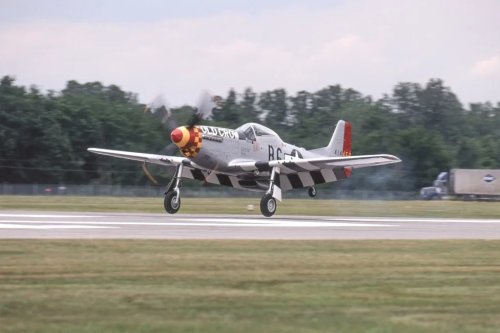
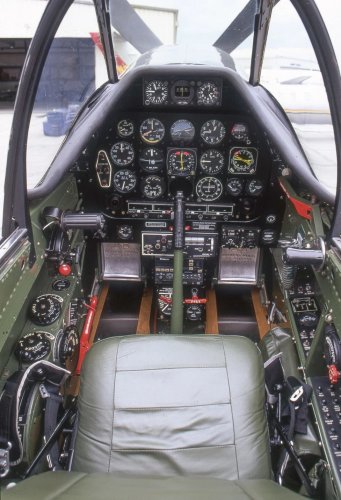
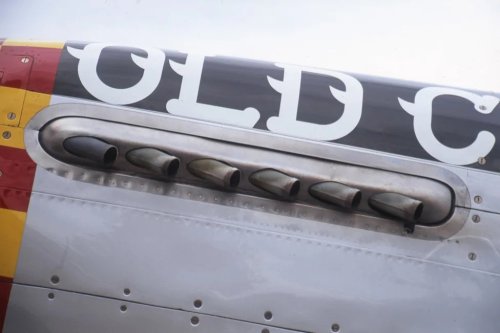
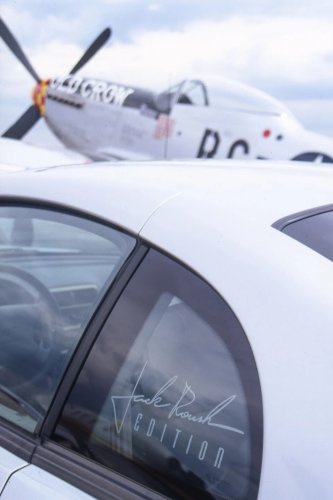
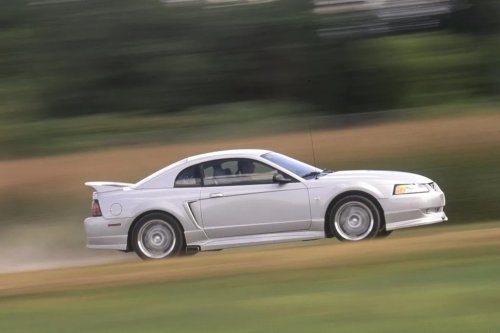
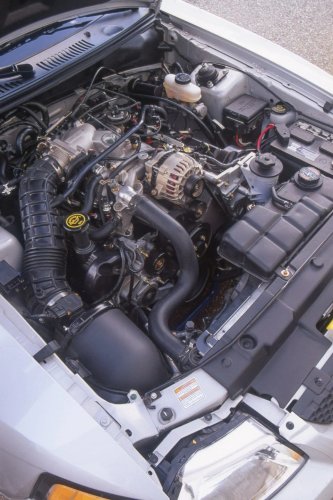
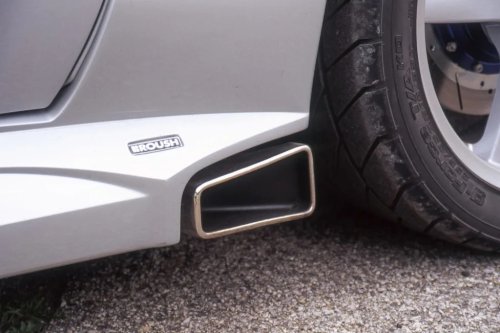
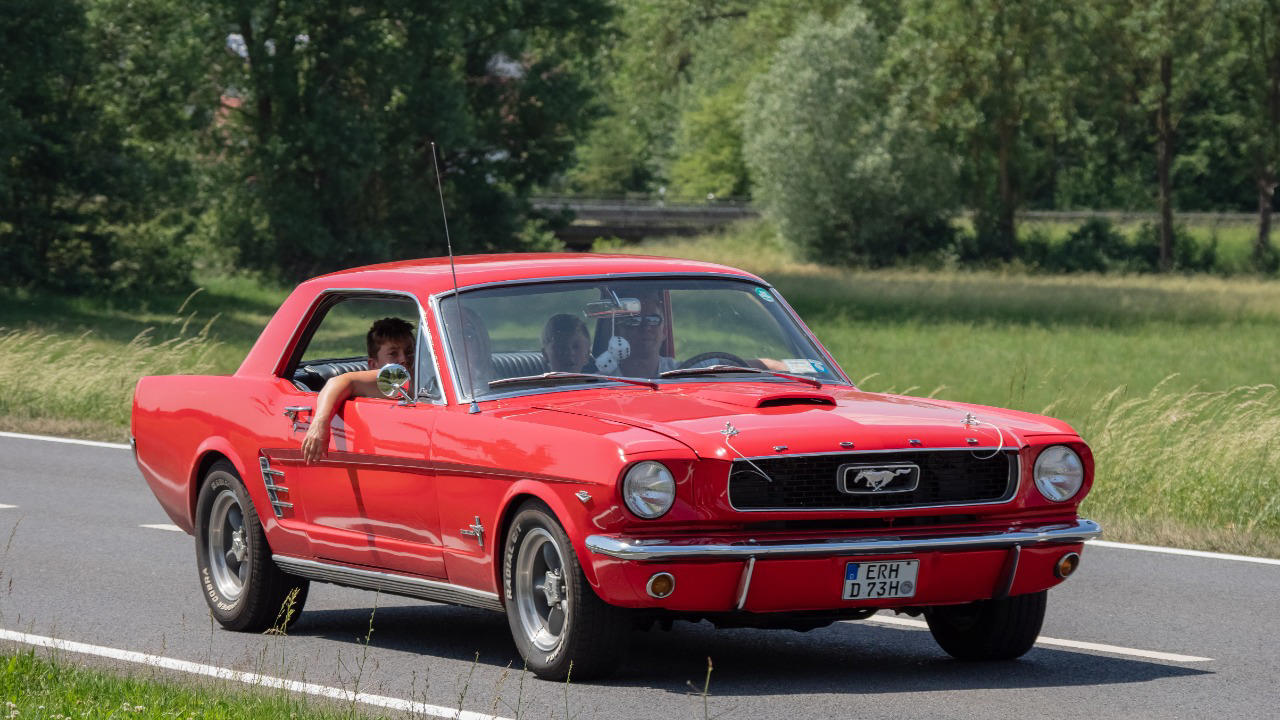
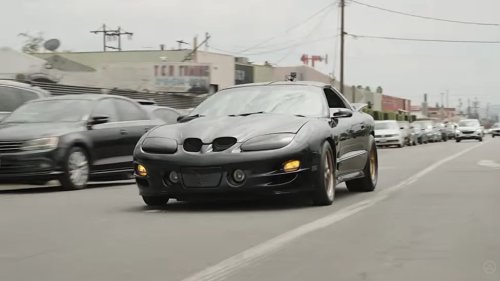
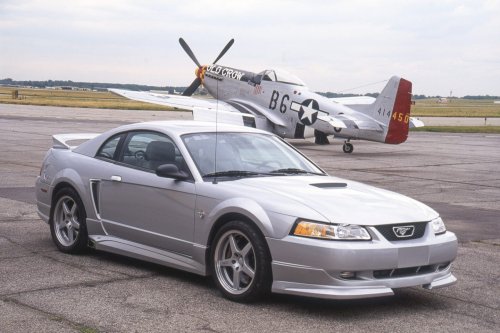
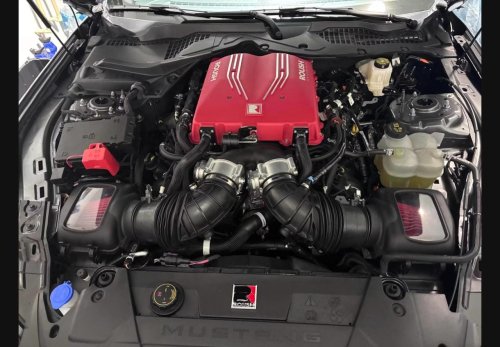
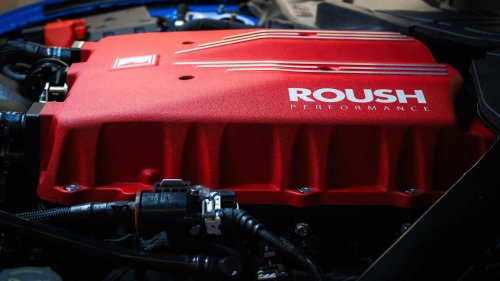
Roush Mustang vs P-51 Mustang Fighter PlaneAaron Kiley - Car and DriverFrom the November 1999 issue of Car and Driver."How about this? One has a top speed of 162 mph, the other 437," I said to senior tech editor Don Schroeder and photographer Aaron Kiley. "Or this? One's wing is 32 feet bigger than the other's. And, uh, both are silver.""Weak. Real weak," said Kiley.''Try again," urged Schroeder."Okay, there's this: One has a ground clearance of 6.5 inches, the other 41,900 feet."AdvertisementAdvertisementSchroeder shook his head, looking at me as if I were an abused orphan."Okay, okay. Let's just say, well, one has six machine guns, and the other doesn't seem to have any weapons at all," I blurted, hoping my colleagues would chime in with suggestions at the earliest opportunity.There was a protracted silence. Then Schroeder said: "Actually, John, we're working on a magazine, not a cartoon strip. Why not just tell readers, 'We did this for a good headline'?""See, he's onto something there," observed private pilot Kiley.Aaron Kiley - Car and DriverJack Roush—the 57-year-old owner of five Winson Cup teams, two Busch teams, two Craftsman Truck teams, and the builder of the Olds V-8 that won this year's Indy 500—also owns three airplanes.AdvertisementAdvertisementOne is a thoroughbred workhorse: a spanking-new Cessna 525 CitationJet. Roush bought this twin-engine, eight-passenger craft because it's fast, because it offers a 1600-mile range (''I made it from Las Vegas to Detroit without a stop," he says), and because it can be flown by a single pilot: him. He flies it every Tuesday from Detroit to his Winston Cup shops in Mooresville and Liberty, North Carolina—90 minutes each way. Then on Friday, he flies it to one of the 34 Cup races he'll attend this year, as far west as Sonoma, California, and as far east as Loudon, New Hampshire.Roush's second plane is a 1944 North American Aviation AT-6 trainer. He flies it only a couple of times a year. Mostly he likes looking at it.Aaron Kiley - Car and DriverBut his third aircraft comprises his first love: a North American Aviation P-51D interceptor/long-range escort fighter, a craft better known as a Mustang. Roush's version, built in 1944, is still fitted with its original Plexiglas canopy—rarer than a '66 Mustang convertible with original canvas. According to Roush's stipulation, the P-51 has been painted to resemble the "Old Crow" fighter that ace C.E. "Bud" Anderson flew in WWII, in support of bombing raids over Western Europe. This particular Mustang, however, never saw combat. It was a trainer in '44 and '45, then was sold to the Canadian military. Roush acquired it seven years ago.Upon delivery, the Mustang was airworthy, but, recalls Roush's administrative assistant, Brenda Stricklin, "It wasn't perfect, and Jack's a perfectionist."AdvertisementAdvertisement"I thought I'd just redo the engine," says Roush, "Then I thought, better do the hydraulics, too, and maybe the electrics, plus add some avionics, and . . . ""See?" interrupts Stricklin. "Everything."The restoration of this plane—an aircraft that, back in the '40s, cost only $44,000 to manufacture (plus $9000 for the engine)—required 10 months. As the P-51 now sits, it's worth $1.4 to $1.8 million, although "you can get a flyable Mustang in rough shape for as little as $800,000," Roush says. "That sum represents, what, two original Cobras? A P-51 is more fun than two Cobras. More fun than four Cobras."Aaron Kiley - Car and DriverThe Mustang is capable of flying at almost 42,000 feet—higher than commercial carriers—so Roush always wears an integral oxygen mask and warm Nomex flight suit. The P-51 cruises at 380 mph, and Roush has had it over 400, but on dive-bomb raids during the war, it could briefly achieve 505 mph—about 75 percent of the speed of sound. "My CitationJet cruises at 420, so they're not too different," he says. "What's more, the P-51 gets five miles per gallon and the jet only 3.8." With 250 gallons of 100-octane low-lead on-board, the Mustang can cruise nonstop from Detroit to Daytona in just under four hours. Roush annually flies the P-51 to only two other races: Charlotte and Talladega.AdvertisementAdvertisementThe plane's colorful livery echoes its colorful history. In Roush's care alone, it has been involved in two "incidents.""I burned a piston flying back to Detroit one time," he recalls. 'The engine didn't sound right. It was shaking. Then smoke came out. If there's one thing I know about engines, it's that they work fine until you let the smoke out." Roush made a successful emergency landing in Toledo, Ohio.Less successful was a landing in Oshkosh, Wisconsin, where the plane had been ferried by a pilot Roush hired. ''The right-side strut wouldn't deploy," he remembers, "so it got landed like that. Tore up the prop, damaged the right wing, tore off the bottom scoop and the flap. But I had it fixed in six weeks. These planes are so strong structurally that they're essentially unwreckable. Course, that's if you have spare parts."Aaron Kiley - Car and DriverRoush does. For starters, he owns 16 Rolls-Royce Merlin V-12 engines, four of which are ready to roar at any moment. "I know it sounds like overkill," confesses the Dynamo of Dynamometers, "but I feel like the keeper of the flame. Someone's got to keep track of these pieces. A lot of the engines were used in hydroplane racing and ended up on river bottoms. When I'm decrepit and gray, I'd like some other young man to take this plane and maintain it—hang on to the pieces I've collected." Originally assembled under license by Packard, each V-12 weighs just over a ton, despite an aluminum block. With a two-speed supercharger—and with Jack's custom-made roller rockers installed—the Roush-built V-12s produce "around 1500 horsepower," he says, "but guys who race them in Reno can get as much as 2500 to 3000 out of them." A Mustang at Reno once averaged 450 mph over the whole course.AdvertisementAdvertisementWhen his Mustang departs its hangar at Willow Run Airport in Ypsilanti, Michigan, Roush packs special tools, two spare magnetos, a voltage regulator, and a spare tire. If other parts are required, he isn't worried. Roush recently purchased a second Mustang—a P-51 2F, with two sets of controls—that he's restoring as well. The man is his own Mustang club.Roush has earned an airline transport pilot's license, the highest license available, and has a type rating for the CitationJet. The latter required an 11-day test in Wichita. "Eleven days with no racing," he says, shaking his head. "Almost killed me."Stricklin nods solemnly in assent.The P-51 is notoriously difficult to control. If full power is abruptly added while the plane is flying at low speed, for instance, the engine's torque can invert the craft quicker than some pilots can recover. To master such quirks and to acquire the lowest insurance rates, Roush attended a dedicated Mustang flight school in Florida. "Days and days and days in Mustangs, just practicing," he says. "So much time, in fact, it cost me more money than my first house. But that's okay. Pilots have a saying: Takeoffs are optional, but landings are mandatory."Aaron Kiley - Car and DriverEven after so much training, Roush admits to being fantastically nervous when he soloed in the P-51: "I remember handing my [straw] hat to someone. I said; 'Will you hold this? I might—I'm not sure, but I might—need it later.' "AdvertisementAdvertisementSince then, says Stricklin, flying has become Roush's lone hobby. "It's his therapy," she says. "He'll be at a race where they do badly and wreck everything, but when he's flying, he just zones out, totally calm. I don't know how it works."At Willow Run, Roush demonstrated the P-51's capabilities, pulling 4.40 g—just over half its potential—and making a near-full-power takeoff so that Schroeder could measure acceleration. As it turns out—at least up to 130 mph—the P-51 actually lags a couple of seconds behind the Roush Stage 3 Mustang (the other Mustang on hand for our amusement). But after that, as the automobile's thrust dwindles dramatically, the P-51 continues to gather velocity at an almost perfectly linear rate. At 200 mph, both Roush and the Mustang had become a seagull-size speck on our horizon, and the cargo jets that had intentionally delayed their takeoffs in order to watch had finally queued up again for business.Aaron Kiley - Car and DriverThere is, of course, another Mustang in this story—the only one that Jack let us take home. Like every Roush-branded product, this one also flies, but usually atop asphalt only, unless you've just consumed a vast quantity of Smirnoff. Roush Performance Automotive Group (RPAG) in Livonia, Michigan, builds Stage 3 Mustangs that civilians can purchase in one of two ways. You can drop off your existing Mustang GT at Roush's shop, along with a check for $17,000, then wait two weeks for the finished product. Or for a lump sum of $39,000, you can have RPAG purchase a brand-new Mustang onto which it will graft the go-fast parts before the car ever muddies its hooves on city streets.The add-ons are many, including SVO cylinder heads and a Roots-type supercharger, a one-two punch good for 335 hp—75 horses beyond the stock GT's muscle. The suspension is enlivened by beefier anti-roll bars, new rear control arms, Bilstein shocks and struts, and stiffer springs. Nearly treadless 18-inch BFG gForce T/A tires are mounted on handsome nine-inch-wide wheels. The stock brakes are replaced with six-piston Baer/Alcons grabbing 14-inch cross-drilled rotors. The exterior benefits from aggressive front and rear fascias, side exhausts, and an almost-aircraft-size spoiler. The front seats are restuffed so that their bolsters are more aggressive. And, of course, there are those 19 Roush badges and logos in the event that a minor head injury prevents you from recalling what manner of Mustang you're driving.AdvertisementAdvertisementOn our test car, all the aftermarket pieces, and the painted surfaces in particular, were flawlessly finished. "It looks macho and obviously modified, without pandering to 19-year-olds," notes Schroeder, "although the side exhausts come close."Aaron Kiley - Car and DriverWhat you first notice about driving the Stage 3 is that it's loud. Half of the cylinders' byproducts are expelled only a couple of feet south of your left earlobe, and on freeway slogs, the basso-buffo drone can annoy. What you notice next is that the ride is borderline harsh and that the steering is somewhat nervous and susceptible to bump steer.What you won't notice is the supercharger. Neither whine nor wheeze intrudes, and the power delivery is seamlessly fluid all the way to 6000 rpm. In fact, peak torque resides at a low 3800 rpm.On the skidpad, the Roush Mustang makes the most of its race-bred underpinnings, logging a colossal 0.94 g. That's 0.06 g beyond what an independent-rear-suspension SVT Cobra can achieve. What's more, if you exceed this pony's lateral limits, the front end simply dissolves into major understeer—a surprising trait from a Mustang but one that won't kill you.Aaron Kiley - Car and DriverThe engine upgrades work as advertised, too, delivering a tire-smoking 0-to-60 shot of 4.9 seconds (0.6 second quicker than a stock Mustang GT) and a quarter-mile blast of 13.5 seconds at 106 mph (0.7 second and 8 mph better than the GT, and while we're making comparisons, 0.3 second and 2 mph better than a Chevrolet Camaro Z28). Perhaps predictably, the Stage 3's drag-strip prowess proved almost identical to our supercharged Mustang GT project car's (C/D, July 1999), whose pieces Roush coincidentally also built and installed for $4694. The only notable difference is top speed—162 mph for the Stage 3 vs. the project car's 155 mph.AdvertisementAdvertisementThe Roush Mustang disappoints only in braking. Its 181-foot stop from 70 mph means it's merely a few feet superior to the last two Cobras we tested. The huge Baer/Alcons—which reliably cause parts geeks to faint with envy—ought surely slow more emphatically than that. Roush is investigating.Aaron Kiley - Car and DriverRoush is also investigating the details of a one-year warranty. Given our project Mustang's mechanical setbacks, we can tell you that those details are worth studying.Every editor who drove this Mustang walked away smiling, if a little deaf. Be aware, however, that with its razor-sharp reflexes and flinty ride, this is a hard-core sports car that is happier hustling at nine-tenths than it is on laid-back commutes. It is—forgive us—a P-51 among Mustangs, a pony car unique in styling, performance, and, well, price. Explaining 40 large worth of Mustang to your spouse may take some inventive gum flapping. While you're at it, you might also solicit another $1.4 million to buy a slightly used second Mustang. The one that really flies.You Might Also LikeGift Guide: Best Ride-On Electric Cars for KidsFuture Cars Worth Waiting For: 2025–2029