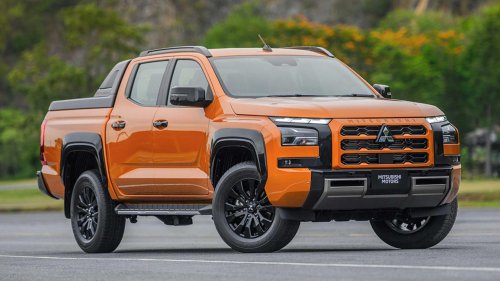

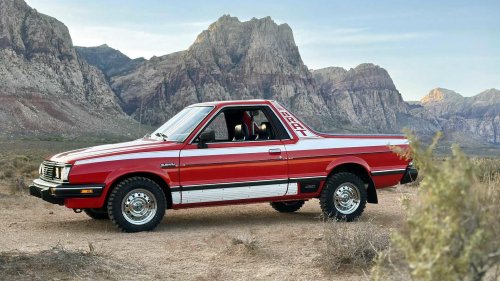
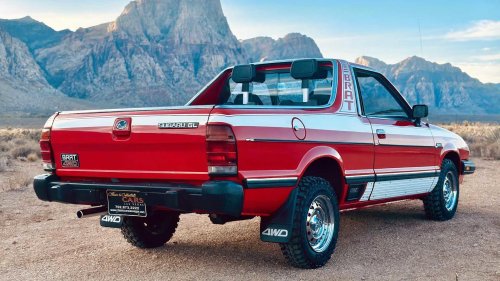
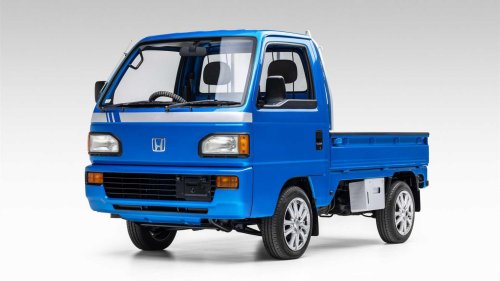
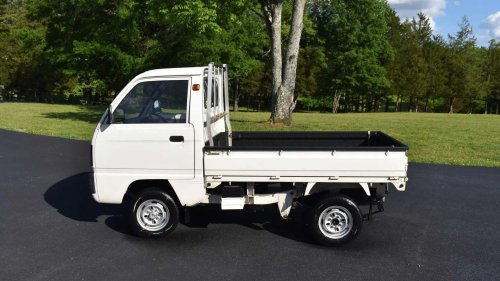
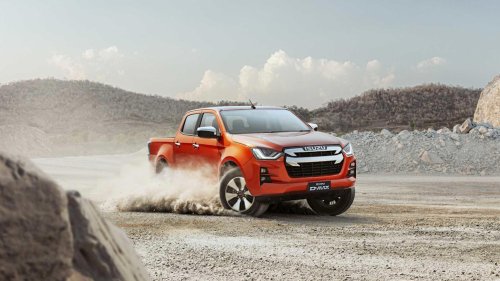
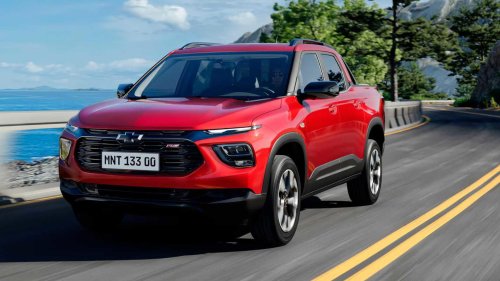




















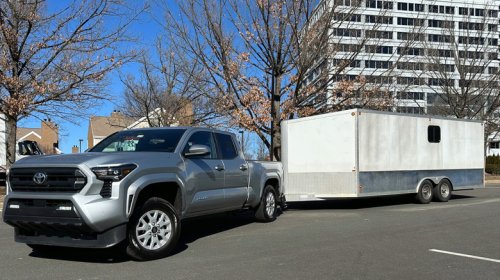




What do chickens and pickup trucks have in common? No, this isn’t the setup to a joke, it’s a genuine question. The answer is, more than you think — largely thanks to wartime rationing, the transatlantic trade war, and Lyndon B. Johnson.The history of how the pickup truck market came to be affected by what is humorously referred to as the “Chicken Tax” is a fascinating one. This tax is the reason why pickup trucks built abroad are a rare sight on American roads, and many models that are highly popular elsewhere never made it to the States. It has been shaping the automotive market for six decades now; here is how it came to be. Cluck, Cluck: What Actually Is The Chicken Tax? Mitsubishi The idea that chicken could have ever been anything but a staple might seem bizarre to most modern Americans, who are used to eating chicken multiple times a week on average. However, before World War II, beef was a far more common type of meat, and chicken was considered an alternative kind of protein. During and immediately after the war, however, things changed as beef had to be rationed in order to feed soldiers. American chicken farmers seized a major opportunity for growth; they didn’t just start to sell chicken locally in larger numbers, but they also exported plenty to the European market.In an effort to protect their own farmers, several European nations (including France and West Germany) fought back by imposing tariffs on US-imported chicken. This led to a sharp drop in export sales for American farmers; by the early '60s, sales of US chicken in Europe had dropped by nearly a quarter, which led to growing international tension.Around the same time as the diplomatic fight over chicken was going on, a similar but diametrically opposed scenario was playing out in a very different industry: not the agricultural one, but the automotive one. This time, the issue revolved around European goods being imported to the States, rather than the other way round. European automakers such as Volkswagen had become highly popular in the US, with models such as the Beetle and Type 2 becoming ubiquitous on American roads. Sales of European models were so high that the Union of Auto Workers (UAW) banded with automakers to lobby President Johnson, as well as threatening to go on strike due to the growing threat.INEOS At the start of 1964, President Johnson signed an executive order that offered a solution to both problems. The order imposed a 25% tax on a range of imported foreign goods, including potato starch, brandy, and “light duty” (under 10,000 pounds) pickup trucks and vans. Since the definition of “light duty” was based on gross vehicle weight, most trucks built in Europe and Japan, which are typically lighter and smaller, were affected by the tax. As prices rose dramatically almost overnight, sales of Volkswagen models and other imported vehicles dropped sharply.In a single move, President Johnson responded to the European nations that had taxed US chicken, as well as appeasing the UAW and reducing the number of imported trucks on the road.The tax on pickup trucks is one of the main parts of this executive order that is still in force today, continuing to affect the way the American automotive market looks. Today, only one automaker chooses to sell a truck built abroad in the States: Ineos, with the Grenadier Quartermaster. This luxury pickup is currently the only model that has to pay the Chicken Tax, which, combined with more recently imposed tariffs, inflated its price tag by around 10% last year. How Automakers Get Around The Chicken Tax Bring A Trailer For as long as the Chicken Tax has existed, automakers have been looking for ways to get around it. In many cases over the years, they have been successful in this endeavor, managing to get foreign trucks into the States through various loopholes and creative tactics.Some of these solutions involve splitting up the assembly process of the vehicle between the country of origin and the US. For nearly two decades after the introduction of the Chicken Tax, the chassis cab workaround was a popular method of getting around it. This essentially consisted of importing partially assembled trucks without a bed (known as chassis cabs) and then installing the bed in the US. This reduced the import tax to a mere 4%. However, the loophole was eventually shut down in 1980. Importing knock-down kits was another option that operated on similar principles. The Mercedes Sprinter van, for example, was partially disassembled before being imported to the US, and then reassembled in a local factory as the Freightliner.Other solutions involved disguising a cargo van as a passenger vehicle, installing seats before the import process and removing them afterward. Ford and Ram both attempted this approach, the former with the Transit Connect and the latter with the ProMaster City. Ford simply removed the seats once the vehicles arrived in the States, while Ram also made the passenger version available to customers. However, Ford’s scheme was eventually shut down.Bring A Trailer One of the most famous examples of automakers getting creative to avoid the Chicken Tax is the Subaru Brat. This funky pickup truck had a bed fitted with carpeting and two plastic “jump seats”, complete with grab handles to avoid getting thrown out of the vehicle when hitting a bump in the road. It may have been a safety nightmare, but it was enough to pass off the Brat as a “passenger car”, thus circumventing the Chicken Tax. One Interesting Way American Farmers Avoid The Chicken Tax: Importing Old Kei Trucks Bring A TrailerThe Chicken Tax only applies to new vehicles. Old pickup trucks (well, older than 25 years) can be imported, although they come with their own set of expenses and challenges. In the American agricultural world, importing a vintage kei truck has become a popular way of owning a foreign pickup, with all the advantages this type of truck has to offer.Bring a Trailer Kei trucks are compact, agile, have surprisingly large hauling and towing capacity for their size, and offer great fuel economy. Older models come with very few frills such as advanced comfort or safety features. All these features make them ideal workhorses. They can handle narrow paths and rough terrain without protesting, and can squeeze themselves into spaces most American trucks would struggle with. As a result, many farmers choose to import old kei trucks, as they don’t really have an equivalent type of vehicle on the US market.As Japanese automakers have been producing kei trucks for decades, even excluding all models built after 2001 leaves you with a wide range of options. Some of the kei truck models most frequently spotted on American farms include the Toyota Acty and the Suzuki Carry.Due to their nature, however, these vehicles typically have some legal limitations placed on them. They can usually only achieve a top speed between 50 and 80 mph, and are almost completely devoid of modern safety features, which means in most states they’re only allowed on private property. Some states, such as Texas, have a ban on kei trucks with a specific exception for agricultural use. Others, such as Louisiana and Alabama, allow kei trucks but prohibit their owners from driving them on highways. Some Cool Trucks The US Missed Out On Because Of The Chicken Tax Isuzu The Chicken Tax has made the American pickup truck market more insular, with most foreign models being shut out due to high costs that would inevitably have to be passed on to the consumer. As a result, there are several interesting models from all over the world that simply never made it to US shores, but still have plenty of fascinating characteristics. Let’s take a closer look at three of them.Isuzu D-Max: The D-Max was released in 2002, and is currently in its third generation. Initially a compact pickup truck during its first two generations, it grew in size for its current generation, a mid-size pickup truck. Despite having never been sold in the US, the D-Max previously had a link with the American car market: its second generation was a sister model to the Chevrolet Colorado. That arrangement, however, came to an end with the arrival of the current generation in 2019.Mitsubishi Triton: A mid-size truck, the Triton has been around for nearly half a century, having been introduced in 1978. It is currently in its sixth generation, which hit the market in 2023. Sporting an aggressive, rugged design and a comfortable, plush interior, the Triton would fit right in on the American market if it weren’t for that pesky Chicken Tax.ChevroletChevrolet Montana:The Montana compact pickup was first introduced in 2003, and is currently in its third generation. The first two generations were coupe utility trucks based on the Opel Corsa, while the current one is a compact pickup truck. Built in Brazil, the Montana is powered by a three-cylinder engine, paired with either a six-speed manual or a six-speed automatic transmission.