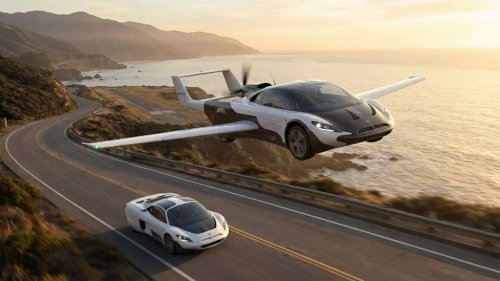
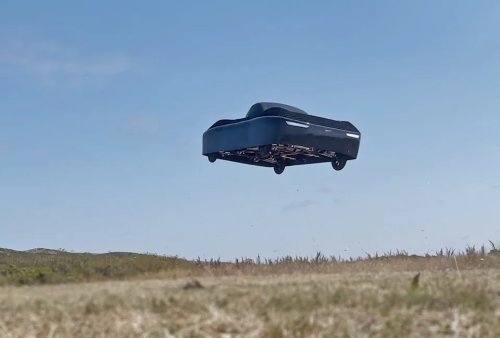
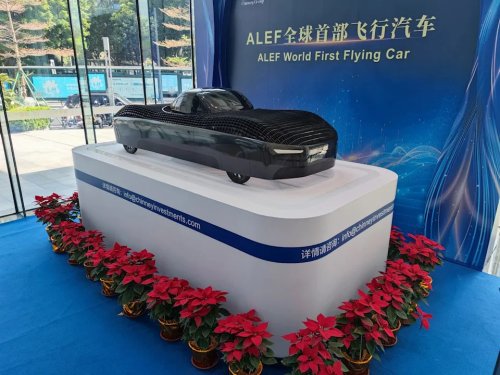
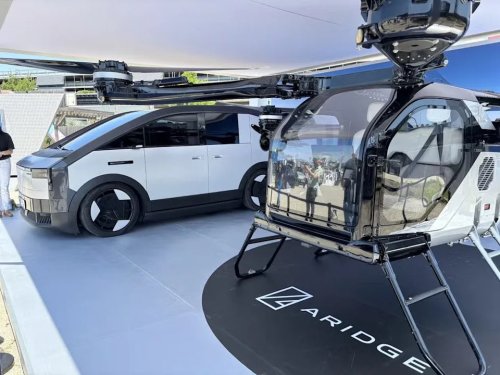
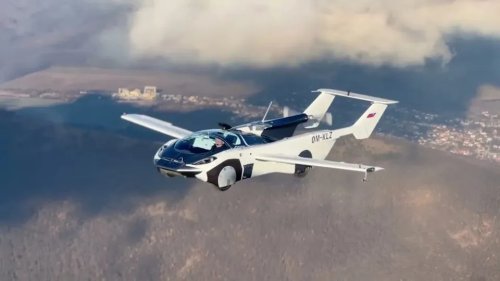
We Were Promised Flying Cars. They’re Finally Almost Here. Really.AutoweekJim MotavalliWed, September 16, 2026 at 5:48 PM UTCAdd us on GoogleWe Were Promised Flying Cars. They're Almost Here.Klein VisionVenture capitalist Peter Thiel famously said, "We were promised flying cars, but all we got is 140 characters," referring to the length of a tweet. It's true that big industrial companies like General Electric started seeing themselves as "digital" innovators tied in to the "Internet of Things," and stopped delivering hardware with heart-stopping technical breakthroughs. And Ford started seeing its business as delivering transportation via online demand, rather than offering cutting-edge vehicles.But nonetheless, flying cars are finally coming. Really. One American company is in limited pre-production with an ultra-light, and a Chinese competitor plans to deliver an actual fully certified model as early as next year. We're slowly moving past the "Apex receives interim conditional temporary certification to fly at 10-foot altitudes over Boise" press-release stage. But despite plenty of development (and history going back to the 1950s), it's still very early days for the flying car.Alef Aeronautics Model AAlef Aeronautics is currently fielding a limited-production ultra-light version of its forthcoming $300,000 Model A. This is what it looks like before taking off…Alef AeronauticsAlef Aeronautics was founded in 2015, and is based in San Mateo, California. It went into actual limited production late last year with its 250-pound Model Zero Ultralight, a vertical takeoff and landing (VTOL) air-ground craft that can be controlled by a pilot or remotely. The Model Zero has received an FAA Special Airworthiness Certification granted to experimental craft.AdvertisementAdvertisementJim Dukhovny, CEO of Alef, told Autoweek, "Alef is the first flying car in history according to the traditional definition of a drivable car capable of vertical takeoff. Right now, the first vehicle intended for customer delivery is in production. Alef is preparing an existing facility for the production of 100 vehicles and has signed agreements toward larger-scale mass production."Dukhovny said the current limited-edition model "conforms to the FAA's ultra-light category requirements, which do not require separate certification or a pilot's license to operate but do restrict its use." The rollout is limited to "a few early customers," primarily to see how the flying car works in the real world.… and after lift-off.Alef AeronauticsUltra-lights have plenty of restrictions. They can be used only for recreational or sport flying, must weigh less than 254 pounds if powered, and are limited to one seat. Oh, and they can't go faster than 63 mph.So don't think Alef has an imminent glide path to full deployment of a general-purpose flying car. That will take longer, since airworthiness, type, and production certification are all needed. After the ultra-light, Alef plans the full certified rollout of the hand-built, $300,000 Model A, for general customers in the recently revised Light Sport Aircraft (LSA) class. Dukhovny says it "will begin replacing traditional cars in rural areas with limited connecting infrastructure and challenging terrain, such as mountains and bodies of water." The Model A has a driving range of 200 miles and 110 miles in flight.AdvertisementAdvertisementThe one- or two-seat Model A never actually looks like a plane; even in the air, it resembles a Jetsons-type bubble-topped luxury sedan that somehow can actually take off into the wild blue yonder. This flying car doesn't need a runway. Once it's taken off vertically, its chassis rotates and the front and rear of the vehicle form wings. The cabin is on gimbals so it stays level.Under current LSA rules, sport planes can be used at night, have up to four seats with no weight limit, and a maximum clean stall speed of 59 knots (67 mph).The Alef Model A on display in China last year.VCG - Getty ImagesOn the ground, Alef had initially planned to license the vehicle (with four hub motors) as a low-speed vehicle (LSV), restricted to 25 mph on public roads. But Alef says its now abandoned that plan, and the flying cars, in all their configurations, will be Specially Constructed Vehicles (SPCNS), without the 25-mph restriction. SPCNS is used for kit cars, dune buggies, homemade trailers, and other such road-goers. Full certification for public roads and skies remains pending. There are more than 3,000 reservations for the Model A.Here's are some other flying cars, in various stages of development:Xpeng Land Aircraft Carrier (LAC)Also priced around $300,000, this entry from Chinese automaker Xpeng was recently shown at a company showcase in Munich, Germany. The LAC is a modular flying car, resembling a muscular, six-wheel minivan. The two-seat electric VTOL aircraft, made of lightweight carbon fiber, is housed in the back of the vehicle. It detaches, and takes off in a five-minute process, initiated with a single button push.The Xpeng Land Aircraft Carrier carries a VTOL in the back.Jim MotavalliThe LAC itself, with some autonomous capability, can travel more than 600 miles on a battery charge, but the aircraft is meant for short hops of 12 miles or less. It charges via the "mothership." In Munich, Tan Wang, co-founder of the Xpeng subsidiary Aridge that will actually build the LAC, said that the company is planning to start producing the outlandish vehicle as early as next year, with sales initially limited to China but possible expanding to the Middle East. Xpeng claims 7,000 orders, mostly in China, and a dedicated factory has been built in Guangzhou.Samson Sky SwitchbladeThis is a longer-term project, but the Oregon-based company said September 14 it had secured a $80 million investment from Dubai-based Matin Group to build the Switchblade. Samson said it needs another $20 million to start production.The Samson Sky Switchblade project just got an $80 million investment. More is needed.Samson SkyThe two-seat Switchblade is planned as a hybrid flying car "that delivers sports car performance on the ground and high-performance capability in the air," the company said. It's designed to run on premium auto fuel, will fit in a standard garage, and "can be driven on highways or local roads to any nearby airport." To fly, the wings swing out and the tail extends. We're also told that "all flying surfaces remain fully enclosed while in driving mode," and that the Switchblade "transitions from driving to flying configuration in three minutes at the push of a button."AdvertisementAdvertisementOn the ground, the Switchblade is a fairly ungainly bullet-nosed three-wheeled car with deeply sculpted aerodynamic sides. In the air, it can reach 190 mph and fly at 13,000 feet. Prices are estimated at $200,000 for a version that can fly in good weather only, and $235,000 for a version that can handle a variety of different conditions.Klein Vision AirCarThis entry is from a Slovakian startup, which has been working on the AirCar for something like 30 years. An air worthiness certificate was obtained in 2022, and by 2025 the AirCar had made 500 takeoffs and landings and had 170 flight hours.The Klein Vision AirCar has impressive specs.Klein VisionLike the Samson Switchblade, the AirCar deploys its wings and tail quickly, in about 90 seconds. With a 280-horsepower engine, it has a heady ground speed of 124 mph, and a cruising speed of 155, with a 620-mile range in the air. Its maximum altitude is 10,000 feet.Market availability was supposed to be 2026, but that's not likely to happen. Initial production is said to be sold out. The target price is $800,000 to $1 million. This one isn't a VTOL, and needs a runway. And the operator needs a pilot's license.AdvertisementAdvertisementThere's also an American AirCar, with plans to start selling a VTOL in 2027. It claims $25 million via 260 "deposit-backed pre-orders" and "1,000+ manned test flights across 10 prototypes." The AirCar can stay in the air for 40 minutes, and has a $99,000 price. But this AirCar can't hit the highway, just the skyway.Other flying cars in development include the PAL-V Liberty gyroplane, with five-minute transformation from car to aircraft and up to 310 miles of range, and the AeroMobil, with under-three-minute car-to-plane times and a reported "350,000 hours of design, development and testing."


















 +65 others