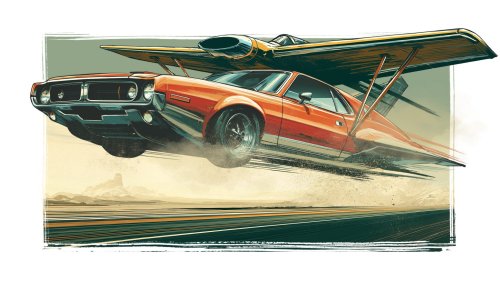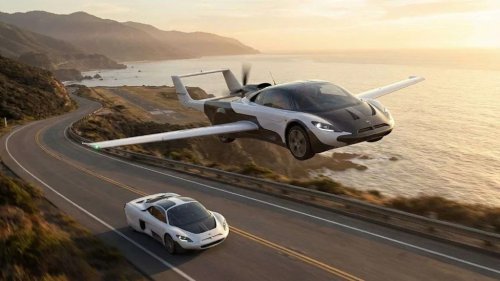
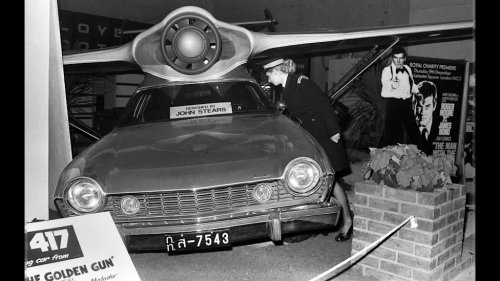
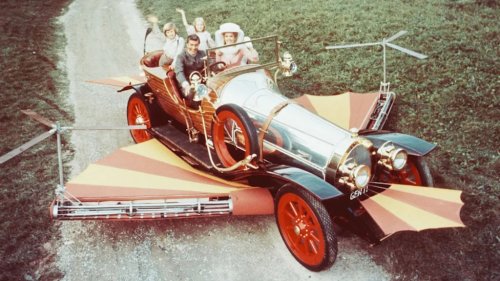
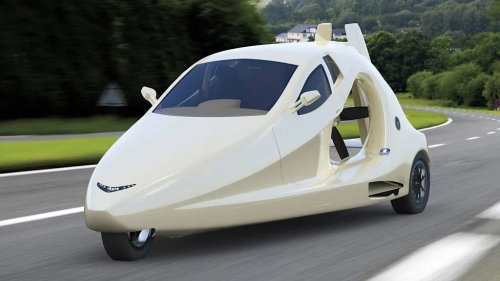
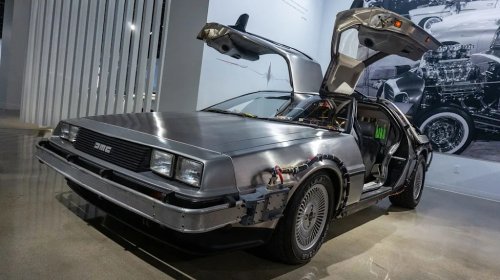
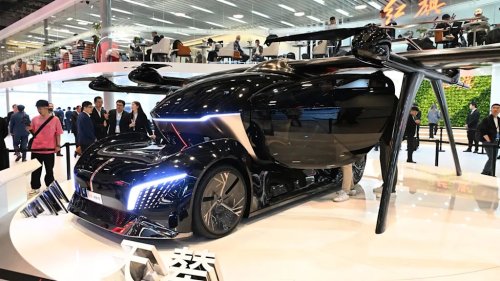
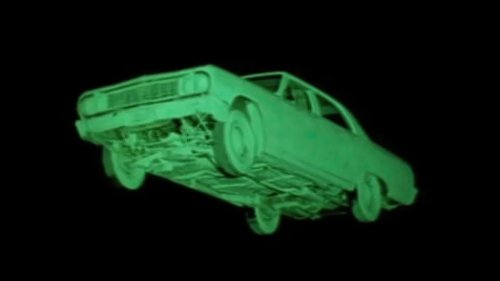
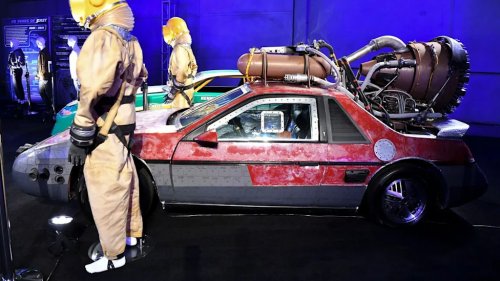



















Hollywood Flying Cars, Reality-CheckedRyan Lugo - MotorTrendDon't look now, but the Department of Transportation just announced a new pilot project designed in part to push air taxi adoption and vertical takeoff and landing cargo capability across 26 states. It's called the Advanced Air Mobility and Electric Vertical Takeoff and Landing Integration Pilot Program (whew!), and it's got all of us asking: Does this mean we're finally getting flying cars?Flying cars have long been the standard joke for anyone skeptical about the future of automotive technology, and while the real world sadly lags behind fantasy, Hollywood has been all too willing to indulge in the people's passion for cars that can soar. To celebrate the news that flying cars are now one step closer to crowding our skies, we put together this look at the most memorable movies that delivered on the promise of going up, up, and away to beat the traffic—and how close to actual flying car tech each of those examples truly is.Getty ImagesThe Man With the Golden GunThe James Bond franchise must have been on a bit of a budget crunch in 1974, because nearly all of the hero cars in that year's The Man With the Golden Gun hailed from the American Motors Corporation. This included the getaway ride of big bad Scaramanga, who slips behind the wheel of an AMC Matador coupe and takes to the skies after attaching an enormous set of wings and a jet engine to the vehicle while hiding out in a hanger.AdvertisementAdvertisementHow Does It Work? Scaramanga's Matador is a pretty basic setup—wings for lift and a turbine for thrust—but it's worth noting that the setup can be added and removed as needed. To this end, there are big struts linking the wings to the rocker panels (though no heat shields between the jet engine and the cabin). It's a clip-on design that measured an astounding 42 feet wide on set, and although it didn't actually fly, it was realistic enough to require a crew members keep a close eye on it when it was windy outside (as the AMC had a tendency to lift itself off the ground).Is There Modern Flying Car Tech Like This? This type of flying car is perhaps best represented by the "planes that can drive" segment of the industry, which is one of the earliest forms of commercially available auto-fliers. Perhaps the most famous is the Aerocar, a vehicle that went on sale in the early 1950s and bears a striking resemblance to Scaramanga's escape machine, albeit with a much more developed tail. Most important, the Aerocar's wings and fuselage could be removed when not needed for flight, making it a near-direct analog for the Bond model (and certainly an inspiration for the prop).Less successful but hailing from the same era as the Matador was the AVE Mizar, a prototype "flying Pinto" that integrated a set of detachable wings and a pusher prop (borrowed from a Cessna Skymaster) onto the body of Ford's ill-fated econocar. The Mizar saw some of the Pinto's bad luck rub off on it when the inventors were killed during a crash in the prototype phase.Getty ImagesChitty Chitty Bang BangChitty Chitty Bang Bang, the movie, is named after Chitty Chitty Bang Bang, the car, which is owned by protagonist Caractacus Potts. An inventor by trade, Potts transforms a wrecked race car (in reality a completely custom design put together by a production designer and a sculptor) into a vehicle filled with more gadgets than you'd find in a certain franchise's Aston Martin offerings, including the ability to fly. In a fun bit of synchronicity, the book Chitty Chitty Bang Bang was based on was written by none other than James Bond creator Ian Fleming.AdvertisementAdvertisementHow Does It Work? Chitty Chitty Bang Bang's capacity for flight comes into play when the car is driven off a cliff with Potts' entire family inside. Potts, driver now turned pilot, expands a set of wings from the sides of the car, with a tiny propeller at the rear keeping things moving forward.Is There Modern Flying Car Tech Like This? While the idea of a hand-made, open-top classic car that can fly might seem far-fetched, you might be surprised to find out that Chitty Chitty's retractable wings and propeller setup of yesteryear actually represent the fine point of flying car technology today.Getty ImagesVehicles like the Samson Sky Switchblade, for example, incorporate exactly these features, albeit in a much smaller (and three-wheeled) package. Marketed as a sports car that can also do 200 mph in the sky, the Switchblade is currently sold as an Experimental plane, in terms of its FAA classification, but one that can be driven with either a car or bike license when not in flight.MotorTrendBlade Runner/Total Recall/Back to the FutureAhh, the hover-car. While all of the above machinery requires some type of traditional runway to take to the skies, the real dream of any flying car enthusiast is the ability to hit a button, levitate above the gridlocked traffic surrounding them, and zip off into the wild blue yonder.AdvertisementAdvertisementHollywood has fed into this fantasy more than once. Perhaps the most grounded examples are the "Blade Runner franchise, which were wheeled rigs that could crawl along the trash-strewn alleys of future megalopolises or climb above them like some kind of ungainly albatross. More recently, there is also the flying DeLorean from the Back to the Future series, as well as the hovering police vehicles from the 2012 remake of Total Recall.How Does It Work? The method of locomotion when viewing futuristic hover cars is almost always kept vague or gussied up with some kind of technobabble. Repulsor lifts, some type of downward-pointing turbine, anti-gravity—it doesn't really matter most of the time because let's be honest, one of these franchises is about time travel and another is about androids, and we don't have either of those technologies solved, either.Getty ImagesIs There Modern Flying Car Tech Like This? Vertical takeoff and landing (VTOL) is the holy grail for flying car companies, and as such it's no surprise that there are more competitors vying for this kind of skybound commute than in any other area of the industry. In particular, there's a fair amount of crossover between the VTOL crowd and electric aviation, which aims to build battery-powered flying machines, or eVTOLs.The trouble is, most mainstream automakers attached to these kinds of projects are focusing on the "air taxi" aspect and less on making a dual-purpose drive/fly model. Toyota, Suzuki, Hyundai, BMW, and Honda are all involved in eVTOL development, but none of these can truly be called cars. Instead, you have to look at smaller players like Pal-V (which builds a road-ready gyrocopter trike), and Aska (producers of a helicopter with four wheels) to get close to this kind of special effect.Repo ManRepo Man/FlubberSometimes, a movie makes an enormous leap (and we're not just talking about the bus jump in Speed) that requires you to suspend every shred of logic and just go with the flow of the plot. There are more than a few flying cars on the silver screen that fit under this heading, but we're going to go with two of the most egregious: the vehicles in Flubber and Repo Man.AdvertisementAdvertisementHow Does It Work? Don't look for any scientific explanation for either of these flights of fancy. In Flubber, Robin Williams' character invents a mysterious green goo that just, well, lets his Thunderbird slip the surly bonds of Earth. In Repo Man, there's a dead alien in the trunk of a Chevrolet Malibu that turns it into a radioactive, glowing green sky chariot that ascends into the heavens (and leads us into the end credits).Is There Modern Flying Car Tech Like This? Look, if it were possible to drop some goo in a bucket of algae and then spray it all over a classic Malibu, then we'd all be sky-faring billionaires many times over.Getty ImagesFast and the Furious 9You might be thinking, "surely there's no more ridiculous flying car concept than the two movies above." As it turns out, there isn't—but there's one more entry on this list of the Hollywood flight club that is still absolutely absurd but just barely skates past "aliens in the trunk" on the plausibility scale. We're referring, of course, to the Pontiac Fiero that achieves low Earth orbit in the ninth installment of the Fast and the Furious series.How Does It Work? Introduced with a giant rocket strapped to the back of its cargo deck, the Fiero explodes at the end of its first scene—a nice callback to the fire-related woes that beset the car when it was merely trying to tackle daily commute. Later, a vastly more powerful version of that same propulsion system sends the Pontiac into space after piggy-backing on a transport plane for the initial assist out of the planet's gravity well.AdvertisementAdvertisementIs There Modern Flying Car Tech Like This? While Tesla has actually launched a Roadster into space on one of its sister company SpaceX's Falcon rockets and made bizarre claims that a new version of the drop top will be offered with a rocket-equipped "SpaceX package," the latter is more likely a play to launch the company's stock price rather than let you cosplay as Tej and Roman. That being said, rockets are a lot more real world than anything Robin Williams invented back in the '90s.