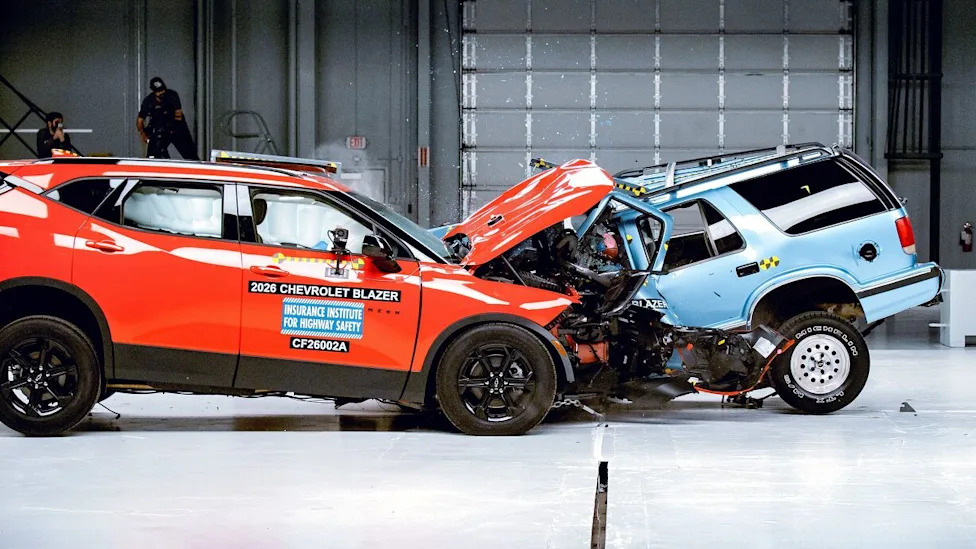



















watch 1996 chevy blazer obliterated by 2026 model in brutal crashIf you still encounter folks online claiming that older cars were "built like tanks" and inherently safer than modern "plastic tin cans," do them a favor: send them this video.To celebrate the 30th anniversary of its vehicle safety ratings program, the Insurance Institute for Highway Safety (IIHS) orchestrated a spectacular, head-to-head collision that visually maps three decades of structural engineering. The institute pitted a pristine 1996 Chevrolet Blazer against a brand-new 2026 Chevrolet Blazer in a 40-mph moderate overlap frontal crash.The footage is a violent, physics-driven reality check.Frame-by-Frame: Structural Integrity vs. Total CollapseWhen you watch the slow-motion footage, pay close attention to the behavior of the two passenger cabins at the exact moment of impact.AdvertisementAdvertisementThe 2026 Blazer (Right): Notice how the impact energy is intentionally routed around the cabin. The front bumper and engine bay crumple systematically, acting as a giant shock absorber. The windshield pillar (A-pillar) remains completely straight. The driver's door frame doesn't buckle, ensuring that the survival space inside stays completely uncompromised.The 1996 Blazer (Left): The old body-on-frame SUV suffers an immediate, catastrophic structural failure. Because 1990s steel lacked the high-strength tensile properties of modern alloys, the crash energy completely bypasses the front clip and basic crumple zones, transferring directly into the cabin. The floorpan buckles, pushing the dashboard, firewall, and steering column backward and upward directly into the driver dummy's lap.The Decapitation FactorThe most shocking moment in the video occurs during the interior cabin angles of the 1996 Blazer. Because the steering wheel is driven violently into the driver's space, the timing and geometry of the late-90s airbag deployment go completely awry.The fully inflating airbag strikes the dummy squarely under the chin rather than cushioning the chest and face. The kinetic force snaps the dummy's head backward and toward the window with such extreme velocity that the mechanical nodding joint in the dummy's upper neck completely shears off, detaching the head from the body.AdvertisementAdvertisementWhile IIHS engineers notes that a human neck handles these specific forces differently than an aluminum test mechanism, the underlying data is clear: a human driver in the 1996 model would have faced catastrophic, unsurvivable injuries to the head, neck, and lower limbs. Meanwhile, the dummy in the 2026 Blazer recorded data indicating the driver would walk away with minor bumps, bruises, and an intact body.This video isn't just automotive theater; it's a visible validation of the safety regulations and consumer-driven testing metrics that have quietly saved nearly 50,000 lives over the last thirty years.