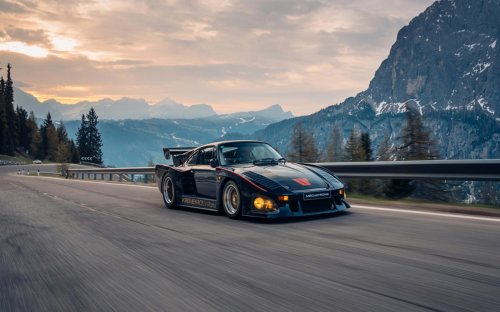
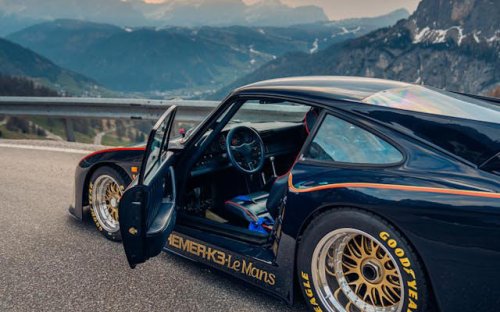
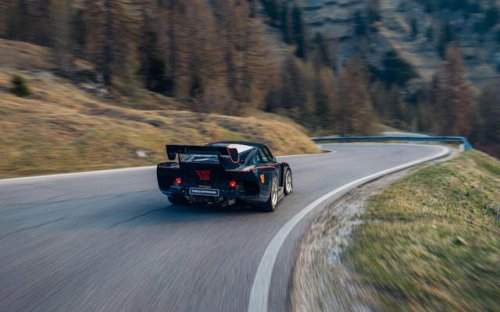
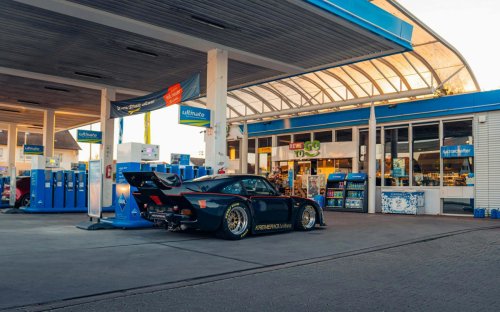
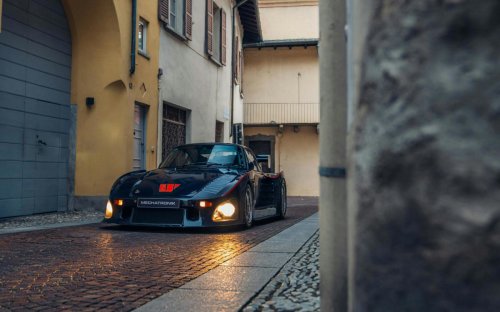
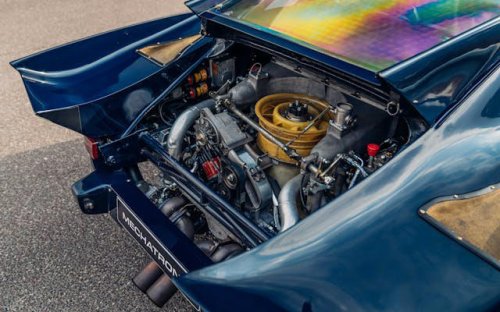
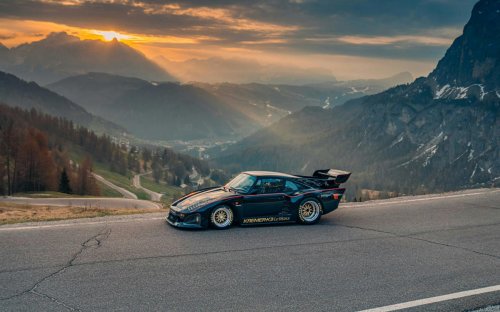
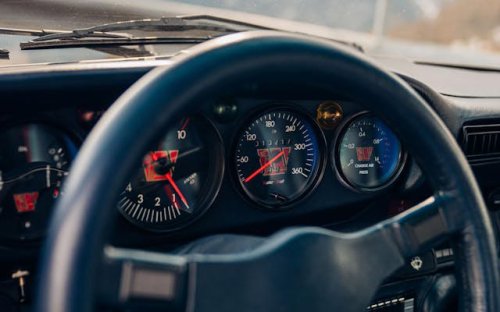
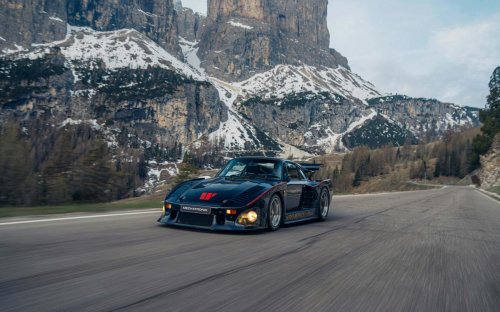
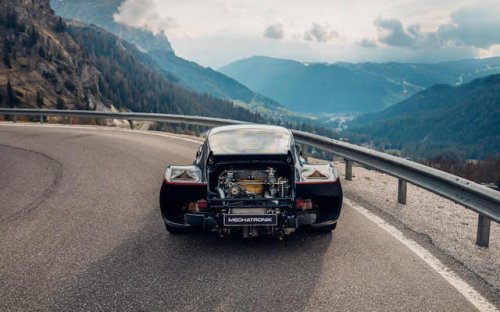
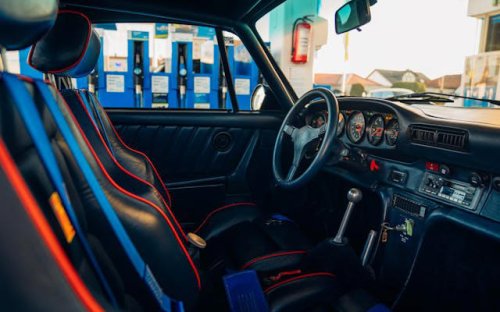
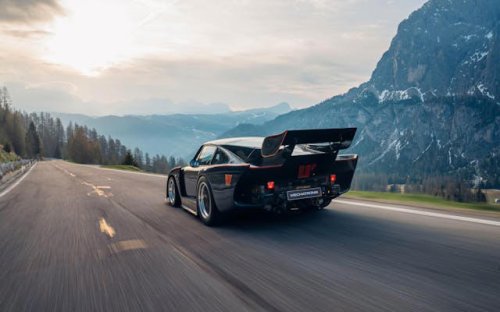

















Walter Wolf’s 220-MPH Kremer 935-K3 Takes to the Road Again Picture yourself atop a rocky crag in Italy’s Dolomite mountains, the setting sun dropping below the clouds to bathe the scenery in a golden warmth. Below you, serpentine tarmac slithers down the steep slope in looping hairpins, a playground not unlike the opening scene of The Italian Job. Despite a light breeze, it’s quiet—but then the silence is split by the whip-crack of a flat-six engine firing to life with instantaneous fury. Far below you, a leviathan stirs again, after decades having lain dormant. Walter Wolf’s Kremer K3 lives again. Throughout the 1980s and beyond, Ferrari and Porsche brawled over the definition of the ultimate supercar. Porsche’s take was the 959; fast in the dry, fast in the wet, fast if you wanted to drive it through the desert past the pyramids, and in 1986, it achieved a top speed of 197 mph. For Ferrari, it was the F40, as raw as carpaccio, unforgiving in the extreme. In 1987, the F40 hit 201 mph, the first production car to break the 200-mph barrier. Scalpel or shotgun—choose your weapon. But even as schoolyards rang with an argument that still echos today, the ultimate road-going supercar question had already been answered… And the man with that answer was Erwin Kremer. Together with his brother Manfred, Erwin had built a reputation for racing Porsches of the highest caliber. In 1979, one of the brothers’ 935-K3s had won the 24 Hours of Le Mans outright, with a Kremer Racing 935 also sitting in third place. Rounding out the podium that year was American Dick Barbour’s team, also in a 935, which had attracted plenty of attention for having actor Paul Newman behind the wheel as one of its three drivers. Later that year, the Kremer brothers received an unusual request, possibly the most lunatic thing they’d ever been asked to do: Would it be possible to take that Le Mans–winning provenance and create a road car out of it? It wouldn’t be easy, but it wasn’t just anyone asking, and the Kremers set to work. Upon completion, Erwin Kremer steered the only 935-K3 Strasse ever built onto the autobahn, where he promptly hit 220 mph. Imagine being in the right lane driving a diesel Golf when this thing went past at speed. Commissioning this kind of project required deep pockets, but it was also a matter of reputation. Kremer Racing was used to working with motorsports teams, with specific demands and requirements. Building a road car was something else entirely. However, the man with the request was Walter Wolf, who deserves a bit of an introduction. In 1979, Wolf was running his own F1 team for the third year in a row, having hired on James Hunt as a driver. The team had its most successful season in 1977, with driver Jody Scheckter winning in Argentina, Monaco, and at the end of the season in Canada. Wolf Racing ran just a single car, but with a little more luck in the tail end of that year’s season, the team might well have pulled off a memorable underdog championship victory. The money funding this effort came from oil speculation, but Wolf’s fortune had been built from nothing. After living as a child in abject poverty in postwar Slovenia, he moved to Montreal, began working as a diver on oil rigs, and eventually hit it big as the oil crises of the 1970s spiked prices. He was neighbors and friends with Gilles Villeneuve in the south of France, proudly displayed Canada’s Maple Leaf flag on the rear wing of his F1 cars, and once won a 512 BB on a handshake bet with Enzo Ferrari on the outcome of the Monaco Grand Prix. Somebody with a life this interesting doesn’t pilot a diesel Golf in the right lane, and among Wolf’s lasting legacy is the series of prototype Countaches he commissioned. All three still exist, two of them located in Japan, the first of which is the very first Countach to get that signature wing. With V-12s hand-built by Giampaolo Dallara, these Lambos were each very special, and Wolf wanted something equally wild to follow them up. To prepare the K3 for the street, the Kremers raised the suspension to 10 cm of clearance versus 5 cm for the racing cars. The Bilstein dampers also had slightly different tuning. As for the bodywork, that was all Le Mans–style K3 with the addition of indicator lamps and reflectors as per legal road requirements. Erwin Kremer called his creation 98% identical to the Le Mans–winning 935-K3, and this car’s monstrously turbocharged flat-six engine is proof. Displacing roughly 3.0 liters (Le Mans rules spec would be 2.85L, but Kremer’s internal records don’t list a specific figure), it is twin-turbocharged to a staggering 740 horsepower, with a curb weight of less than 2600 pounds. To create a somewhat luxurious experience, much of the interior of a contemporary 930 was added, including leather seats and air conditioning, although this last was really only for the driver. Wolf also had a high-end stereo fitted, including a dash-mounted equalizer with a bewildering array of options. The final bill for all this was the equivalent of $3.7M today. Still, Wolf got his money’s worth, and he put more than 6000 miles of incredibly high-speed driving on the odometer during his ownership. Considering he also had his pilot’s license and often flew his helicopter places, that’s plenty. Perhaps most amusingly, in order to get the car plated for the street, he leaned on his Canadian contacts and obtained Alberta license plate DJD 639, even though the car was largely driven between the South of France and Germany. On these autobahn blasts, Wolf would run the K3 to such speeds that the specially hand-shaved Goodyear racing wet-spec tires would wear out on the rear. He solved this problem by having an extra set flown ahead of him on a small plane so they could be changed before a return run. By 1986, the K3’s road license had expired, and by then Wolf was driving a Procar-spec BMW M1 road car and a Ferrari 288 GTO, among other interesting cars. The following year, he agreed to sell the 935 to former Le Mans racer Angelo Pallavicini, an avid collector who put it on display in his Swiss museum. For nearly 40 years, the Wolf K3 didn’t see the road again. The gauges, along with parts of the bodywork, are adorned with the stylized W of Wolf’s racing endeavors. Alex Penfold/Mechatronik All that changed a couple of years ago, when the car returned to Kremer Racing for a complete overhaul and refresh. The work took nearly two years to complete, cost around $175,000, and focused on trying to preserve the car’s incredible originality, while bringing it back from dormancy. To emphasize its return, German supercar specialist dealer Mechatronik didn’t trailer the Wolf K3 the 300 miles from their showroom in Pleidelsheim to display at Lake Como for the concours earlier this month. Mechatronik’s Linus Otto drove it. Up and over the Dolomites, out in the world, 740 hp of Le Mans–winning ferocity unleashed on the world once again. “Everything is very heavy, as in clutch, accelerator, brakes, and steering,” Otto told Hagerty. “Combined with a short bite point and needing a certain way to get going takes some getting used to, but feels natural once you do it a few times and know how to do it. After three days of driving the K3, I almost stomped the clutch pedal of my daily driver through the floor, because I instinctively used the same force necessary for the K3 clutch on a normal car. “The engine is extremely loud, and the sound mix of engine, turbos, and pops and bangs is addictive, never making you want to stop accelerating. While the noise shakes everything around the car, on the inside it does not hurt the ears, thanks to the low and voluminous tone and the road-car interior with some sound isolation. “The interior itself feels comfortable, and apart from some racing features mostly familiar from normal 911s of that era, [it even has] electric-powered windows and comfortable seats. Visibility out the front and sides is as good as in a normal 911, with the rear view being obstructed from the massive wing. “The K3 will take you to emotional highs you did not know exist. All this paired with an incredible history make it one of the most desirable cars—and particularly Porsches—in existence.” It’s worth here taking a brief sidebar about the other 935 Strasse in existence, as it is so hugely different as to underline just what makes the Wolf K3 so special. Commissioned by Tag Heuer founder Mansour Ojjeh, this car was completed by Porsche’s Sonderwunsch division, infusing a standard 930 with the looks of a 935. It can be thought of as an evolution of the flachbau (flat-nose) cars, but with a 3.3-liter flat-six making 375 hp, it is half as potent as the K3. Walter Wolf didn’t petition the Kremers to turn a road car into a race car, he asked them to do the reverse. As the only such 935-K3 to have been built, it offers a truly one-of-one uniqueness, and the performance levels are ridiculous even by today’s standards. Best of all, it is no longer a museum piece. Wolf rarely kept cars around as investments. He bought them to drive, and he did so with purpose. Today, his Le Mans–spec K3 Strasse stands ready again to take to the road, to bounce its thunder off the mountains. Who dares take the wheel?