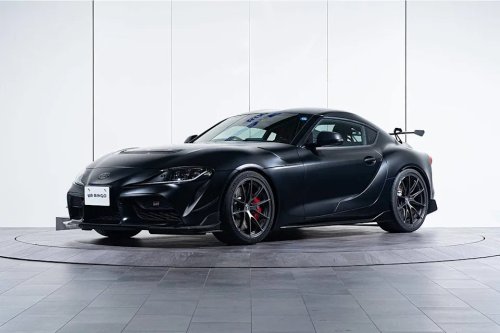
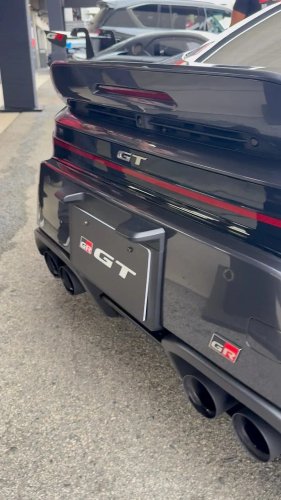
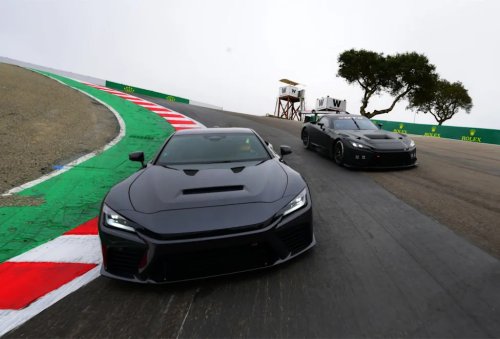
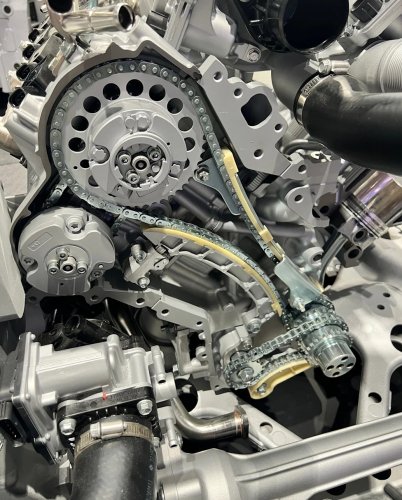
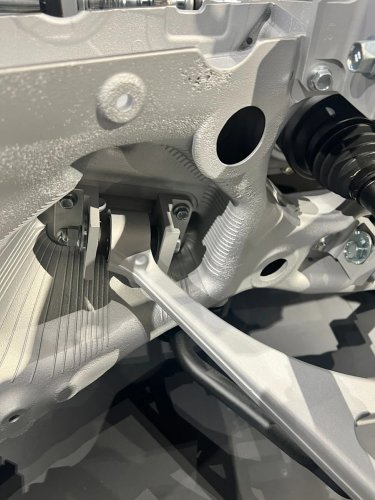
Toyota GR GT Spills More Secrets in MontereytoyotaIt's been just over seven months since Toyota revealed the GR GT, its upcoming sports car designed with an almost singular purpose of winning races in its GR GT3 form. Few details have trickled out since our initial look during the official unveiling, however, so a press briefing at WeatherTech Raceway Laguna Seca during the Rolex Monterey Historics at Monterey Car Week gave us a chance to dive a little deeper on the powertrain and structure.First, a look at the static model of the complete car. In person, the GR GT looks more impressive than the photos convey. The hood seems impossibly long, the sides seem incredibly flat. It's all in service to the race car's aerodynamics, as the silhouette is almost identical between the road and competition versions. Toyota's representatives say 80 percent of the GT3 version of the car is shared with the road car, meaning that it's much more than just a silhouette racer.toyotaIn terms of the aerodynamics, not having to add wider fenders in front or rear minimizes the turbulence, reducing drag. There's also a fun detail at the back of the car, where a par of tabs above the license plate bracket stick out suspiciously far. The reason is, FIA rules state the rear wing can be mounted at the rearmost part of the bodywork; in this case, the GR GT3 can use these extra few inches to mount its wing further back, increasing the lever arm of the applied downforce.Fred SmithThe specifics of where each inlet and vent flow into the car has yet to be divulged, but the intake and mesh vents on the hood are fitting nod to similar elements on the Lexus LFA, as is the stylized intake atop the rear fenders. Even the outer door latch, a flush panel that pivots inward, mirrors that of Toyota's last supercar.AdvertisementAdvertisementIt's no secret that the GR GT borrows the layout and orientation of the Mercedes-AMG GT3, with the engine mounted aft of the front axle line and a transaxle hanging off the back. This, again, is with the GR GT3 in mind, because a long wheelbase with mass at both ends makes for stable, predictable handling. (Which is a benefit when many GT3-based series feature classes with amateur racers.) The long hood is also handy for creating smooth airflow over the rest of the body.The most shocking part of the powertrain, however, is that it is entirely rigid from the crankshaft to the axle shafts, with no bushings or universal joints in between. Power goes directly from the flywheel to the carbon-fiber drive shaft (which is encased in a carbon-fiber torque tube that features flat sides for added stiffness), into the wet-plate clutch pack at the front end of the transmission, and through the gears. At the rear of the transmission, the helical gears are cut such that the output shaft is canted at a two-degree angle, just enough to clear the sides of the gearbox and route forward to the mechanical limited-slip differential inside the bellhousing without need for a universal joint. In practice, that means both the GR GT and GT3 should be incredibly responsive.One other interesting feature in the gearbox is a small gear-driven oil pump tucked in near the differential. Its location means that it turns in direct portion to rear wheel speed, instead of using a shared circuit with other components.toyotaThe hybrid motor, with its own clutch pack, sits at the front of the transmission with the wet plate clutch. This serves as the starter and alternator, and provides power to the accessories such as power steering and air conditioning. It also moves the GR GT backwards when requested, by spinning in reverse with first gear engaged; there is no traditional reverse ratio in the gearbox. And, perhaps most importantly, is the role the electric motor plays in damping engine vibrations and facilitating faster shifts.AdvertisementAdvertisementAt the briefing, a Toyota representative stated that the 40 horsepower of the hybrid engine is "less than five percent of the total power," which is a giveaway that the stated 641 horsepower of the engine will increase, most likely as higher-performance variants throughout the car's lifecycle. (40 horsepower is more than 6 percent of the current number; 5 percent would mean 800 hp or more.) There's also a clue in the engine's designation of G40E, which designates it as part of the same family as the G16E three-cylinder in the GR Corolla and GR Yaris and the G20E teased in the mid-engine GR Yaris M Concept and likely to power an upcoming mid-engine sports car: those smaller engines in the G family are capable of at least 100 hp per cylinder.Mike AustinMoving back to the engine, Toyota's goals were to mount the motor low and rearward, so the lack of an accessory drive (it's powered by the hybrid system) helps keep the length to a minimum, and a dry sump oil system allows for low mounting. The oil circuit features large hoses attached to the humongous oil reservoir tucked behind the front passenger wheel, and a pair of IHI turbochargers feeding 16 pounds of boost into the 4.0-liter V-8 sit atop the vee. The relatively long timing chains visible in the chassis cutaway suggest that the engine will not be as free-revving as the 8000-plus rpm engines employed by Chevrolet, Ferrari, Lamborghini, and Porsche in the respective road-going version of their GT3 cars, but if the aforementioned power upgrades come true, the GR GT should have a respectable weight-to-power ratio compared to its competitors.And finally, the chassis. Toyota uses four extremely large castings—one at each corner—to mount both the suspension and powertrain, continuing the theme of structural rigidity from the engine and transmission, with the suspension mounts designed to shear off and keep the castings intact. The suspension setup itself is fairly conventional, with double wishbones in front and rear with extra later links in the rear. The coilover springs have an adjustable perch, presumably so that owners can adjust the ride height and overall rake to suit their preferences or home track.Mike AustinThe GR GT3 race car will show up Stateside in IMSA sometime after the start of the 2027 season, with GR GT deliveries likely starting towards the end of next year. We're still left waiting for more details, but from a technical standpoint, the GR GT continues to look as promising as its small luggage compartment looks impractical.You Might Also LikeIf You Can Only Own One Car, Make It One of TheseThese Are the Most Popular Cars by State





















 +63 others