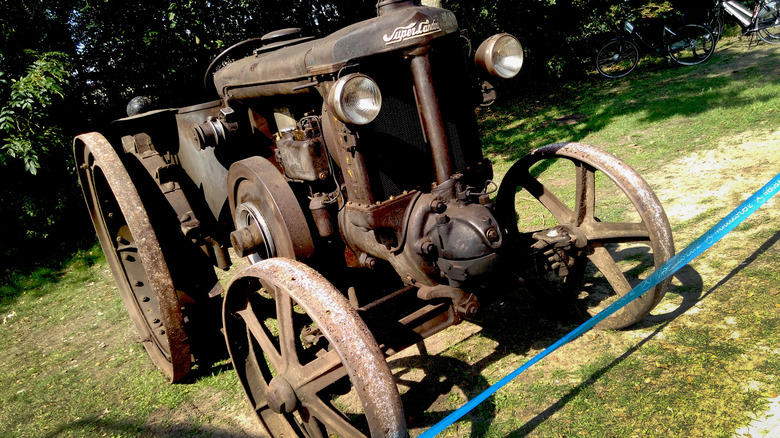
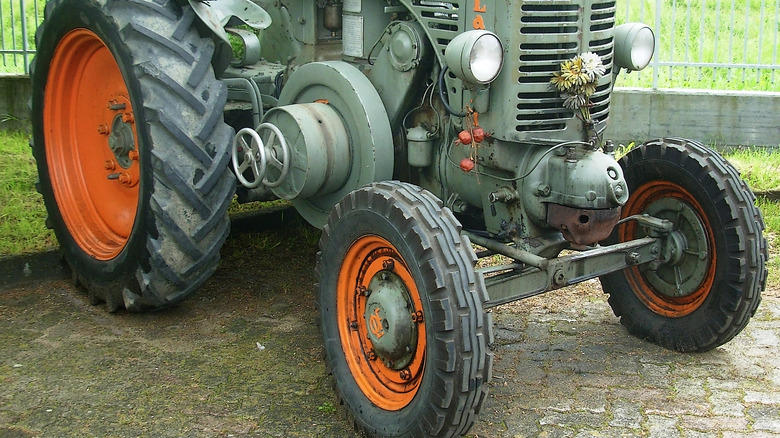
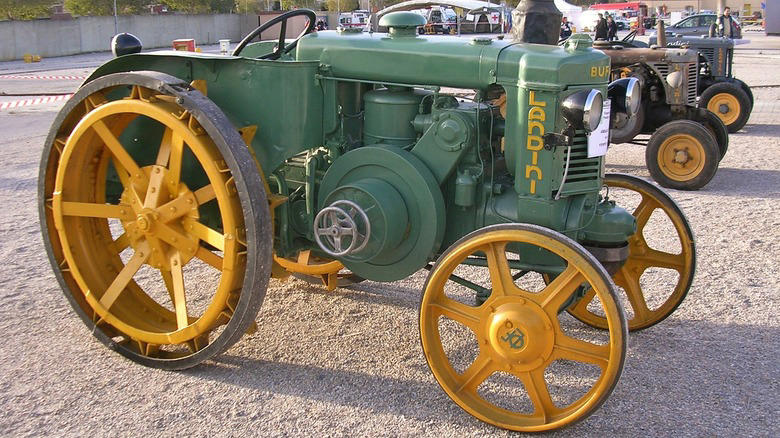
A SuperLandini hot-bulb tractor parked in a field behind a blue boundaryWe've all heard a lumpy V-8 idle brutishly at 650 RPM. It's a great sound, but that's practically Iron Maiden's "The Trooper" compared to some lazy, low-rev single-cylinder tractor engines. We're not talking about 400 or 500 RPM, mind you. We're talking about an engine that can idle at zero revs. You read that right. This old-school agricultural mill operates in such a way that it can idle without completing a full rotation even once. Well, technically.It's the handiwork of Italian inventor and businessman Giovanni Landini, a man with his sights set on making agrarian life easier through invention and innovation. And though time and technology left this "hot-bulb" engine in the rearview, the crude, albeit awesome application was an interesting chapter in early 1900s agricultural machinery. Sure, a goose egg for idle speed is one thing. But wait until you hear how you start this thing. It easily earns its place among the strangest engines ever built. A Landini 'hot-bulb' engine can technically run at zero RPMA Landini L45 Testacalda hot-bulb tractor parked at a showIn traditional single-cylinder tractors like the SuperLandini SL 50, the hot-bulb mill served as a simple means to run agricultural equipment on crude fuel like kerosene. Despite the weird name, the basic componentry is pretty familiar: A controlled combustion process moves a piston (a pretty big one at that) inside of a cylinder, and that motion drives a crankshaft. Sounds like your typical internal combustion process, right? Not quite.In a hot-bulb engine like that of a classic Landini tractor, the combustion process takes place in a chamber, or bulb, hanging off the front of the motor. A metal plate inside the bulb provides a hot surface for fuel to vaporize, interact with the air, and combust. The byproduct gases of that combustion would then travel down a short path and drive the piston inside the cylinder walls. Presto, you've got the sort of early-century mechanical magic that produced as much as 30 horsepower prior to 1925.Here's the thing, though: some hot-bulb tractors could idle without completing a single revolution. Due to its two-stroke design, the engine can let fuel into the bulb to allow combustion to happen before hitting top-dead-center. That means the crankshaft can rock back and forth rather than completing a trip around. So, technically, the Landini tractor can run at zero revs.That said, the starting procedure was nowhere near as simple as using a hand crank or thumbing an electric start. An operator would need to heat the bulb, often with a blow torch, for minutes on end. After it was warm and toasty enough, someone would spin the huge flywheel on the side of the engine until the engine kicked on and start idling. Not the only hot-bulb tractor engineA green and yellow Landini hot-bulb tractor parked in a row at a classic tractor showIt's a mind-blowing design. A hot-bulb sending gases to a single, massive piston isn't exactly the sort of tractor technology you'll find in a Landini showroom today. It's certainly a far cry from the diesel-powered tractors Ford made for decades. But the Italian agricultural equipment builder wasn't the only name in hot-bulb engine-powered tractors. The German-built Lanz Bulldog, for instance, also made use of a hot-bulb engine, though the later Lanz tractors displaced roughly 630 cubic inches to the SuperLandini's massive 745 cubes.Like the Landini, the Bulldog could technically run at zero RPM by rocking its crankshaft back and forth without making a full revolution. Better yet, energy of the huge piston, crankshaft, and flywheel moving has a tendency to shake the entire tractor rhythmically, making a 74-year-old tractor look like it's dancing. Look out, that single-cylinder old-timer is about to get down! Even automakers like Porsche made lovely little tractors, but nothing quite as strange as the torquey Italian with the ability to run at zero revolutions. Want more like this? Join the Jalopnik newsletter to get the latest auto news sent straight to your inbox, and add us as a preferred search source on Google.



















 +31 others