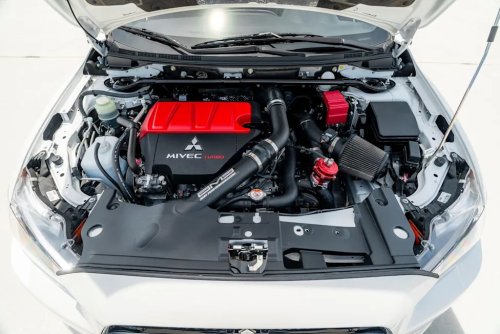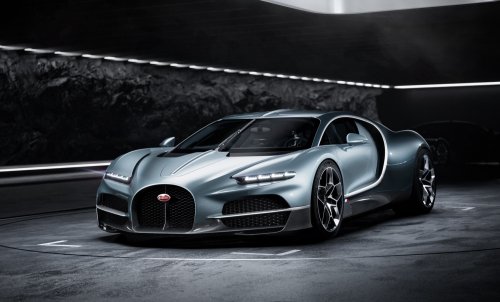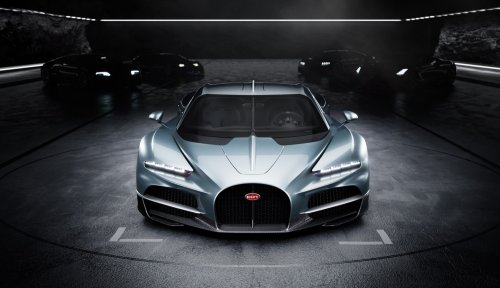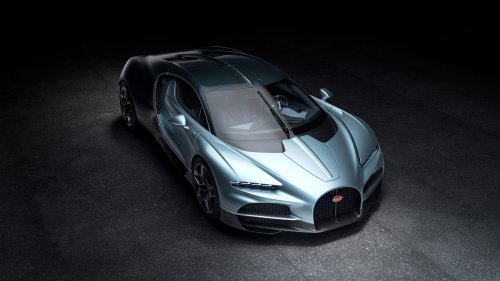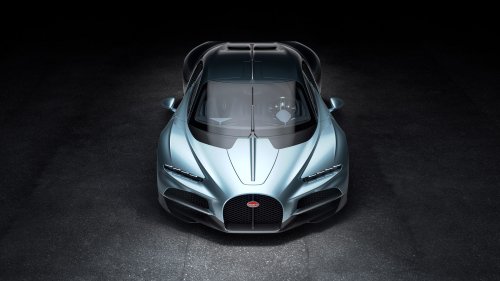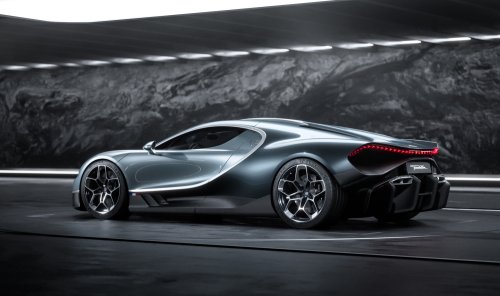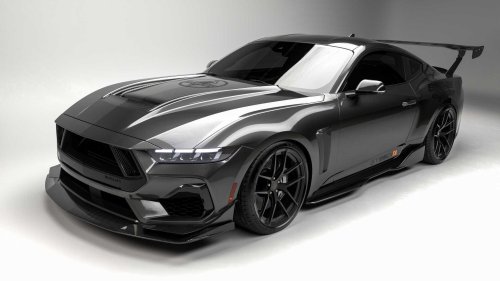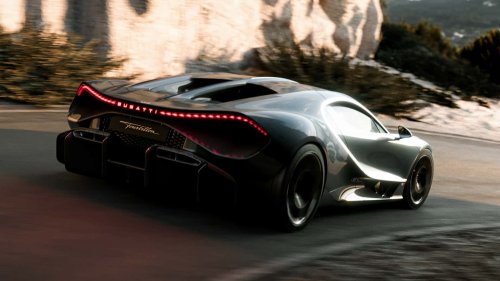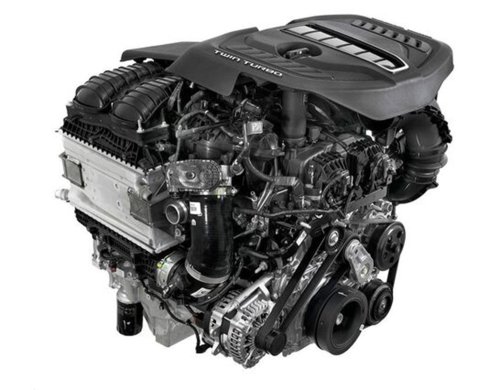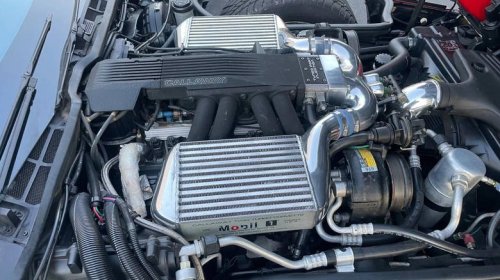
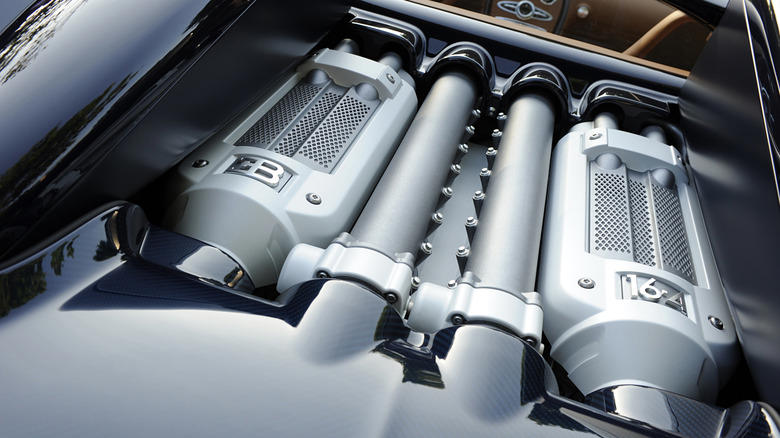
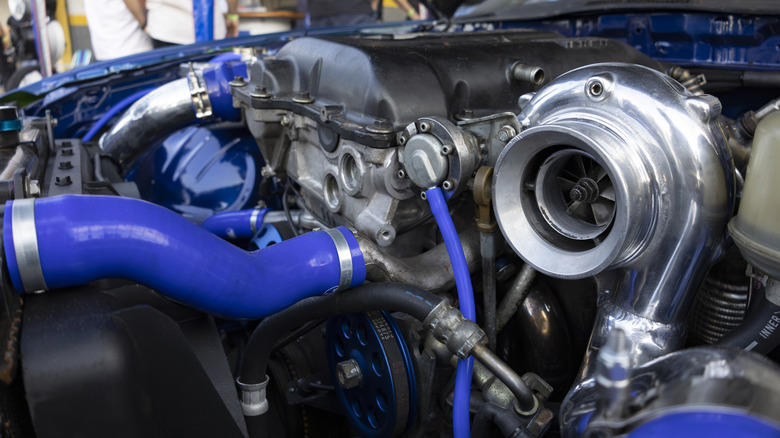



















Eight-turbo Mustang doing a burnoutOne of the greatest human inventions of all time is the exhaust-driven turbine supercharger, colloquially known as the turbocharger, or turbo. When one of these bad boys starts winding up, you know you're in for either a fast ride or an epic explosion. And if one turbo is good, surely more is better, right? But how many more can you put on a car before it's just too many? It seems like just about every gas and diesel vehicle on the market today features a turbocharged engine. There are plenty of twin-turbocharged engines out there, too (lots of pickup trucks and SUVs use twin-turbo V6 engines these days), and Bugatti even made four turbos make sense back in the 1990s. When twin-turbocharged engines are run in parallel rather than sequentially, you're getting a bit of a compromise that still works better than a single turbocharger. By running two turbos on a V8 engine, let's say, each turbo will be spun up by its own bank of four cylinders. This allows you to use smaller turbochargers, which spool quicker on launch, while providing a larger quantity of compressed air at a given RPM. More boost and more power without the massive boost pressure threshold delay of a single big turbo. What if you want to do more than that, though? Three- to five-cylinder engines typically don't need more than one turbocharger. Engines using between six and 12 cylinders can usually make do with a pair of turbochargers. Anything 12 cylinders or above can be engineered to use four, but that isn't necessarily required to make big power.There isn't really a number at which you could stop adding turbochargers to an engine. With a wild enough imagination and a large enough bank account, you could theoretically build compound turbo setups that feed each other basically infinitely. There is definitely a point at which additional turbochargers won't make additional power, though. With lots of dyno time, a huge budget, and good fabrication skills, you could find out that number for your own application, but I don't recommend going that route. How many turbos is just right?Bugatti quad-turbo engineIt's important to talk about what a turbocharger is and how it works. Each turbo has an exhaust turbine that captures energy from the flow of exhaust gases, and a compressor wheel that pressurizes ambient air before pushing it into your engine. Compressed air makes the combustion force in the cylinder more powerful. The more exhaust flow you have, the faster the turbine spins, necessitating the turbocharger spool up before delivering boost. The short version of that technical story is that a turbocharger helps your engine make more power.There are way too many variables to really dumb it down to a few simple sentences, but the general rule of thumb is that a smaller turbocharger will spool faster and run out of steam at higher RPM ranges, while a larger turbocharger will make more power, but takes a lot longer to provide initial power. Back in the good old days, some cars like Porsche's 959 and Toyota's MkIV Supra used sequential turbochargers with a small turbo for off-the line acceleration feeding into a larger turbo for higher-RPM boost. These days OEMs can have the best of both worlds with variable geometry turbocharger housings that grow as boost buildsBugatti famously used four turbochargers for its EB110 V12 and later for the Veyron 16.4. Like in the above twin-turbo V8 analogy, Bugatti employed smaller turbochargers to make more power without feeding all of the exhaust pressure and spinning the turbines faster. With these large multi-cylinder engines, multiple turbochargers can be used without much downside. It would make a lot less sense to use four turbochargers, say, on a four-cylinder engine, or eight turbochargers on an eight-cylinder engine. So what's the right number of turbos?Turbocharged engineThese days, the efficiency of a turbocharger has improved so much from when they were introduced to road cars in the 1960s, that you could easily use a single turbocharger on a larger engine, particularly with electric turbocharger pre-spooling for low-RPM driving, like they have used in Formula One or like Porsche uses in its newest 911 GTS. The Mustang example built by Boosted Lifestyle in the video above is definitely not working to maximize turbine efficiency or power. It makes big power, sure, but sometimes less is more. In this case, each of the eight turbochargers is fed by a single cylinder's exhaust gases, which requires each to be quite small in order to actually build boost.Perhaps adding more turbos is a method to improve off-the-line acceleration for something like a 1/8th-mile car, but the aerodynamic drag, increased heat, massive cost, build effort, and inefficiency make it a dubious proposition at best. A properly-sized single- or twin-turbo setup would likely prove better in just about every way. Oh, and you'd be able to see where you're going.Or, you know, you only live once, so why not build a quad-turbo four-cylinder for your Honda S2000 and tell us how it went. Maybe you'll figure something out that the OEM engineers never could, because you're a smart fella. It's really up to you; the world is your oyster. If you think you need a Ram with 17 turbines spinning up boost for your Cummins, go for it. Want more like this? Join the Jalopnik newsletter to get the latest auto news sent straight to your inbox, and add us as a preferred search source on Google.