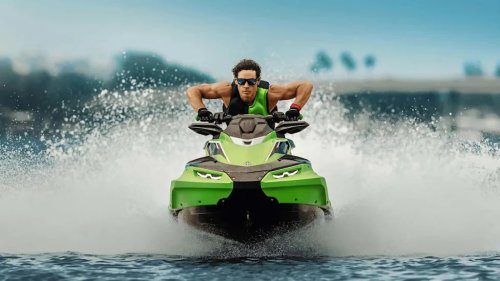
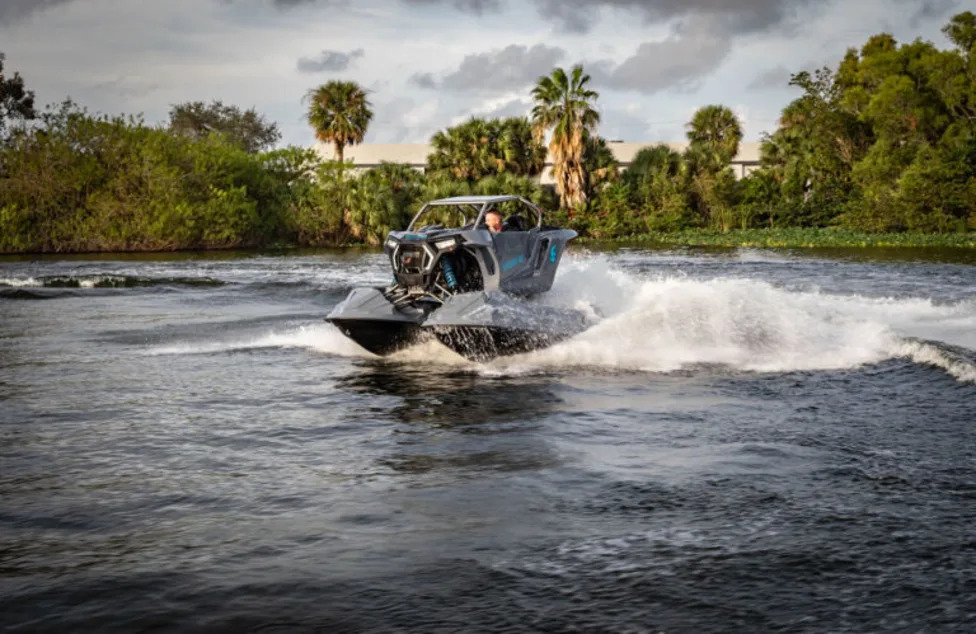
This $250,000 Watercraft Is Part UTV, Part Jet Ski — and Has 800 HPRyan Goldberg had a simple enough idea: take a Polaris RZR and a pair of Yamaha WaveRunners and combine them into one machine. Everyone he told thought it was a terrible idea. Eight years later, his company Shadow Six Racing is selling the result for $250,399 – and has more than 250 reservations already waiting.Shadow Six Racing has branded its creation the Typhoon, positioning it under a self-coined classification: the Aquatic Utility Vehicle, or AUV – a designation the company calls a world first, though whether that label represents a genuine new powersport category or simply savvy marketing remains to be seen. It looks, at a glance, like someone bolted a side-by-side cab onto a catamaran made of jet skis.The reality underneath is considerably more engineered than that. Beneath the carbon composite twin hulls, each reinforced for durability, sits a dedicated 1.8-liter supercharged Yamaha GP1800R SVHO engine putting out 250 hp, while the overall structure is built around a tubular titanium frame fitted with Polaris bodywork. That's 500 hp in the base configuration. Buyers can spec Stage 1, 2, or 3 Riva Racing performance packages before delivery, pushing output toward 700 hp or, per the video making rounds online, "over 800 horsepower" with the full Stage 3 setup.AdvertisementAdvertisementThe presenter in that video says: "This right here is a first ever. It's basically a UTV stacked on top of two jet skis. Except everything is built from scratch by a company that's selling this for $250,000. I'm going to show you around. It's got over 800 horsepower and can reach about 140km/h."What Makes It More Than a StuntThe engineering underneath the bodywork is where this gets genuinely interesting. The Typhoon's total weight comes in at 2,365 pounds, with the vast majority of that mass – around 2,000 pounds – submerged beneath the surface. Each of the two engine-housing hulls accounts for roughly 1,000 pounds, whereas the cab structure overhead, built from titanium and carbon fiber, adds just approximately 300 pounds. Shadow Six attributes the Typhoon's rollover resistance to two key engineering features: a low-slung center of gravity and a four-corner independent suspension system that alone accounts for more than 30 patents. Unlike traditional watercraft, which rely on hull geometry alone to handle the stresses of high-speed movement across open water, this vessel's suspension system is engineered to actively absorb those dynamic forces.Inside the cockpit, carbon fiber covers almost every surface. The controls feature a yoke-style handlebar equipped with throttle and brake levers mounted on both sides in motorcycle fashion, while the ignition takes design cues from military aviation – a fighter-jet-inspired toggle switch protected by a red flip-up safety cover. Rear-hinged suicide doors provide entry, and inflatable collars at the waterline help the craft manage rough conditions.The presenter's summary of the safety equipment is short: "No airbags, no seat belts. Just living in the moment."AdvertisementAdvertisementIn its base configuration, the watercraft reaches speeds of approximately 68 mph, though the Stage 3 upgrade package can take that figure beyond 80 mph. The video quotes approximately 140 km/h – roughly 87 mph – which tracks with the higher performance configurations.Goldberg built the first prototype with help from fabricator Michael Meives and a custom jet ski shop out of West Palm Beach, Florida called Wamilton's Customs. He has spoken openly about the doubt he faced throughout the development process. "People told me what I was doing is ridiculous," Goldberg has said. "Over the course of a year, I asked engineers to shoot me down. Tell me what I don't know and tell me what I don't have an answer for. Let me work it out from an engineering standpoint."The Typhoon is sold exclusively through Riva Motorsports in Florida – the largest personal watercraft retailer in the world, per the company – and Shadow Six says production is capped at around 30 units annually, limited by supply chain rather than by the order book. With 250-plus reservations already logged, that's roughly a decade of backlog at current production rates. At $250,399 to start – and well over $300,000 once you factor in full performance packages – that's a lot of money for a category that didn't exist three years ago. Whether the Typhoon stays an expensive toy or becomes the foundation of something genuinely new in powersports probably depends on whether Goldberg can bring manufacturing partners in to scale production."I just love the smile it puts on people's faces," he's said. "Even through posts people are getting so excited about it. For me, that's what matters in life."Hard to argue with a machine that produces a wake you can see from a satellite image.

















 +21 others