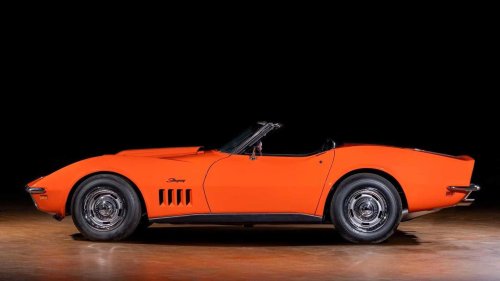
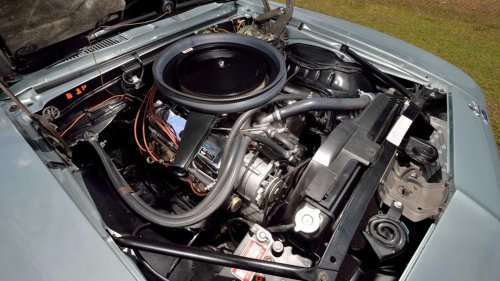
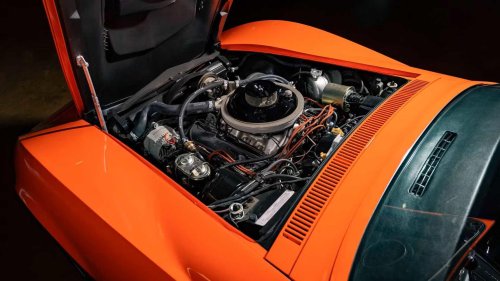
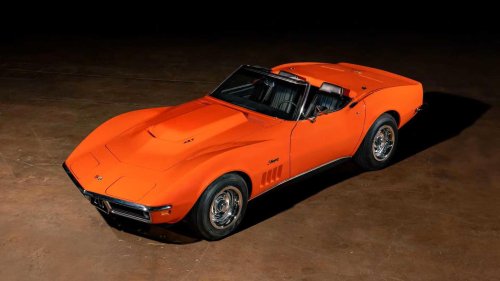
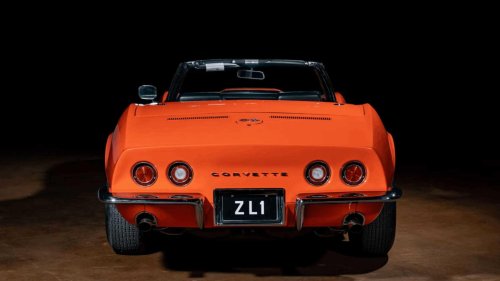
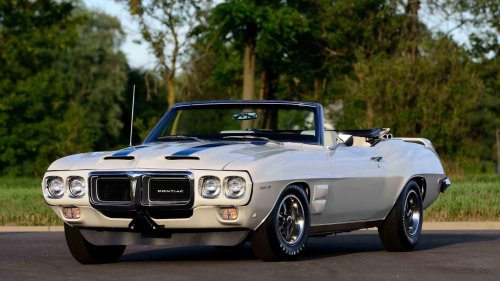



















UPDATE: 2026/07/26 11:00 EST BY SEAN MCMANUS General Motors Made Some Rare Muscle Cars Over the YearsWe have added a section at the end of the article to discuss the five rarest muscle cars to leave General Motors' production lines.Corvettes have always been special — from the first-generation icons of the 1950s that helped define the American sports car to the exotic and mid-engined 2026 Chevrolet Corvette. Through the years, the name has always stood for performance and innovation. Yet, the most powerful old Corvette ever built by the factory didn't come from the modern era of fuel injection, computers, and power adders. It arrived in 1969, at the very peak of the muscle-car wars and blurred the line between race car and street car. Over the decades, only a handful of people have ever experienced what it was like to own one — an old Corvette so brutally powerful that it remains the most potent factory-built example of the classic era.This article focuses strictly on old Corvettes, typically between the C1 to C5 generation Corvettes. Modern Corvettes (C6 - C8) produce significantly higher horsepower thanks to advanced technology. Production figures and pricing come from GM records and respected Corvette historians. The 1969 Corvette ZL-1 That's ZL-1, Not ZR1RM Sotheby'sThe sixties were a special time for the auto industry. In an era before catalytic converters, modern emissions systems, and heavy government-mandated fuel-efficiency standards had really taken hold, the horsepower wars for muscle-supremacy were in full swing. Among all the major players - Ford Mustangs, Dodge Chargers and the cars from Buick, Oldsmobile and Pontiac - the Chevrolet Corvette was one of the most effective weapons on the battlefield.Constructed with a lightweight fiberglass body and fitted with a powerful V8, the Corvette had already earned its reputation as a top performer on the street and on the racetrack. For 1969, the Corvette came with a 350-cubic-inch V8 as a base engine. The only other options available were four different versions of the 427, with varying horsepower outputs. The top engine offering was the mighty L88 version of the 427 big block. It was rated conservatively at 430 horsepower. However, there was another 427 available that was not advertised. This was a race engine that was quietly offered by Chevrolet to satisfy homologation rules set forth by the Sports Car Club of America (SCCA) and the Canadian Automobile Sport Club (CASC).To be technical, the ZL-1 is not a trim option; it was a regular production option (RPO) code that designated the all-aluminum 427-cubic-inch big block V8 for the 1969 model year Corvette.The ZL-1 is one of the rarest and most legendary engines in Chevrolet history. It was originally developed in the 1960s for the Canadian-American Challenge Cup (Can-Am) series. Race teams like McLaren and Chapparal needed a lightweight, high-power big block to maintain their competitive edge against Ford and other contenders. To meet homologation rules, GM had to offer the ZL-1 in a production model. So for 1969, it was available as an RPO on the Corvette and a central office production order (COPO) on the Camaro."The 1969 ZL-1 was the most exotic Corvette ever produced. It was basically a Can-Am engine in a production car. Only two were built because it was so extreme."- Dave McLellan, Chief Engineer, Chevrolet Corvette The ZL-1 Engine Explained An All-aluminum Race Engineered Assassin Mecum AuctionsWith all the alphanumeric RPO codes mentioned in this article, it's important not to confuse the ZL-1 with the L88. Although both are 427 cubic inch big block V8's, they have some key differences that set them far apart. Most importantly is the block material. Dimensionally identical to the cast iron block L88 427, the ZL-1 was special, it used a sand-cast 356 T6 aluminum block with iron sleeves.The block was fortified with thicker webbing in the main bearing area, a thicker deck, had provisions for a dry-sump oiling system to be used and was cast with two threaded tabs that protruded into the lifter galley for two additional cylinder head bolts. The ZL-1 used the second design aluminum cylinder heads from the L88, which were open combustion chamber and were said to flow up to 30% better than the previous design.RM Sotheby's The bottom end consisted of a strong forged steel crankshaft with four bolt-bearing caps. The forged aluminum pistons attached via forged connecting rods and helped create the nominal 12.5:1 compression ratio inside the combustion chamber. The use of high octane fuel was necessary to avoid running into any spark knock issues. Making the best use of the improved cylinder heads, solid lifters and a more aggressive camshaft with higher lift was utilized. Fuel was delivered by a four-barrel Holley 850 cfm double pumper carburetor perched atop an aluminum high rise intake manifold.The ZL-1 did share its transistorized ignition system with the L88. Optional for some other engines, this higher-energy ignition system was needed to meet the demands of the high-performance L88 and ZL-1 big block engines. The transistorized ignition ensured a more consistent and reliable spark delivery than a conventional points ignition system. This was crucial for both the L88 and ZL-1 high performance big blocks, especially at higher rpm.The all-aluminum 427 ZL-1 big block V8 weighed in at 200 pounds less than its cast-iron counterpart, the L88 427. It was even lighter than a small-block Chevrolet 350 V8 engine of the era. In its stock form, the ZL-1 was said to have produced 580 horsepower, giving the ZL-1 a power-to-weight ratio that was intended for racetracks and bad decisions. The Most Collectible Classic Corvette The Terrible Two RM Sotheby's Some cars are low production, limited release, or just scarce. This vintage Corvette with the ZL-1 engine is downright mythical. Kevin Mackay, a well-known Corvette restorer, owner of Corvette Repair and respected authority on Corvette history, says that Chevrolet built a total of seven ZL-1 powered Corvettes. Two of these cars were sold to the public, while the rest were used for test mules, or press cars, with no intention of public sale.It's evident that GM didn't want to sell many, as it was never advertised, it was never in any sales brochures or catalogs, and it was obscenely expensive. To purchase a ZL-1 powered Corvette, you first needed a dealer that was willing to put in the order. That might have been the least painful part.Secondly, you had to be prepared to pony up for not just a Corvette (with a base price of $4,781.00), but your Corvette had to be ordered with the 430 horsepower L88 427 big block. The L88 option was pricey enough at $1,032.00 for the engine alone. Ordering the L88 also required several supporting options, such as the F41 heavy-duty suspension, a limited-slip Posi-Traction rear-end and heavy-duty brakes, pushing the price even higher. Only 116 L88 powered Corvettes were sold for the 1969 model year.The cherry on top was the ZL-1 engine itself, which tacked on a whopping $4,718.35, doubling the price of a base Corvette, putting the MSRP of a ZL-1 powered Corvette over $10,000 in 1969. For perspective, that's equivalent to $91,000 dollars today. Not only was the ZL-1 powered Corvette outlandishly priced in 1969, this tradition has continued, as the value of ZL-1 cars has done nothing short of skyrocket. In August 2023, one of the two publicly sold ZL-1's hit the auction block and sold for $3.135 million when the gavel dropped. Or Were There Three? RM Sotheby'sIt's widely accepted and published that there were only two ZL-1 powered Corvettes ever sold to the public. One, a Monaco Orange convertible with a black soft top (recently sold for $3.135 million). The other, a Daytona Yellow Coupe with T-Tops owned by Rogers Corvette Center. These are apparently the only two confirmed publicly sold ZL-1 Corvettes. However, a book titled "American Muscle" written by Randy Leffingwell, heavily featured cars from muscle car collector Otis Chandler.In it, the book features a Can-Am White 1969 Corvette with a factory-installed ZL-1 big block engine. Although this is a ZL-1 powered Corvette, the nuance is that it was a factory test car - eventually acquired by Chandler and was never sold to the public. This is where the confusion and lore resides. The assumption is that most factory test/engineering cars are destroyed, dismantled or kept by the factory.However, some did "slip out the back door", to known and trusted employees or collectors. As GM kept the ZL-1 program intentionally low-profile, information is scarce on the exacts, but Otis Chandlers Can-Am white ZL-1 powered Corvette is a prime example of a test/engineering car that escaped the factory, eventually resulting in private ownership.The 1969 Corvette was the only year Chevrolet offered the radical ZL-1 engine in a production Corvette. At the time - and for decades afterward - it was the most powerful classic Corvette ever built. With only two examples technically sold to the public, it remains the rarest of old Corvette models and one of the most legendary muscle cars ever made."The ZL-1 is the Holy Grail. It's not just rare - it's the pinnacle of what Chevrolet was willing to do when no one was looking."- Kevin Mackay, Founder of Corvette Repair,Corvette Restorer and Historian General Motors Made Some Rare Muscle Cars Over the Years MecumNone are as rare as the ZL-1 Corvette, but GM hasn't been shy about its limited-release muscle cars from back in the day. We have a whole list of the rarest factory GM muscle cars, but here are some highlights:The five rarest GM muscle cars (excluding the Corvette) happen to be Pontiacs. In the fifth position rests the 1997 Pontiac Firebird SLP Firehawk LT4, of which only 29 were produced. It used a 5.7-liter V8 that made 330 hp and 340 lb-ft of torque, and was special due to being made in collaboration with an upgrade specialist called SLP. Next is the 1971 Pontiac GTO Judge Convertible; only 17 left the production line, since insurance costs at the time were so high nobody wanted to buy them. That said, the best-condition examples left today fetch near half a million dollars at auction.The three rarest GM models include the 1963 Pontiac Tempest Super Duty, with 14 units produced, the 1969 Pontiac GTO Judge Convertible, with fewer than 10 confirmed examples produced, and finally, only 8 examples of the 1969 Pontiac Firebird Trans Am Convertible ever left the production line. That last model didn't sell well to begin with, since its high torque output could twist the chassis without a roof to support structural integrity. Nevertheless, one sold at auction for $1.9 million in 2016.