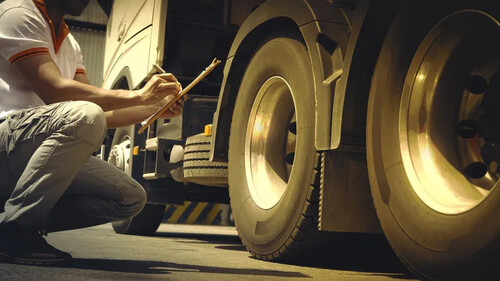
New truck tires inside a warehouse - Artem Khaustov/ShutterstockTruck owners and enthusiasts are generally referring to the load range when talking about a tire's ply rating. The ply rating of a tire originated during the early days of tire construction. It referred to the number of cotton layers used when constructing the tire. More layers meant more plies, and more plies meant a stronger, more durable tire that could support more weight. So, when talking about a 10-ply versus a 12-ply tire, it was supposed to refer to a tire with 10 or 12 actual plies or layers, which was true in the olden days.Tires have evolved since then, with modern varieties containing a mix of natural rubber, synthetic rubber, steel, nylon, polyester, and other compounds. The evolution of radial tire construction has made the ply rating less literal, since manufacturers can now make truck tires that are as sturdy and durable as 10 or 12-ply tires while using only 2 or 3 plies of advanced materials. Subsequently, the load range became more standardized, using letters to represent tire strength more consistently in terms of load capacity than the old bias-ply system. A 10-ply tire now has an E load range that supports 3,000 to 3,500 pounds for each tire, whereas a 12-ply tire has an F load range that's good for 4,000 or more lbs. Read more: Why Did Automakers Stop Making Cars With Pop-Up Headlights?10-ply truck tires are great for everyday useA group of Ford Ranger midsize trucks parked on a dirt road - Tramino/Getty ImagesThere are pros and cons to 10-ply or 12-ply tires, but it ultimately boils down to driving habits. For daily drivers that occasionally tow light to moderate trailers, carry tools or gear, and make infrequent off-road trips, 10-ply tires generally cost less, are a comfier all-rounder, and can deliver maximum fuel economy without sacrificing all-season performance.AdvertisementAdvertisementThe cons, if any, are a lower load range and potentially reduced resistance to cuts and punctures owing to its "softer" construction. Load Range E or 10-ply tires are commonly rated at up to 80 PSI. Note that the maximum load pressure is not the recommended tire pressure, as inflating the tire to its maxium PSI is a terrible idea unless it's carrying its maximum rated load. The maximum load pressure refers to the peak cold pressure required for the tire to carry its rated load.12-ply truck tires are for harsher, heavy-duty useRear lower quarter view of a pickup truck forging a rough road and with tires wrapped in mud - uguruysall/ShutterstockWhile a 10-ply construction is like the Goldilocks of heavy-duty truck tires, 12-ply tires are geared more towards extreme towing, hauling, and off-roading than everyday comfort. The stiffer construction makes 12-ply tires more resistant to punctures and excessive wear, all while having a 4,000-lb or more load capacity. In short, it can tow and carry greater weight, has higher stability under load, and is ultimately more robust. Still, you may be wondering exactly why their stiffness can ride harsher. The stiff sidewalls of 12-ply tires don't flex and contort as much to cope with road undulations, which can result in reduced smoothness. The tough and durable construction of 12-ply tires requires more complex assembly, making them pricier on average. The inherent stiffness of the construction also results in a heavier tire, which can lower fuel economy due to the vehicle having more unsprung mass. A 12-ply truck tire has an F load range with a maximum load pressure typically around 95 psi.Is the load range different from the load index?The sidewall markings of a new tire with a 106 load index and Y speed rating - Zigmunds Dizgalvis/ShutterstockIt's worth noting that load range differs from load index. The load range refers to the tire's strength and pressure rating system. On the other hand, the load index refers to the maximum load the tire can support when properly inflated. For instance, a tire with 245/70R17 XL 114T markings on the sidewall means the tire is 245 mm wide, has a 70-aspect ratio, and is a radial tire designed for a 17-inch wheel. The final 114T marking refers to the load index (114) and speed rating (T).AdvertisementAdvertisementYou'll need to refer to a load index chart to determine the tire's load-carrying capacity. In this case, a load index of 114 means each tire can carry 2,601 pounds. With four tires (2,601 x 4), the maximum load carrying capacity is 10,404 lbs. Meanwhile, a T speed rating means the tire can travel up to 118 mph. Using this data and depending on vehicle use and manufacturer specs, you should generally avoid buying new tires with a lower load-carrying capacity than the factory OEM tires. However, it's perfectly fine to go for tires with a higher load index, especially if you're planning to tow more or carry heavier loads more frequently.Want more like this? Join the Jalopnik newsletter to get the latest auto news sent straight to your inbox, and add us as a preferred search source on Google.Read the original article on Jalopnik.