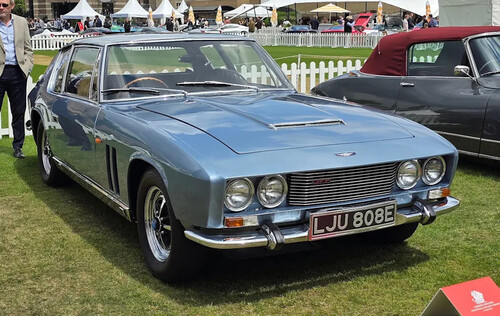
Adding an all-American V8 engine to the chassis of a lightweight British sports car is perhaps the greatest Anglo-American collaboration since Lend-Lease was a thing. There’s something about that potent combination of a competent and well-sorted driver’s car and an engine so large it barely fits inside that it always turns out bangers. It was like a real-life cheat code that made cars go much, much faster. But one above all stands the test of time, mostly because it was weird as well as fast. An Independent British Sports Car Maker, From Beginning to End Hagerty UKIt’s easy for the unfamiliar to look at British motoring though the first three-quarters of the last Century, and think that all they offered was a handful of exotic brands. You know, the big-name outlets like Lotus, Jaguar, Aston Martin, Bentley, Rolls-Royce, and then the massive multi-brand conglomerate British Leyland. In truth, up until around the late ‘80s, Britain was home to dozens, and at times hundreds of smaller firms. They were often groups that built cars in sheds by hand, with little more than sweat and hard graft.One of the most famous British automakers to never be absorbed into British Leyland but bumped sides with plenty of its sub-brand was Jensen Motors. The company was founded by the Brothers Richard and Alan Jensen who, in 1931, decided the established aristocracy of British sports cars needed another major player. At the time, famous names like Jaguar and MG were still in their infancies — a time when there was still plenty of room for a new player in town.The duo got their start designing bodies for long-haul trucks, as well as re-bodying little Austin 7s with boat-tail bodies before dedicating themselves to their own novel brand. Over the decades, Jensen grew a reputation on two fronts. One for surprisingly durable metal bodies for British trucks and lorries, which became an invaluable asset during the Second World War. On the other, bespoke sports cars like the H-Type and S-Type (no relation to Jaguar), established Jensen as a top name in British sports cars. Taking the Established English Sports Car and Making it Better Bring a TrailerThe process of turning the established British sports car formula, i.e., a tiny drop-top with a puny engine, almost no weight, and handling like divinity,and making something beyond that, wasn’t typical by any stretch. The company began the post-war period closing out its truck production, which finalized by the early ‘60s, and building sports cars like the original Interceptor, and GT cars like the 541 and the C-V8.The C-V8 proceeded to gap Aston Martins and Jaguars while giving Lamborghinis and Ferraris panic attacks. But its rear-drive Grand Tourer layout traced its roots back to the earliest days of European sports cars — a traditional setup in a way that felt just a little long in the tooth by the late ‘60s. To really grab headlines, Jensen needed to think outside the box.Around that time, Jensen’s top brass in the West Midlands hired a man named Federico Formenti to design a new, exciting model based on the second iteration of the Chrysler V8-engined Interceptor. Formenti represented the Milan-based Carrozzeria Touring Superleggera, most famous for its work with Alfa Romeo, Ferrari, Maserati, and BMW among others. But what Jensen had planned for this new model that moved the needle was beneath the body. For the first time ever, a non off-roader was about to get full time four-wheel drive. Jensen FF: An Unheard of Kind of Sports Coupe in the 1960s Classic DriverThat’s right, eat your heart out Audi Quattro, and every modern Subaru that isn’t the BRZ. Every modern sporty all-wheel drive system ultimately traces its roots back to the work Jensen contracted to Ferguson Research Ltd. of Coventry, who developed the system used in what became the FF.The 383-cubic inch, 6.3-liter V8 once again came from Chrysler, the same engine found in Mopar products the world over well into late 1970s,as did the three-speed Torqueflite automatic transmission. Sure, it wasn’t a three-pedal manual, but the arrangement led well to toeing the line between a sports car and a proper four-seater GT car.Underneath the car, a transfer case with dual prop-shafts you’d expect to see in a Bronco or Land Rover gave the FF an edge that, assuredly, no one else saw coming. Thanks to its Italian body styling, the FF also looked every bit the stylish sports coupe it was underneath. With 325 horsepower at the crank on offer, plus 425-lb-ft of pure American torque, this monster could sprint to 60 mph in the mid -to-late sevens. World-Beating Power, Italian Body, British Charm Classic DriverGranted the four-wheel drive system sure added weight compared to other sports coupes. But with four grippy tires pulling the big, heavy British bruiser along meant the Jensen was often quicker off the line than the competition. Long before the computerized 1990s, this all-wheel drive layout was something of a cheat code.Not that an FF could even be sold in the United States, since key parts like the steering gear, braking hardware, and the front portion of the all-wheel drive hardware were engineered directly into the bodywork on the left-hand side. In effect, retro-fitting an FF for left-hand drive would effectively involve re-engineering the entire car, making it a grey market import darling in North America.Speaking of America and the engines they make, a British manufacturing firm called GKN even went so far as ordering the beloved 7.0-liter, 426-cubic HEMI V8 direct from Mopar for test purposes on an existing FF they'd ordered from Jensen. At the time, roughly 1971, these engines jetted 425 horsepower and 490 lb-ft of torque at the crank. But in the special racing spec GKN had ordered, it was pushing closer to 600 horses. The test mule was genuinely fast, hitting 100 mph and then braking back to zero in just 12.2 seconds. But the engine pushed the suspension to the limit at the high end with all the extra weight, plus 500 lb-ft of torque. So Rare, It’s a Holy Relic for Car Enthusiasts1970-Jensen-FF-Front1Given how staggeringly complex the FF was in its day, you’d expect production figures to be pretty low. But from 1966 through 1971, a period of five entire model years, Jensen manufactured all of 320 FFs. That’s a little over 60 examples per year, give or take a few to account for changes in the production line. Production was split into two distinct camps, the original 1966 body style and a comprehensive facelift in 1968.Today, it’s almost unheard of to find Jensen FFs imported to the United States. You can find similar-looking Jensen Interceptor Mk IIs and Mk IIIs all day long. They look awfully similar to an FF as well, but uses a more traditional rear-wheel-drive layout. But the real, genuine example is a unicorn almost guaranteed to stay in the UK, or at least in Europe in general, for many years to come. It’s one of the very best attempts at taking a British chassis, pairing it to an American engine, and creating something so profoundly special that sets a precedent for future all-wheel drive sports cars to follow.Even 60 years later cars like the Nissan GTR and Porsche 911 Carrera four take this same formula and use it to great effect with modern computers and technology. Can you believe Jensen did the same with nothing but gears and lots of oil? It’s a paradigm we’ll probably never see again.Sources: Hagerty UK, Classic Driver