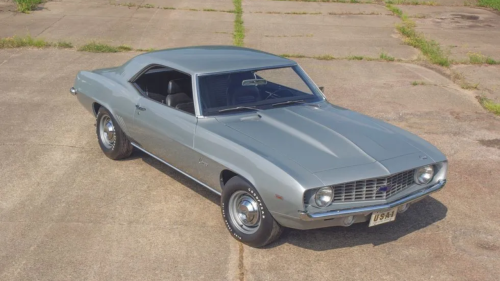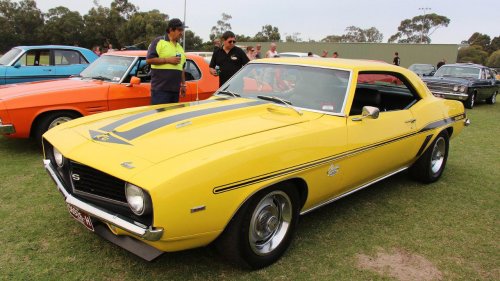




























In the golden age of Muscle Cars, the big Detroit automakers weren't above offering some seriously crazy options on even their most regular production cars. No brand provided better examples of this than Chevrolet. There was a point where you could seemingly get nearly any kind of engine in any car Chevy sold. That included the smaller platforms, which were barely able to handle the higher power you could get in them.How was this all possible? Well, it's thanks to a bit of under-the-table shenanigans you could do if you knew what you were doing. These secretive bits of ordering helped to create some of the most mental performance specials we've ever seen. Chevrolet Had A 'Secret' Ordering System You Could Use To Create Performance Monsters Bring A TrailerChevrolet may have had a huge variety of crazy cars you could order from the factory back in that mid-'60s to early-'70s golden period. But, there were limits on what Chevy would offer a regular customer. For example, it wouldn't let you order a big-block engine in a small or mid-sized car. Not usually anyway. Tucked away among the order forms was a special order system that Chevrolet never advertised. This was known as the Central Production Office Orders (COPO) system. It was originally intended for fleet buyers who wanted heavier duty versions of regular production cars. As a result, it was never advertised to the public. But, entrepreneurial dealers worked out that you could exploit the COPO system to bypass that internal Chevy policy of not putting those high-performance big-block engines in smaller platforms.Once these dealers found that out, and also found out that there was a niche out there for big-block specials of smaller Chevys, they got to work ordering batches of crazy COPO specials. One of those specials is one of the rarest, most legendary and most desirable classic muscle cars of all time. The 1969 Chevrolet Camaro ZL1 Is A COPO Special That's So Rare, Even Chevy Dealers Didn't Know It Existed MecumThe 1969 Chevrolet Camaro ZL1 has to be one of the most famous COPO cars of all time. But, back when it was new, this car was so rare that most Chevy dealers didn't even know it existed! This dealer special was created by Fred Gibb, using COPO option 9560. This gave the Camaro the all-aluminum ZL1 engine that was specifically designed for drag racing. Gibb sold these Camaro ZL1s through his dealership to a very niche customer base—only 69 of these cars were ever made.Putting that crazy high-performance engine in gave the Camaro ZL1 a claimed power output of 430 horsepower (most people believe that it actually produced as much as 500 horsepower) and 450 lb-ft of torque. That made it incredibly overpowered for the small, sports car platform it had been dropped into. That made it a real handful to drive, but incredible for what it was designed to do—absolutely dominate on the drag strip. It's Now One Of The Most Valuable Muscle Cars On The Market Via Mecum AuctionsBecause the 1969 Chevrolet Camaro ZL1 is so rare and its engine is one of the greatest big-block units ever made, examples command huge prices whenever they come up for sale. One Camaro ZL1 sold for $825,000 at an auction in Florida in 2021, while another sold for $700,000 in 2023. When you compare it to the average used value of $69,709 for a first-generation Camaro SS, that really brings home how much of a premium collectors are willing to pay for these crazy COPO specials. Other COPO Cars That Put Big-Block Power In Smaller Platforms via MecumThe classic Camaro ZL1 might be the most sought-after of the COPO cars that dealers created during that golden period. But, it was far from the only one. There were several other examples where the COPO system was used to put those big block engines in smaller and mid-sized platforms. In all these examples, the L72 engine was used, and they were all created by legendary independent Chevrolet dealer Don Yenko. Yenko Camaro MecumFred Gibb wasn't the only entrepreneurial dealer who stuck a massive V8 in the original Camaro. Don Yenko did that too, creating the Yenko Camaro. As his COPO Camaro creation used the L72 V8 instead of the ZL1 V8, the output is a little different. The Yenko Camaro has less power, but it's got more torque. That adds up to it being pretty competitive with the Camaro ZL1, and just as much of a monster on the drag strip! Yenko Chevelle Mecum AuctionsFor a more 'gentleman's muscle car' kind of big-block option, Don Yenko also put the L72 engine in the Chevelle. That L72 power in a mid-sized coupe created something that was as much of a performance monster as the Yenko Camaro, but in a package that looked more like a sleeper car. It even had the option of an automatic transmission, furthering that gentleman's muscle car feel. You wouldn't necessarily realize the power that's under the hood of this Chevelle, unless you saw one absolutely tear it up in a drag race. Yenko Nova Via Mecum AuctionsThe third of Don Yenko's crazy COPO creations we'll be talking about here is the Yenko Nova. This is perhaps the craziest application of the COPO system yet, putting that L72 engine into a small platform that really wasn't designed for it. Only 37 of these cars were ever built, making it even rarer than the 1969 Camaro ZL1. Don Yenko himself was reportedly scared of this car. We're not surprised at all! The Spirit Of The COPO Camaros Was Revived For The Modern Era MecumThe COPO name may be associated the most with that golden age of American muscle. It isn't exclusively confined to that era though. During the 2010s and 2020s, it got a revival via a few special Camaros! Two of those Camaros were factory-homologated racers that were actually sold to members of the public. The third was a one-off prototype that showcased what the future of drag strip monsters could be. 5th Generation COPO Camaro Bring A TrailerThe COPO version of the 5th generation Camaro first showed up back in 2013. Fully intended for racing in NHRA's Stock Eliminator classes, this car was a proper modern interpretation of Fred Gibb's ZL1. It was available with three engine options, and with both manual and automatic transmissions. The automatic transmission is particularly interesting for a modern car, as it's a very old-school 2-speed "powerglide" unit! This was chosen on purpose, as it would be more efficient on the drag strip—a 2-speed transmission would only need to shift once during a run. Like the 1969 ZL1, only 69 of these COPO Camaros were ever built. 6th Generation COPO Camaro MecumThe 6th generation COPO Camaro showed up in 2016, and it was a little different from the 5th generation model. These cars were only available with a 3-speed automatic transmission, and they had slightly different engine options. This included an absolutely massive 632 Cubic Inch V8, producing 1,004 horsepower.Like the 5th generation COPO Camaro, the 6th generation model's production was limited to 69 units. These were produced from 2016-2023, and buyers for them were selected via a lottery system. The final car that was built also didn't go to a paying customer. It went straight to the GM Heritage Collection. eCOPO Camaro The eCOPO Camaro has to be (potentially) one of the most controversial drag strip monsters Chevrolet has ever made. Instead of a snarling V8, the eCOPO Camaro is powered by two electric motors driving the rear wheels. These motors produce a combined output of 780 horsepower and 780 lb-ft of torque. That's enough to cause some serious burnouts, albeit with no engine noise. While muscle car purists might be offended by the eCOPO Camaro's sheer existence, it does point towards something positive. The switch to electric power doesn't mean that muscle car culture will go away, and neither will drag strip culture. It'll just be powered by electricity instead of gasoline.Sources: Chevrolet, Classic.com, Mecum Auctions