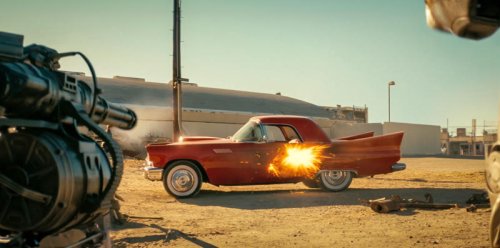
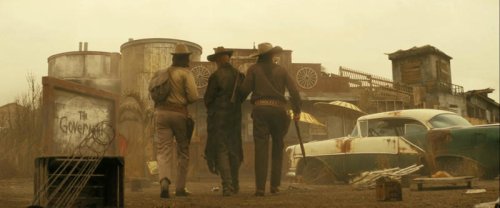
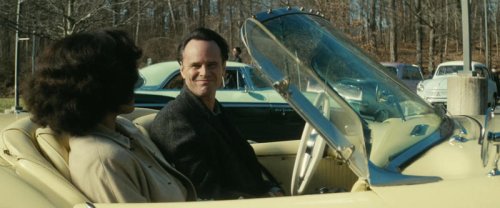
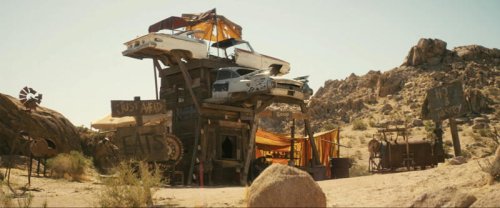
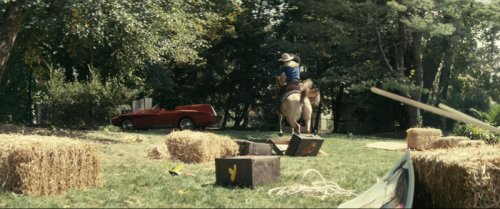
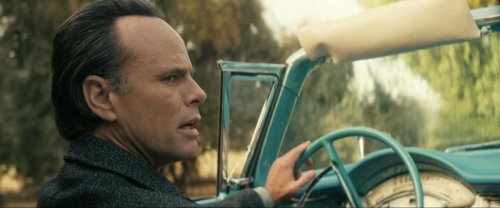
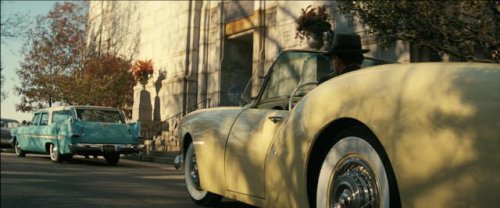
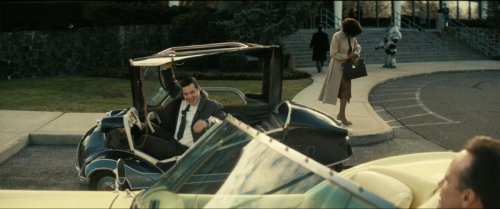
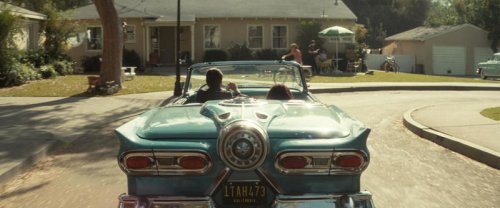
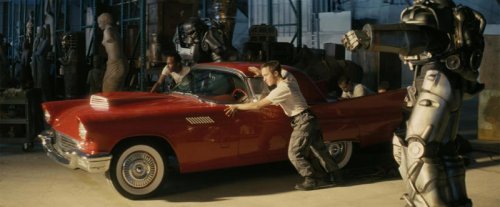
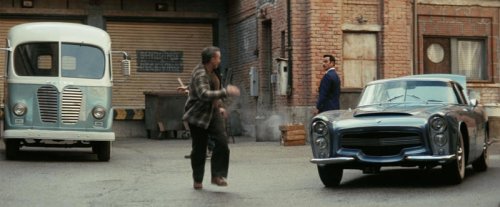
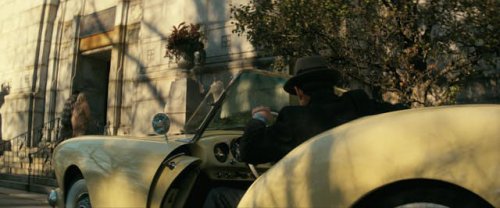
















The Cars of Fallout Are Ever-Present Beacons in the Wasteland Based on the video game series of the same name, the show Fallout is loaded not only with memorable characters, but with memorable machines, and for gearheads, the cars employed by series creators Graham Wagner and Geneva Robertson-Dworet often steal the scenes. Fallout is set two centuries after the nuclear bombs dropped in the Great War of 2077. Just like old westerns, the show toys with our notions of who’s civilized and who’s savage, with Ella Purnell’s naive Vault dweller Lucy MacLean as the audience’s surrogate trying to make sense of a world that isn’t quite what she believed it to be. Kyle MacLachlan stars as Lucy’s father and the Vault’s overseer, along with Aaron Moten as Maximus, a member of the Brotherhood of Steel, and Walton Goggins, who starts out as Cooper Howard, “American veteran and star of the silver screen,” an actor who always played the hero in a white hat in his westerns. Until he evolves into the Ghoul, that is—a morally gray gunslinger in a black hat—more Lee Van Cleef than Gary Cooper. Like an irradiated The Good, the Bad and the Ugly playing out on a vast scale, Fallout is an odyssey through the years, across the country, even underneath it. Each episode twines seemingly unrelated stories and characters, or illuminates intricate, surprising connections forged in the past. The series depicts a near-future that feels impossibly cutting-edge and as old-fashioned as the 1950s, as well as an era 200 years later that is downright medieval, a setting not unlike Mad Max—except without its culture of car worship. Instead, Fallout’s curation of cars reflects the way it plays with time: It chooses existing cars that already feel fantastic, and it modifies others to make them appear more futuristic. In the show’s present day, though, vehicles are mostly unused and decrepit. America now resembles the Wasteland: rusted old cars have become part of the landscape, or they’re incorporated into structures, their use both decorative and practical—to fortify one’s fortress, for example. At one point, Lucy stumbles into what looks like an automotive cemetery in the woods, a decaying collection of cars from the 1940s and 1950s. But Atomic and Space Age aesthetics dominate the show’s flashbacks to the prewar era, its Jetsons-style look. In a truly special cameo, we catch a glimpse of the 1960 Plymouth XNR in the pilot episode—designer Virgil Exner’s asymmetric concept car inspired by the Jaguar D-Type, his own Studebaker Indianapolis race car, and the Watson Indy Roadster. Only one was made, and surprisingly, the series did not employ a replica; what you see on-screen is the real deal. The pilot episode also features actor Vic Oliver’s Studebaker parked nearby, a car that Oliver transformed from a Starlight into a convertible concept car called the Speedster II, inspired by one of Bob Bourke’s designs. In the second season, Cooper and his daughter Janey (Teagan Meredith) drive through a picture-perfect neighborhood where a pristine car sits in every driveway, like a 1949 Nash Ambassador Airflyte, an aerodynamic family car with reclining seats that allowed three adults to sleep inside it. There’s also a ’54 Chrysler Windsor, a ’57 Mercury Monterey, and a ’50 Plymouth Special De Luxe on display; true to the economic nationalism of Fallout’s world, the only cars that exist here are made in the USA. With its cars, Fallout showcases the postwar boom in American automotive innovation. Soldiers returning from World War II brought home everything from Porsches to MGs, and in response to the foreign cars that had begun to dominate the industry and the roadways, American manufacturers decided maybe the market needed more than just sedans and station wagons. The Corvette was introduced in 1953, followed by the Ford Thunderbird and the Kaiser Darrin in 1954. (The Darrin prototype was first unveiled at the Los Angeles Motorama in 1952, just two months before the Corvette.) This is Cooper Howard’s ride of choice: a 1954 yellow satin Kaiser Darrin, an aesthetic oddity with a heart-shaped grille and doors that open by sliding into the car’s front fender wells. Only 435 Darrins were ever built. Automotive stylist Howard “Dutch” Darrin took it upon himself to create the fiberglass-bodied roadster himself, proof of concept for the industrialist Henry J. Kaiser, who was staunchly committed to the production of family cars. Kaiser hated the car, of course, and it nearly didn’t make it past the prototype stage—except that Kaiser had brought his wife along to see it, and she declared that the car was the most beautiful thing she’d ever seen. In the same scene that introduces the Darrin, Vault-Tec chairman Bob Askins (Michael Esper) pulls up alongside Cooper in a Fusion Flea, a fictional car pulled from the game Fallout 4. In truth, it’s really a 1955 Messerschmitt KR 200, the inspiration for the game’s little bubble car. Cooper’s other car is a kind of mutant: a 1958 Ford Fairlane 500 Skyliner convertible with a ’58 Edsel front clip, powered by a rear-mounted nuclear reactor. (Likely intended to be what’s called a Chryslus Corvega Atomic V-8 in the games.) Like many of the video games’ vehicles, it’s inspired by Ford’s 1958 concept car, the Nucleon, an innovative vision of a better future when nuclear power might be harnessed for good rather than giving you radiation sickness on your commute to work. Hypothetically, the Nucleon would have been styled with radiation shielding, but the issues with riding around in a tiny nuke were never really resolved. In Fallout’s vision of the postwar future, America is no longer composed of states but factions, like the New California Republic (NCR), the Legion, “Vaulties” like Lucy, and the Brotherhood of Steel—a religious military force with soldiers called knights who wear mechanized suits of “power armor.” In the second season, the Brotherhood stumbles into an Area 51 warehouse where their ignorance is played for laughs: two squires open an old freezer, find an alien corpse inside, and one of them pushes it out and exclaims with wonder, “A real f**kin’ icebox!” They also discover a mint ’57 Ford Thunderbird here; because they can’t comprehend the rarity and value of what they’ve found, they use it to test the power of their weapons and blow it up. The show’s second season specifically draws from the game Fallout: New Vegas, and that’s where it sources its newest villain as well: Justin Theroux’s Robert House. In this season’s first episode, House is introduced along with his car, a 1953 Dodge Storm Z-250. Dodge was as much a part of the race to create a great American sports car as Kaiser, Chevrolet, and Ford, and it tasked Fred Zeder Jr. with the creation of this Bertone-bodied beauty. It was built on a tube chassis with a hemi V-8, and Zeder imagined his creation would have swappable bodies: the touring body and a lightweight fiberglass body, though only the touring was produced. Zeder later replaced the hemi with a wedge engine, and he repainted the white car a pale metallic blue. Only one was ever made, and like the XNR, this wasn’t rendered with CGI for the show: It’s the actual machine. Although Fallout often turns its cars into fossils or punchlines, like the comically large fusion core affixed to Cooper Howard’s car, the series’ flashbacks spotlight some of the coolest, rarest vehicles ever made. From corporate depravity to faulty tech, the Fallout often puts the worst of humanity on display—but these machines are the exception to the rule—welcome reminders of human ingenuity, the best we have to offer. If you can weather the graveyards of old cars and the ill-fated Thunderbird, Fallout’s truly beautiful and unusual examples of automotive innovation make it worth the pain.