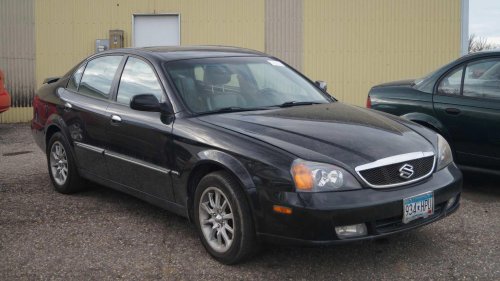
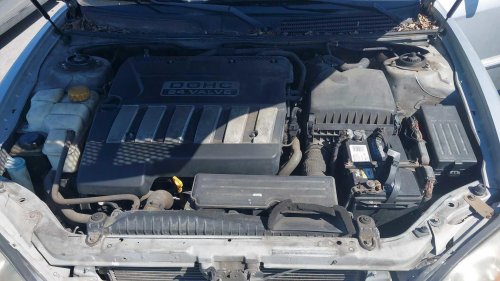
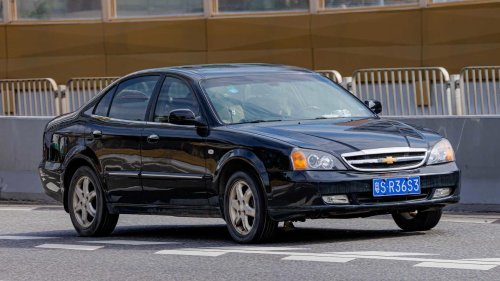
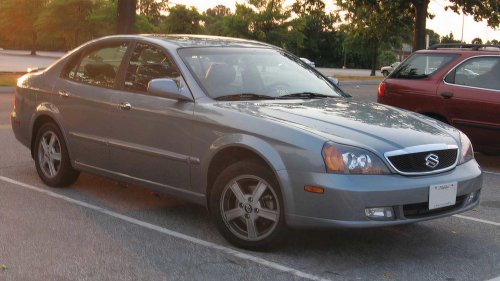



















While Suzuki doesn't have much of a presence in the US these days, they're well-known worldwide for building affordable city runabouts, along with off-roaders such as the forbidden-fruit Suzuki Jimny. There's also the motorcycle and all-terrain vehicle aspect of Suzuki's business lineup. In 2023, the Japanese conglomerate managed to shift nearly two million motorcycles and ATVs. To put it bluntly, Suzuki is quite a contender on the world stage, both in motorcars and other motorized vehicles.However, when it came to the US market, Suzuki was never able to gain a large footprint. In total, Suzuki operated in the US, at least on the automotive side of things, for 28 years, from 1985 to 2013. Their American offerings include the Suzuki Grand Vitara SUV, the Forenza compact sedan, and the Equator mid-size pickup. Another, even more obscure model was on their offering list called the Verona. It was a budget-friendly mid-sized sedan that just couldn't capture the hearts of Americans as much as Suzuki would have liked. But beneath its Japanese sheet metal, the Suzuki Verona had Stuttgart blood in its heart and Italian styling in its appearance. Bred By Winners, Destined For Wallflowerdom 2005 suzuki verona front black Suzuki Verona Quick Facts Introduced in 2004 Debuted at the 2003 Chicago Auto Show Utilized a Porsche-bred transverse inline-six Production ceased in 2006 The story of the Suzuki Verona is almost tragic. For one thing, its 2.5-liter straight-six engine was co-developed by Porsche. That sounds like some mega bragging rights, but apparently, Porsche was primarily responsible for developing the engine mounts. This was because the Verona took advantage of a transversely mounted engine to help make more room inside the passenger cabin.Porsche also aided in the creation of other engine components, as well, although exact specifics are unclear, and Suzuki's absence from the US market makes it tough to ask for further details.The Verona wasn't just special because of the Porsche bits under the skin, but because of the sheet metal itself. Instead of designing the Verona in-house, Suzuki tasked Italdesign - yes, Giugiaro's Italdesign - to help make the Verona a bit more stylish. Some of you may know of Italdesign from the work it did with Volkswagen back in the day. Italdesign is now owned by the broader Volkswagen Group, lending the Verona multiple tie-ins with the German automaking conglomerate's subsidiaries. The Verona's Stuttgart-Inspired Heart 2005 suzuki verona engine front viewThe Verona's sole motor option, the 2.5-liter six-pot, is interesting in its own right. Typically, straight-six motors are not usually featured in front-wheel drive, transversely-mounted configurations. The Verona's engineers wanted the sedan to have ample power and torque to provide an edge over some of the four-banger mid-sized sedan options out there, such as the Toyota Camry. The choice to use an inline engine in a transverse application was unique though, as many rivals utilized six cylinders arranged in a V to accommodate front-wheel drivetrains.As for the rest of the Verona's mechanical makeup, things get very run-of-the-mill. Its transmission was a four-speed automatic, with no manual offered, unlike most other competitors at the time. Drive reports of the era suggested the Verona's ride quality was superb for a budget sedan, and its Porsche-co-developed engine was quiet and smooth, while also offering just enough power to get the Verona up to highway speeds. The Verona Had Siblings Around The World 2005 chevrolet epica front blueBecause GM had a large stake in Suzuki at the time of the Verona's creation, numerous versions of the Verona were sold around the world under different brand names. In other words, classic badge engineering. For the Canadian market, along with Guam and the Northern Marina Islands, the Suzuki Verona was sold as the Chevrolet Epica. Like the Verona, only a 2.5-liter straight-six was available, along with three trim levels ranging from the base LS, mid-range LT, and top-end LTZ.Elsewhere in the world, the Verona was known as the Magnus, produced by Daewoo and Taiwanese automaker Formosa. Unlike the rest of the Verona family lineage, the Magnus offered the transverse 2.5-liter six-pot, but also a smaller 2.0-liter inline-four, a carryover from the Daewoo Leganza. Two trim levels, the V200 and V250, were made available for both versions of the Magnus. A few Veronas were sold in Europe as the Chevrolet Evanda/Daewoo Evanda, with the Chevy versions positioned within the Eastern European market, and the Daewoo version taking up the Western side of Europe. What Happened To The Verona? 2005 suzuki verona front silverThe Verona's purpose in the US was a simple one. On the one hand, the Verona was to do battle against the likes of Toyota's Camry and Honda's Accord. Because Suzuki couldn't directly compete on quality or brand name alone, the Verona was priced below both the Camry and Accord to entice some buyers away from Toyota and Honda. On the other hand, the Verona was to compete with the American sedan offerings, such as the Ford Taurus and the Chevrolet Malibu. The idea was, with its cheaper price, the Verona would capture some buyers from the domestic market by positioning itself as an affordable sedan with Japanese build quality, something the Americans, by and large, couldn't compete with at the time.Unfortunately for Suzuki, the Verona couldn't excel in either arena. Consumers interested in buying Japanese continued to buy Toyota or Honda, not ready to put their trust in a budget-branded Japanese sedan. As for the domestic market, American fans weren't interested in taking the plunge into a Japanese sedan for the same sort of money that its American competitors charged. When it comes to consumers who make choices for nationalistic reasons, it can be hard to sway those folks.After just two years, the Verona was unceremoniously axed. However, despite slow sales, the Verona was also bid farewell to make room for Suzuki's then-upcoming brand reorganization and revitalization. Suzuki decided their US lineup was too old and drab, so a refresh was in order. The Verona's successor, the Suzuki Kizashi, finally came in 2010. Unfortunately for Suzuki, the brand refresh wasn't enough, and the Japanese automaker pulled out of the US entirely in 2013, leaving only its motorcycle and ATV offerings in the US.Sources: Suzuki, Car and Driver