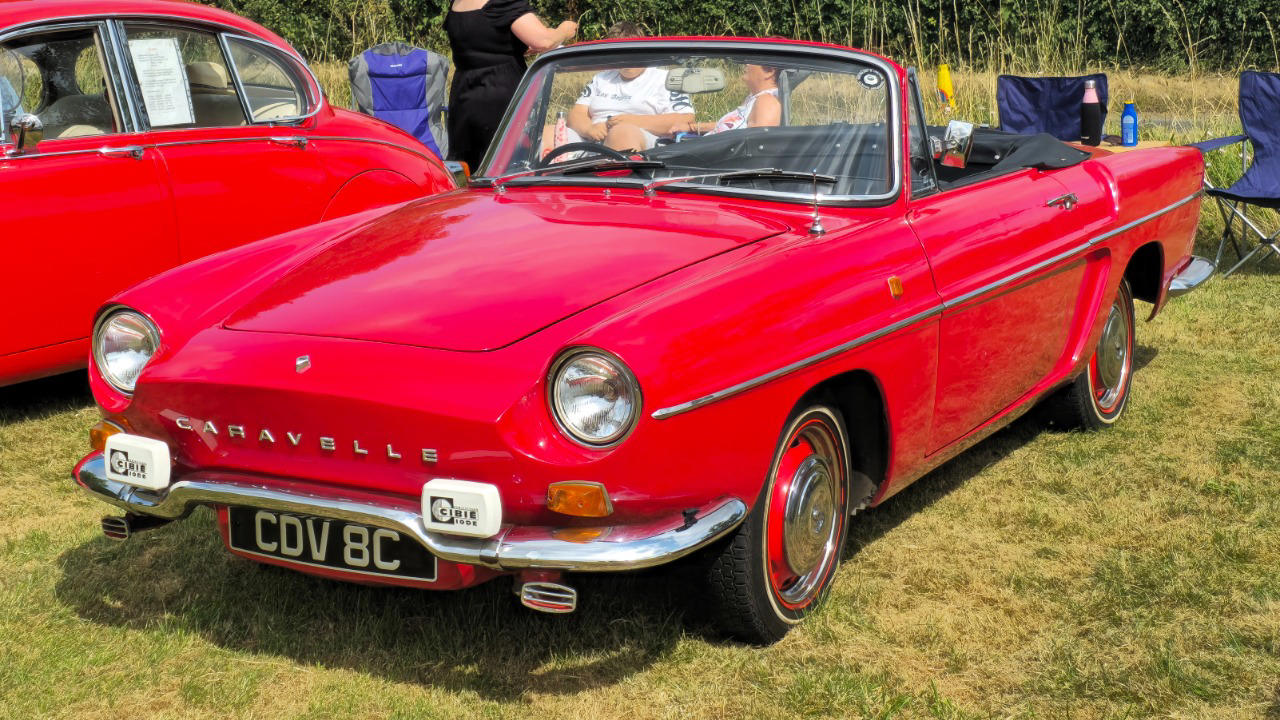



















The 1965 Renault Caravelle leaned into style more than performanceThe 1965 Renault Caravelle was never built to win drag races. It was shaped to turn heads on the promenade, to offer French elegance at modest speeds, and to give drivers a taste of continental style in an era obsessed with horsepower. Half a century later, that decision to prioritize looks and lifestyle over outright pace defines how this compact convertible is remembered. Viewed from today, the Caravelle feels like a time capsule from the 1960s, when a glamorous image and the promise of relaxed touring could matter more than acceleration figures. Its story shows how a manufacturer tried to sell an aspirational sports car experience without sports car performance, and why that tradeoff still appeals to a certain kind of enthusiast. From Floride to Caravelle: a stylish repositioning The model that became the 1965 Renault Caravelle started life as the Floride, a chic coupe and cabriolet spun from the humble Dauphine. The original, Dauphine-based version of the Caravelle, dubbed Floride in its home market, gave Renault a fashion-forward halo car built on affordable mechanicals. According to period coverage, that Floride was later supplanted by an updated design that became the sole type imported from 1965 through 1967, reflecting a shift away from the earlier Dauphine roots toward a more mature grand-touring identity linked to the name Dauphine. Renault had already experimented with the Floride identity in export markets, particularly in North America, where the 1960 Renault Floride Caravelle was marketed as a strikingly different alternative to domestic iron. Enthusiast histories describe how the 1960 Renault Floride, later known as the Caravelle in North America, used its delicate proportions and compact footprint to stand apart from larger American convertibles, and how the combined name Renault Floride Caravelle helped bridge recognition between the original Floride and the later Caravelle badge for buyers who had seen both names in brochures. By 1963, the Caravelle name had been standardized in many markets. Owners’ groups recount that this model name was finally taken over for all other countries in 1963, with all three body styles retaining a familiar rear-mounted four cylinder engine, which kept the basic engineering simple even as the styling tried to project a more sophisticated image. That continuity of layout meant the 1965 car still carried the DNA of the earlier Renault Floride, even as it leaned harder into the Caravelle identity. French elegance on wheels The Caravelle was always sold as an object of style first. A detailed retrospective calls it French Elegance on Wheels and highlights that the Renault Caravelle was presented as a small, graceful sports car with a focus on design and lifestyle. In that account, performance figures such as 145 km, 90 m, 100 km and 62 m appear in the context of its top speed and acceleration, but the emphasis is on the car’s image as French Elegance rather than on any raw numbers from the Fuel System or the Solex carburetor. Renault itself leaned heavily into that image. Another period summary notes that the Renault Caravelle was available in coupe, convertible and hardtop configurations, appealing to a wide range of customers who wanted a fashionable car more than a fast one. Marketing materials presented it as an embodiment of the French art of living, with relaxed open-air motoring and café-side parking as central to the pitch as any specification sheet. That positioning extended beyond brochures. Cultural histories of the model describe how, in the 1960s, the Renault Caravelle was more than just a car, and how it became a symbol of elegance and the French way of life. One widely shared description begins with the phrase In the and continues by framing the Renault Caravelle as a rolling expression of French style rather than a machine to be judged by lap times, underlining how firmly the car was tied to a lifestyle narrative. Celebrity sheen and the Brigitte Bardot connection Renault did not rely on sheet metal alone to sell that lifestyle. Contemporary accounts describe Brigitte Bardot as the godmother of this classic, with her image becoming a true icon for the model. In one evocative profile, The Caravelle is portrayed as a small vehicle that included disc brakes and other modern touches, but the headline detail is that Brigitte Bardot was closely associated with it, which gave the car an instant aura of cinema glamour in the South of France. A separate retrospective on French sports cars from the 1960s refers to a model nicknamed after a movie star and features an interview segment where Robin, a presenter, walks around a Caravelle and comments on its beautiful color and proportions. The clip, introduced with a caption dated Jan and featuring Robin, reinforces how the car still trades on that celebrity aura decades later. The exact performance metrics barely come up in that conversation, which focuses instead on aesthetics and the story behind the car. Under the skin: modest mechanicals Behind the glamorous image, the 1965 Renault Caravelle carried straightforward engineering. Technical listings from a classic car catalog identify the engine in the 1965 model under Engine Specifications as an Inline 4, with the car’s weight recorded in the same table as 1,874 lbs. That data appears in a section labeled Table_title, with references to MMP, Rating and Engine Specifications, and confirms that the car’s basic mechanical package was light and relatively simple compared with larger contemporaries. The same catalog describes how, performance-wise, the 1965 Renault Caravelle was never intended to break records but rather to provide an enjoyable driving experience. That line, anchored under a section labeled Performance, captures Renault’s priorities for the car: adequate power, agreeable handling and an emphasis on comfort and scenery over speed. The catalog entry for the Renault Caravelle in that guide reinforces this by focusing on the car’s character and usability rather than on quarter mile times. Other technical references note that the upgraded cars, first presented at the Geneva Motor Show, eventually featured disc brakes on all four wheels. The Floride and Caravelle line benefited from those improvements, which gave the car more confident stopping power even if the engine output remained modest. The general overview of the Renault Caravelle on Wikipedia places these upgrades in the early 1960s and helps explain why later cars like the 1965 model feel more modern to drive than their early Floride predecessors. Real-world performance: enough, but no more On paper, the Caravelle 1100 S offered performance that was respectable for a small European convertible of its time but unremarkable by sports car standards. Enthusiast figures for the Renault Caravelle 1100 S, produced between 1962 and the mid 1960s, list a top speed around 145 km, which corresponds to about 90 m in miles per hour, and an acceleration time from 0 to 100 km (0 to 62 m) in roughly 17 to 18 seconds. Those numbers, presented in a fan group’s summary alongside references to the Fuel System and Solex carburetor, show why the car felt sprightly enough for boulevard cruising but could not match the pace of more focused rivals. Owner discussions often emphasize that the engine’s character matters more than its outright power. The Solex carburetor and light weight give the car a willing, rev-happy feel, but the Renault Caravelle still needs to be driven with momentum in mind. Drivers talk about maintaining speed through corners and planning overtakes carefully, habits that align with the catalog’s description of an enjoyable driving experience rather than a record chaser. In practical terms, this meant that a 1965 Caravelle could handle everyday traffic and highway cruising in its home market but might feel strained on faster modern roads. The figures of 145 km and 100 km in the enthusiast summary underscore that the car was designed for a world of lower average speeds, where style and open-air comfort counted for as much as acceleration from 0 to 62 m. Design as a selling point Styling was where the Caravelle tried to punch above its mechanical weight. Period commentary credits the car with crisp lines, a reverse-sloped, grille-less nose and carefully set headlamps that gave it a distinctive face. One classic analysis remarks that the Caravelle carried its Ghia styling very well, with the word Its used to introduce a description of those crisp lines and the way they wrapped around the compact body. The reference to Ghia highlights how Renault drew on Italian design cues to elevate a modest platform into something that looked more expensive than it was. Photographs and sales materials from the mid 1960s show how the low beltline, thin pillars and gently rising rear deck gave the convertible a light, almost delicate appearance. The coupe, with its fixed roof and large glass area, looked like a scaled-down grand tourer. These shapes were not simply cosmetic; they helped the car feel airy and gave occupants a panoramic view, reinforcing the sense that the Renault Caravelle was meant for scenic drives and café terraces rather than racetracks. Collectors today often cite those design elements as the main reason to own one. Auction listings for surviving examples, such as a 1965 Renault Caravelle described with Make Renault, Model Caravelle, Type cabrio and Construction year 1965, tend to highlight the Cilinder displacement and mileage but lead with photographs of the bodywork. That emphasis echoes the original sales pitch, where the promise of Ghia-influenced styling did most of the heavy lifting. Pricing, positioning and the value proposition Renault also positioned the Caravelle as a relatively attainable taste of European glamour. A modern pricing guide for a 1965 Renault Caravelle 1100 Coupe RWD Manual lists an MRLP of $3,444 for a representative example, with the entry labeled Coupe RWD Manual and accompanied by sections titled Compare, Search and Overview. While that figure reflects a contemporary valuation rather than the original sticker price, it illustrates how the car still sits in a niche below more expensive classic sports cars, just as it did when new. Back in the 1960s, the Caravelle was pitched as an alternative to cars like the Volkswagen Karmann Ghia and small British roadsters. Commentators who have revisited that rivalry argue that Renault’s offering relied more heavily on its stylish body and French cachet than on performance, which lagged behind some rivals. Yet for buyers who cared more about looking sophisticated than driving quickly, the equation made sense. That value proposition continues today. Enthusiast classifieds often frame the Caravelle as a way to access 1960s European glamour without paying the premiums attached to better known sports cars. The combination of elegant design, modest mechanicals and manageable running costs appeals to collectors who prioritize character over speed. Community memory and cataloged heritage The Caravelle’s legacy is kept alive not only by owners but also by detailed reference material. A dedicated catalog entry for the 1965 Renault Caravelle gathers specifications, ratings and historical notes under sections labeled MMP and Rating and presents them in an Engine Specifications table that spells out details such as Engine and Inline. That catalog, hosted as part of a broader Renault Caravelle Catalog and Classic Car Guide, functions as a snapshot of how the model is now curated as a classic, with structured data sitting alongside narrative commentary. More from Fast Lane Only Unboxing the WWII Jeep in a Crate 15 rare Chevys collectors are quietly buying 10 underrated V8s still worth hunting down Police notice this before you even roll window down