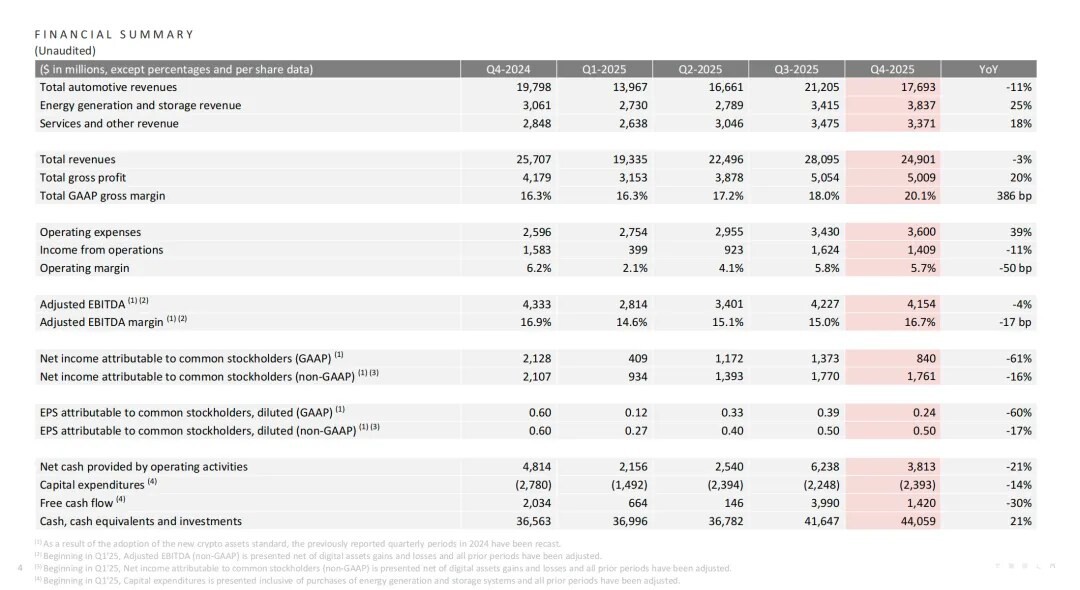
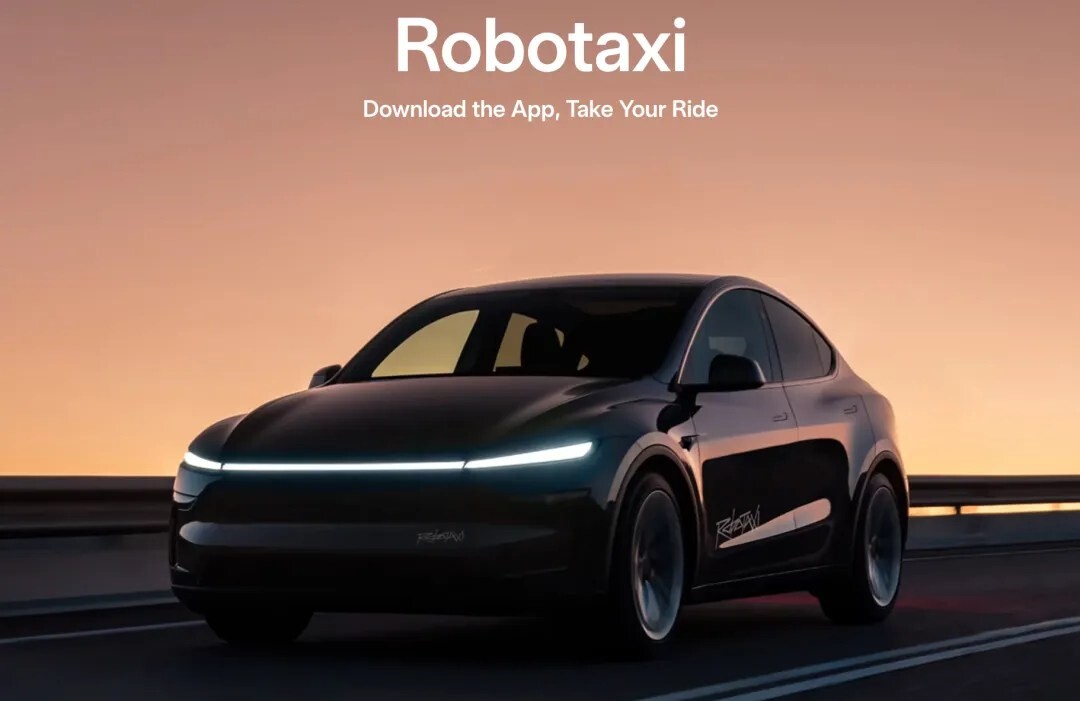
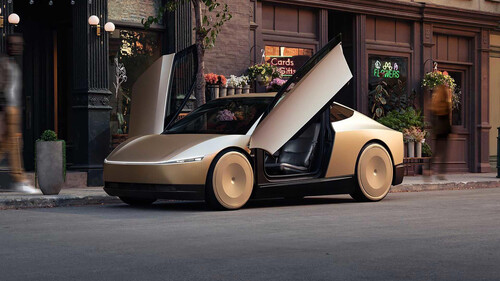
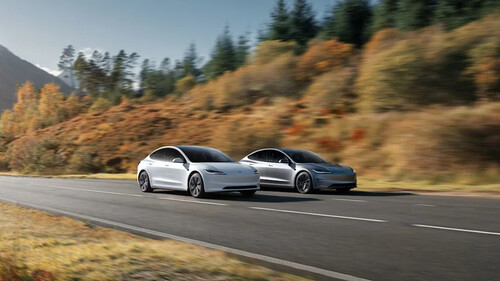
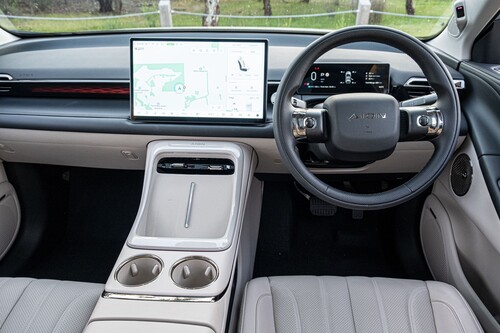
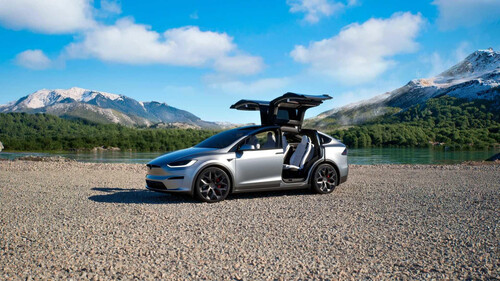
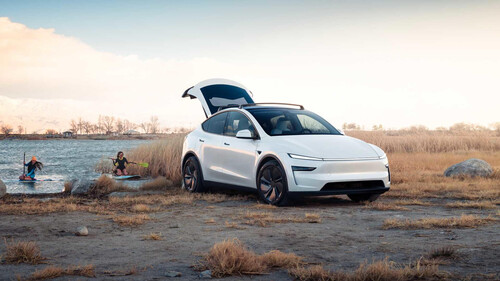
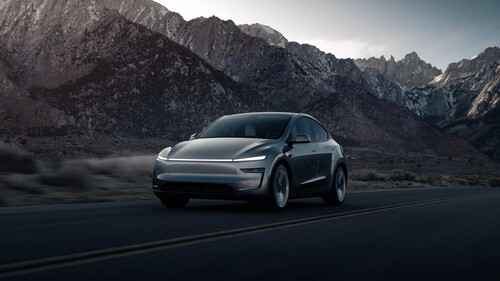
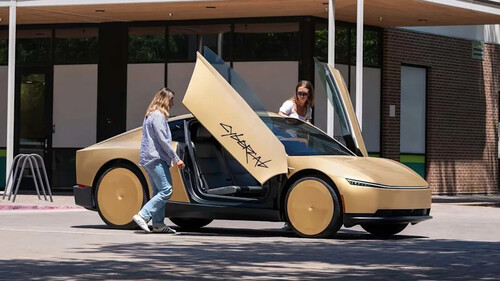
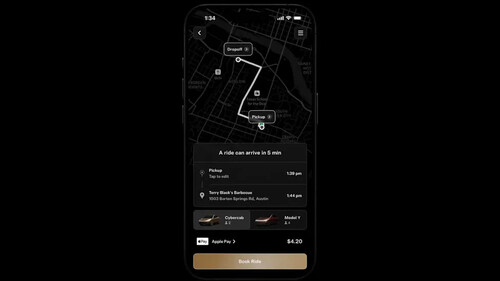
Tesla will discontinue production of its premium Model S and Model X in Q2 2026, shifting focus on physical AI. Early this morning, Tesla officially released its 2025 fourth-quarter earnings and full-year financial report. The most closely watched figure—vehicle deliveries—had already been disclosed earlier this year. To briefly recap, Tesla delivered 418,000 vehicles in the fourth quarter of 2025, down about 16% year on year and quarter on quarter. Full-year deliveries totaled 1,636,129 units, a year-on-year decline of 8.6%, falling below both 2024 and even 2023 levels. On operating performance, Tesla reported fourth-quarter revenue of $24.901 billion, down 3% year on year and 11.4% quarter on quarter. Full-year revenue came in at $94.827 billion, also down 3% year on year—marking the first annual revenue decline since Tesla was founded. Financial data for Tesla from 2021 to 2025 GAAP net profit deteriorated sharply, with fourth-quarter net income at just $840 million, down 60.5% year on year and 38.8% quarter on quarter. Full-year net profit totaled $3.794 billion, down roughly 46%. Tesla attributed the steep fourth-quarter profit decline to increased spending on AI research and development, stock-based compensation, and restructuring-related costs, with operating expenses rising 39% year on year. Still, Tesla’s full-year report was not without highlights. Fourth-quarter GAAP gross margin rebounded to 20.1%, while cash and cash equivalents rose to $44.059 billion by year-end. Energy storage emerged as the standout growth engine, with deployments surging 49% year on year to a record 46.7 GWh. The segment posted record gross profit for a fifth consecutive quarter, reaching $1.1 billion in Q4. Financial data for Tesla from 2021 to 2025 Adjusted earnings per share for the fourth quarter came in at $0.50, beating analyst expectations and lifting Tesla shares by 4% in after-hours trading. FSD subscriptions climbed to 1.1 million, up 38% year on year. Although global EV deliveries declined in Q4, Tesla said Asia-Pacific deliveries reached an all-time high for the quarter. Tesla emphasized that it is in the midst of a transition from a hardware-driven automaker to what it calls a “physical AI company.” The company appears to frame its first-ever revenue decline, two consecutive years of falling deliveries, and sharply lower profits as growing pains of this transformation. Pressure Persists in 2025 Declining annual revenue and profit figures in 2025 closely mirror Tesla’s weakening delivery performance. After peaking in 2023, Tesla’s annual deliveries have now fallen for two consecutive years, even as Asia-Pacific deliveries hit a quarterly record in Q4. In China, Tesla was notably aggressive in 2025. Early in the year, the refreshed Model Y debuted globally in China, followed shortly by a five-year zero-interest financing program. In the second half, Tesla launched the China-specific Model Y L with a three-row, six-seat layout, and rolled out a seven-year low-interest financing offer toward year-end—prompting imitation from Chinese automakers. Tesla Model Y L Despite these efforts, Model Y annual sales still declined sharply, totaling 425,337 units, down about 11.45% year on year. Model 3 sales rose compared with 2024 but failed to reverse Tesla China’s overall delivery decline. Tesla also noted that annual deliveries for models other than the Model 3 and Model Y fell by more than 40%. In the U.S., the much-anticipated Cybertruck reportedly saw deliveries of only about 20,000 units in 2025, down 48% year on year, while continuing to face production constraints. Looking ahead, Tesla said Cybercab and Semi, both slated for mass production in 2026, could help lift deliveries. The company also confirmed that Megapack 3 will enter volume production in 2026, potentially pushing its fast-growing energy storage business to another record year. Musk told investors that, in the long run, Cybercab would become Tesla’s core volume driver, with annual sales “several times” those of other models, though he did not specify a timeline. He also delivered a surprise announcement: Tesla will discontinue production of its premium Model S and Model X in the second quarter of 2026. Tesla Model S Musk said the decision reflects Tesla’s focus on autonomous products, with growth to be driven by lower-cost vehicles and FSD subscriptions, adding that Model S and X are no longer aligned with the company’s future plans. The end of Model S and Model X marks the close of an era. Model S entered production in 2012 and set the design and interior template for most subsequent Teslas, while Model X followed in 2015. Both models were refreshed in 2021 and later gained three-motor Plaid variants, delivering dramatic performance gains, with the Model S Plaid joining the “two-second club” for 0–100 km/h acceleration. Model S Plaid In China, the 2026 Model S starts at RMB 855,900 ($119,826), while the 2026 Model X starts at RMB 895,000 ($125,300). The China Passenger Car Association has not disclosed 2025 China sales for these models, though global Model S/X deliveries are estimated at around 30,000 units. This strategic adjustment aligns with Tesla’s broader shift in vision. More pragmatically, as Musk noted, Tesla’s capital expenditures in 2026 will be “very large,” requiring sustained investment in AI, autonomous driving, and other high-potential areas. Shift to ‘Physical AI’ Musk argued that heavy spending on R&D and infrastructure will lay the foundation for Tesla’s transformation and is a necessary step toward future-facing businesses. On the earnings call, he said Tesla’s 2026 capital expenditures will surge to $20 billion, covering expansion of production lines for new products such as robots, development of the AI5 chip, and investments linked to xAI. He went further, suggesting Tesla may need a massive integrated “Tera Fab” capable of combining logic chips, memory, and advanced packaging to meet surging compute demand. Tesla AI5 chip AI6, he said, will be initiated and enter development within a year. Tesla has not ruled out that $20 billion in annual spending could extend beyond 2026. Musk was unequivocal about the transformation. In mobility, he said Tesla will ultimately produce only autonomous vehicles, envisioning a future where any Tesla owner can turn their car into a Robotaxi via FSD. He predicted that human-driven travel could fall to 5%, or even 1%, over time. Tesla already operates a Robotaxi fleet of more than 500 vehicles in the U.S., Musk said, with the fleet potentially doubling every month. Tesla Robotaxi Tesla’s service centers, charging network, and other infrastructure are positioned to support rapid expansion. Unsupervised Robotaxi services have already begun in Austin, Texas, with scale expected to increase once charging and engineering challenges are resolved. On FSD, Musk said the system has achieved 100% unsupervised operation in certain scenarios, though he disclosed no further details on upcoming versions. Musk also linked the Model S/X phase-out to the Optimus robot program, noting that production capacity will be reallocated to the third-generation Optimus, set to debut in the coming months. The new Optimus is described as more human-like, capable of learning by observing human behavior, verbal instruction, or video data. Tesla aims for annual Optimus orders of up to 1 million units and is ramping up investment and factory retooling accordingly. Tesla Optimus Meanwhile, Musk expects the energy business to continue delivering outsized growth and said Tesla plans to integrate further into the solar value chain, from raw materials to finished solar panels. Taken together, Musk outlined a post-2026 Tesla centered on three pillars—autonomous vehicles, general-purpose robots, and energy storage—underpinned by proprietary AI hardware and software. AI chips, he said, are “the most critical issue” for the company’s future, reinforcing Tesla’s ambition to become a true “physical AI company.” Only the Paranoid Survive At the start of 2026, it remains difficult to judge whether Tesla’s high-stakes transformation will pay off. But Tesla’s history—and Musk’s career—suggest that bold gambles have often been central to its success. “Only the paranoid survive,” Musk reiterated in response to the final question on the call, quoting the maxim that has long guided him. He said Tesla’s recent changes are driven by necessity rather than choice, citing once-controversial moves such as building lithium refining and cathode plants that later proved essential to Tesla’s resilience. Against a backdrop of slowing global EV growth, Tesla’s pivot toward AI-centric businesses may be rational. Notably, many Chinese EV startups also embraced AI-driven transformations in 2025—though Tesla’s shift is arguably more sweeping. Looking ahead to 2026, Tesla faces several unresolved challenges. First, can it reverse the decline in annual vehicle deliveries, particularly in key markets like China amid intensifying local competition? Second, Cybercab’s rollout and regulatory approval remain uncertain. In China, for example, there is no clear regulatory pathway for vehicles defined as two-door, two-seat models without steering wheels or pedals, casting doubt on near-term growth prospects. Third, large-scale commercialization of Optimus will inevitably face competition from rapidly advancing Chinese robotics companies. Musk acknowledged this on the call, saying China “will definitely be a strong competitor.” He argued Tesla’s advantages lie in real-world AI capability, greater dexterity and flexibility of its robotic hands, and mass-production expertise—but Chinese general-purpose robots are advancing quickly and will pose a serious challenge globally. Finally, both Robotaxi and humanoid robots remain largely unproven commercially, leaving Tesla’s chosen battlegrounds still largely uncharted. These uncertainties suggest that volatility will define much of Tesla’s 2026. Perhaps the answer will become clearer a year from now—when the world can judge whether Musk’s latest act of “paranoia” once again reshaped the future.