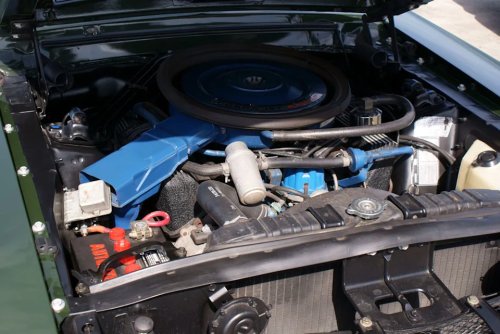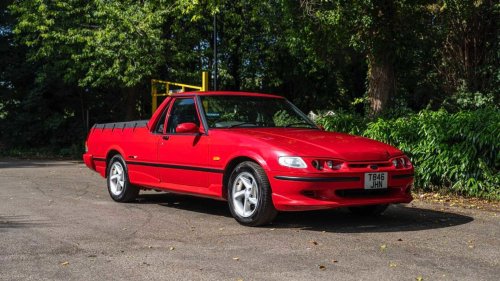
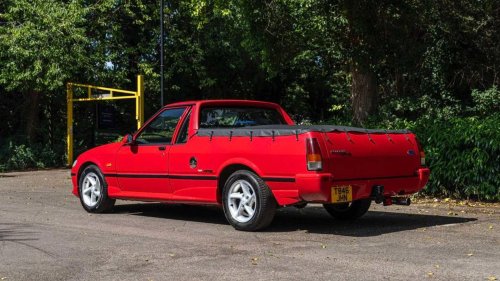
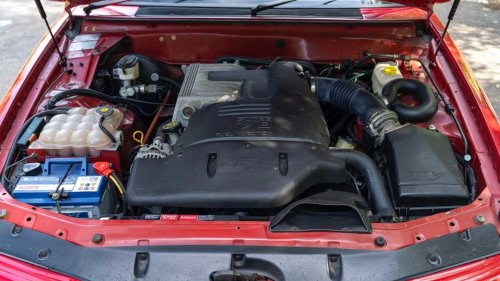
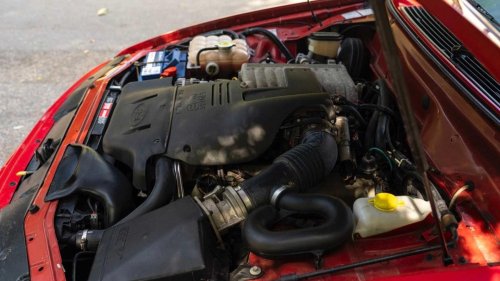
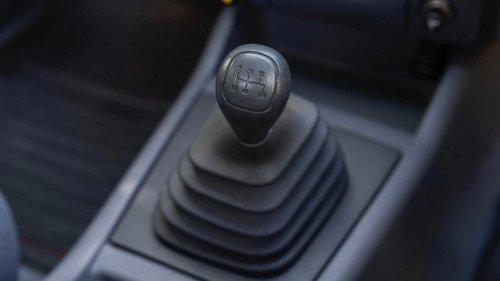
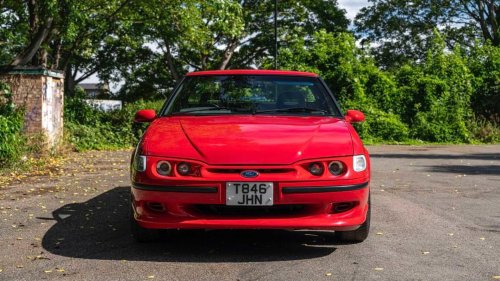
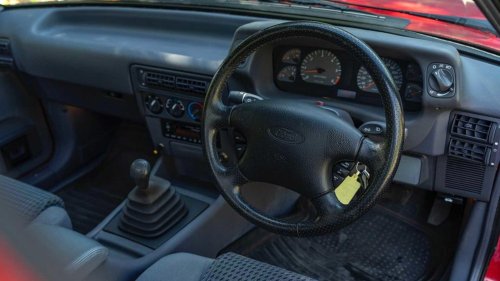
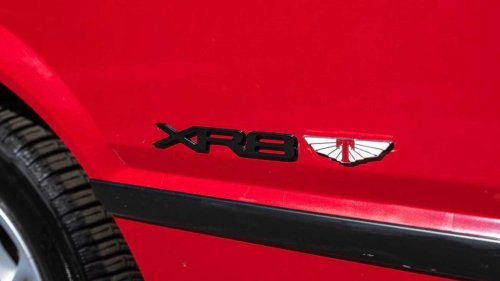
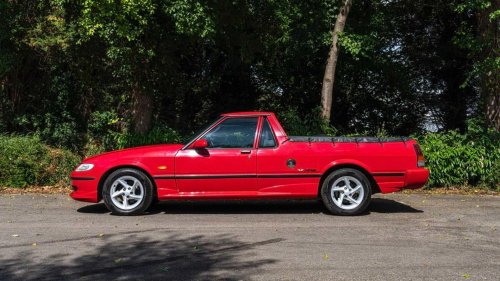
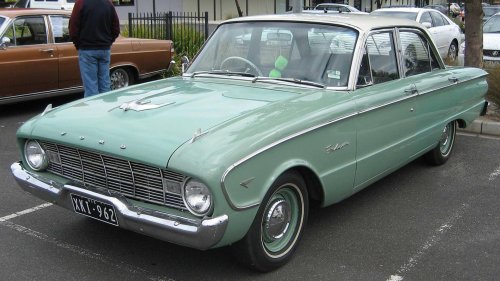
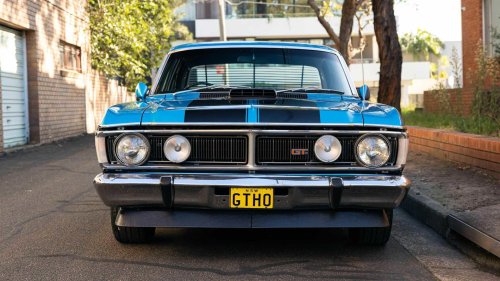
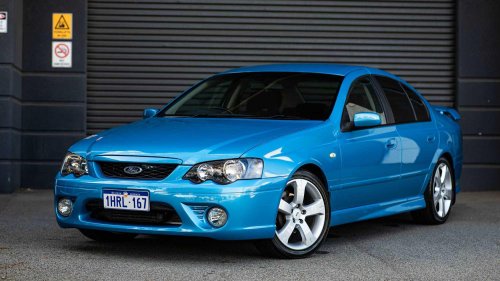


















While the pickup truck is a widely popular segment in the US, things are quite different over in The Land Down Under. Down there, the pickup (as we know it) doesn't carry nearly as much popularity as it does here. However, the car-based pickup truck called the "Ute" is exceptionally exceptionally popular. The ute still ranks among the top five most popular vehicle segments on the continent, and it's been that way for some time.There have been many utes over the decades that were designed with performance in mind. After all, most utes are, in fact, car-based, so swapping in a hot engine and some tuned suspension components from the factory isn't all too hard. Take our model of interest, the Ford Falcon Ute XR8 XH Series II. It was an extremely rare model when it first hit the market, and fewer than 700 were produced. However, even more rare are manual-equipped examples, of which just over 200 are thought to have been built. Great For Both Work And Play CarandClassic.com Much like how the old-school pickup truck was largely relegated to work duties in the US, the ute was also a work-exclusive vehicle throughout the mid-20th century and beyond. However, during the late 1980s and 1990s, the ute started to adopt a performance-oriented personality alongside its blue-collar attitude. Arguably, the ute that really kicked things off regarding performance was the 1990 Holden Special Vehicles (HSV) Maloo, which produced 241 horsepower from a 5.0-liter V8.However, near the end of the 1990s, Ford of Australia decided to take a concrete stance in the performance ute market. The brand introduced the Falcon Ute XR8, part of the XH Series II. Alongside the XR8 – which was equipped as standard with a 5.0-liter V8 – Ford also brought forth an XR6 iteration, which came with a 4.0-liter inline-six engine. However, XR6-grade Falcon XH Series II models are not considered rare.CarandClassic.com What is rare, though, are the XR8 models, produced between 1997 and 1999. It's commonly thought that roughly 624 examples were produced in total between 1997 and 1999. However, of those 624 models, only 212 came with manual transmissions. Tickford, Ford of Australia's tuning arm, helped design some of the XH Falcon XR8's underpinnings, along with its quad-headlight front fascia, which it shares with the standard Ford Falcon four-door EL XR8 sedan. Under The Hood CarandClassic.comPowering the XH Series II Falcon XR8 is a Ford 5.0-liter V8. Much like the 5.0-liter Ford V8 found in the US, the XR8 takes advantage of the 302 Windsor eight-pot. The engine itself is part of the long-standing Windsor family's final iteration, and boasts features like electronic sequential fuel injection. Interestingly, the 302 Windsor V8's roots can be traced all the way back to the late 1960s, when the brand needed a new engine for its GT40 race car, as a Le Mans rule changed, capping engines at 5.0 liters of displacement.CarandClassic.com As for the rest of the XH Series II Falcon XR8, it took advantage of a "T5" five-speed manual transmission produced by Tremec, a brand normally associated with General Motors performance vehicles produced around the same time. Automatic-equipped models received a four-speed made by BorgWarner Australia. Its suspension was honed by Tickford, and boasted stiffer springs and shocks, along with upgraded sway bars. Its ride height was also lowered.CarandClassic.com However, despite its athletic suspension setup, it maintained a 1,168-lb maximum payload capacity, the same as the standard XH-series Falcon. In addition, a special limited-slip differential (LSD) sporting a 3.45:1 gear ratio is standard kit.CarandClassic.com What You'll Get & How Much You'll Pay CarandClassic.comBeing a ute, the Falcon XH Series II XR8 doesn't come with things like built-in drink coolers and television sets. Instead, things are rather bare-bones inside its two-seater cabin. However, a couple of creature comforts were included with the XR8 package. For starters, buyers are granted the use of manual air conditioning, along with cruise control and an upgraded stereo. Instead of a bench seat, two bolstered bucket seats with extra side bolstering are included.CarandClassic.com On the outside, that Tickford front fascia with its four headlights takes center stage. Along its flanks sit a pair of "XR8" badges. Around the back, things are rather standard fare for the XH Series II Falcon, apart from another XR8 badge and an enlarged exhaust tip. Its cargo bed measures 81 inches long by 61 inches wide. A special set of 16-inch wheels comes standard with the Falcon XH Series II XR8, as well. Current Pricing CarandClassic.comThis ute is rare, meaning its pricing will, unfortunately, reflect that. In addition, most XH Series II Falcon XR8s still reside in Australia, meaning they'd need to be imported to the US. However, because the 25-Year-Rule has elapsed, you can now legally do so.Accurate current pricing metrics are few and far between. However, one site by the name of CarSales.com.au shows a typical "indicative" price of anywhere between $6,900 and $8,100. Of course, if you're importing one, there will be numerous other fees attached to that price. When all is said and done, the total cost could very well exceed $10k. The Falcon's Place In Australia Wikimedia Commons: SicnagWhile the US did have a Ford Falcon of its own from 1960 to 1970, the namesake was much more popular, and longer-lasting, in the Australian market.It was first introduced in 1960. At the time, Ford was having a hard time Down Under. Holden, a General Motors subsidiary operating in Australia, was gaining popularity quickly, and Ford's sales were suffering as a consequence. Ford's offerings in the late 1950s were models like the Zephyr and Zodiac, both of which were designed for the English market. Despite a modest amount of success for both nameplates, Ford still could not compete with Holden's lower prices, necessitating an all-new, Australian-market model.However, this endeavor was going to prove expensive. Reportedly, on a trip to Detroit, Ford of Australia executives became enamored with the as-yet-unreleased Ford Falcon destined for the US market. The car itself met all Ford of Australia's criteria, and was the correct size to serve as a direct Holden competitor. With a healthy amount of experience building American cars, Ford Australia struck up a deal with Ford HQ, and brought the Falcon back with them.CollectingCars Production began in earnest in late 1959, and sales began sometime in early 1960. The Australian Falcon was a hit, virtually right off the bat. However, a litany of issues stemming from its inability to handle the harsh Australian outback quickly cropped up. The hit to its reputation was so bad that it, reportedly, turned many folks away from the Falcon. However, the second-gen Falcon, also known as the "XL" generation, attempted to address the issues regarding suspension durability, with further improvements made over the next few generations.CollectingCars.com By 1977, the Falcon had become Australia's bestselling car. Continuing into the 1980s, it kept its popularity near a peak, consistently outselling its Holden-bred competitor, the Commodore. During the 1990s, the Falcon managed to secure a large chunk of the Australian fleet sales market, along with the hugely popular ute segment. But all good things must come to an end and come the 2010s, the Falcon's stranglehold on the market dwindled, resulting in the storied nameplate's axing in 2016.