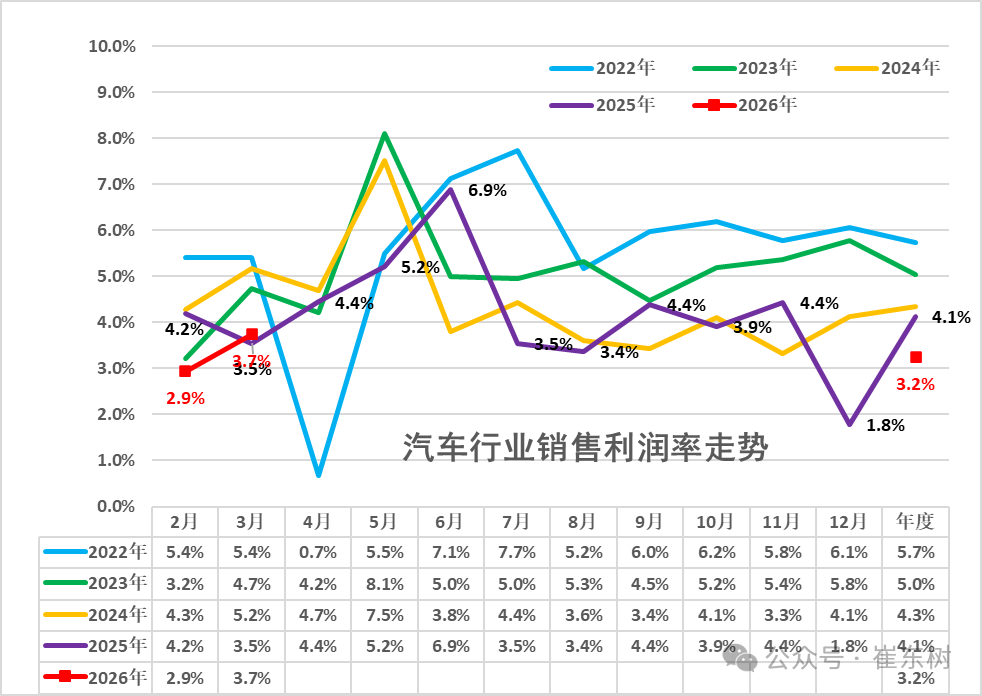
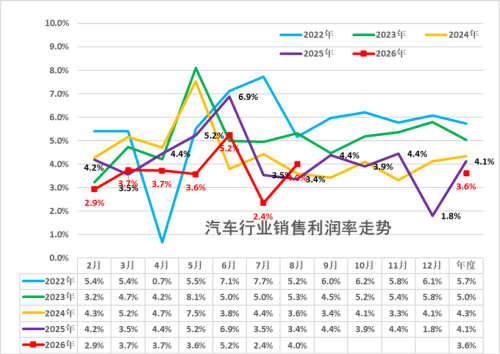
Gasgoo Munich- Data cited by Cui Dongshu, secretary-general of the China Passenger Car Association (CPCA), shows China's auto output reached 7.15 million units in the first three months of 2026, a 6% decline from the previous year. During this period, total revenue for the automotive sector stood at approximately 2.41 trillion yuan, dipping 0.2% year-on-year, while total costs climbed 0.7% to 2.14 trillion yuan.Source: Cui DongshuSqueezed between falling revenue and rising costs, the auto sector's total profit for the first quarter slumped 18% year-on-year to 78.4 billion yuan, dragging the sales margin down to 3.2%. Although the profit margin for March alone rebounded to 3.7%—improving on the 2.9% seen in January and February—it remains near historical lows.The auto industry's profitability lags significantly behind the broader downstream industrial sector. While the average profit margin for downstream industries hovered around 6% in the first quarter, automakers managed just 3.2%—nearly half that level. Meanwhile, upstream mining profits remained elevated, with the non-ferrous metals sector logging a 39.1% jump and the oil industry's margin surging to 32.9%, creating cost pressures for mid- and downstream sectors. With lithium carbonate prices doubling and commodity prices staying high, raw material costs for manufacturers continue to mount.On a per-vehicle basis, revenue came in at 337,000 yuan in the first quarter (including double-counting), up 5.4% from a year ago. However, cost per vehicle rose 6.3% to 299,000 yuan. Taxes per vehicle increased 3.9% to 27,000 yuan, while gross profit per vehicle tumbled 13.2% to 11,000 yuan.Analysts note that because most automakers do not produce batteries directly, their profit sustainability is at risk as domestic battery prices soar even as export prices fall. Adding to the strain, consumer sentiment remains cautious, keeping operational pressure high. Although local governments are pushing "trade-in and equipment renewal" policies to boost domestic demand, profitability in the auto sector is recovering much more slowly than in other consumer goods areas.