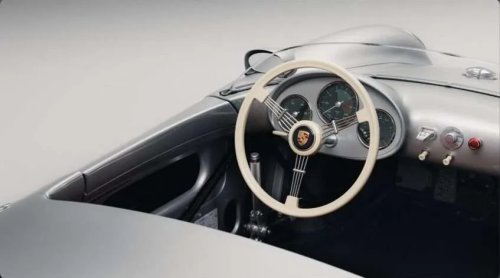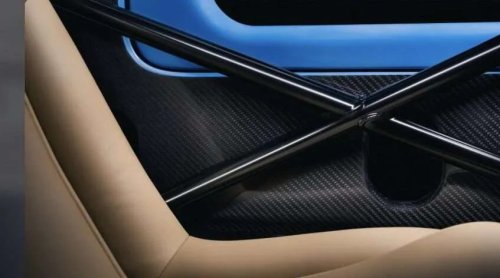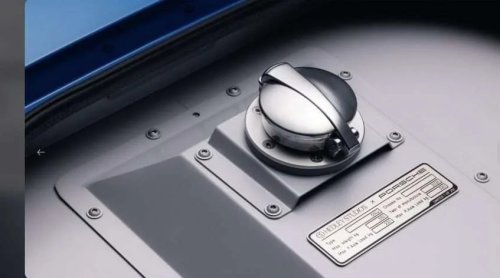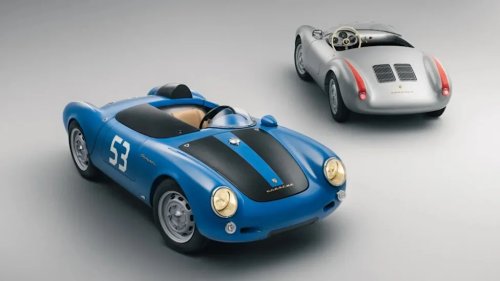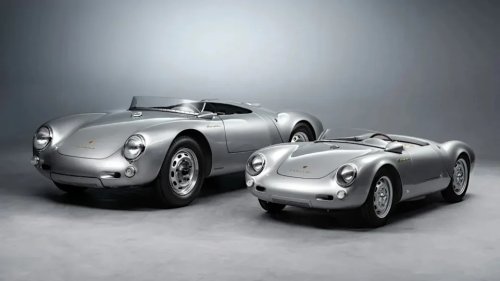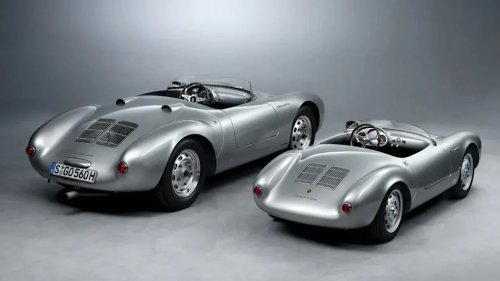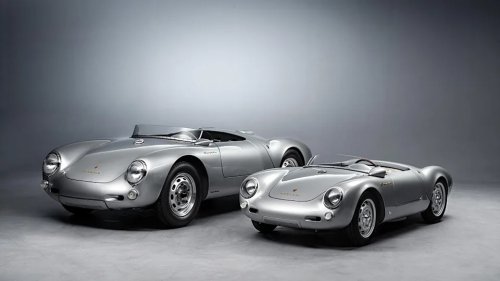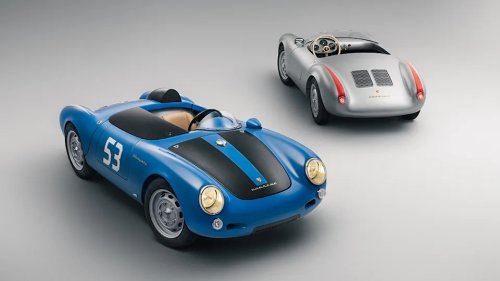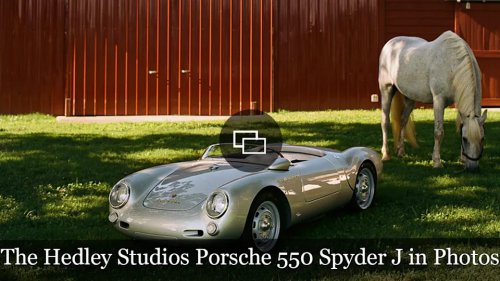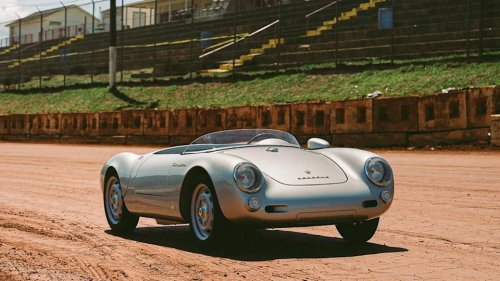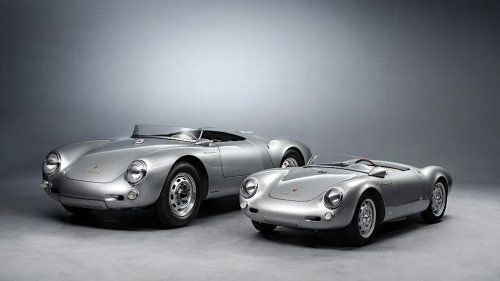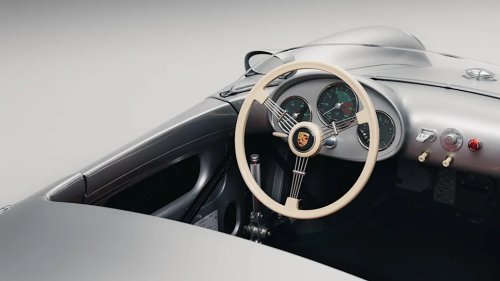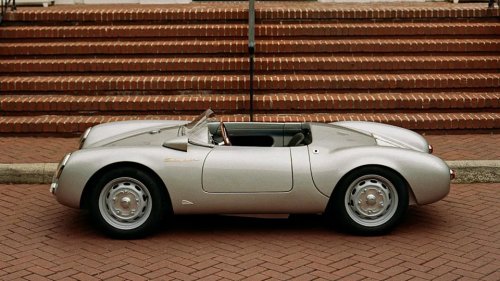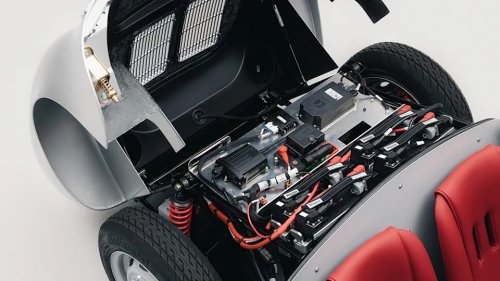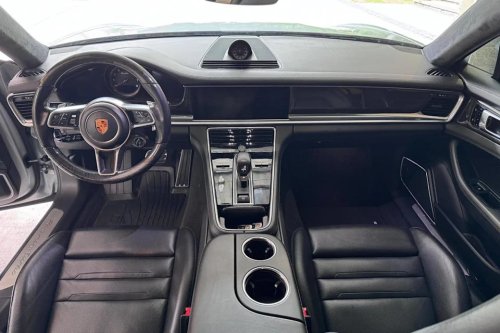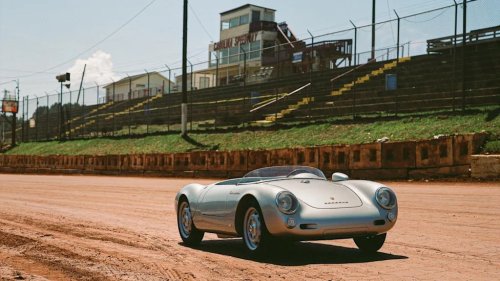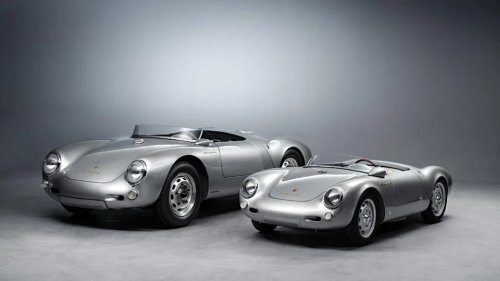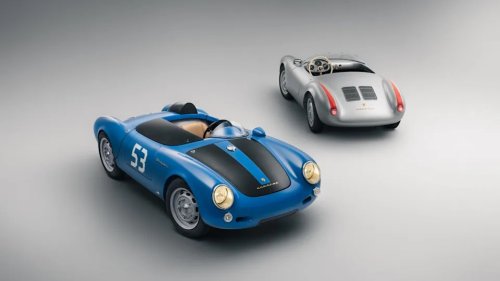
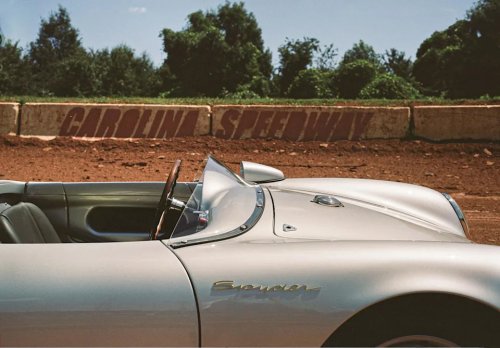
















Porsche Licensed an 80-Percent 550 Spyder That Runs on 48 Volts — and Can’t Legally Touch a RoadBackfire NewsEL PuckettMon, September 21, 2026 at 2:00 PM UTCAdd us on GooglePorsche has signed its name to a 550 Spyder that stands about four feet wide, carries no engine, seats two adults, and cannot be registered in any country on earth. It is called the Porsche 550 J, it is built in Oxfordshire by Hedley Studios, it is capped at 250 examples, and it starts at £69,500 before local taxes. First deliveries land in spring 2027.The easy reaction is to file this under expensive toys and move on. That would be a mistake, because the engineering decisions underneath it are unusually disciplined, and the legal status of the thing is genuinely strange in a way that matters to anyone who actually writes the check.Eighty percent is a much bigger reduction than it soundsPorsche lists the 550 J at roughly 2.9 metres long and 1.2 metres wide — about nine and a half feet by four. That is 80 percent of the original's linear dimensions, and linear scaling is deceptive. Cube it and you get 0.512, meaning the 550 J occupies barely half the volume of the car it copies. Anyone who has tried to package two adults, a battery pack, a drivetrain and real suspension travel into half a car's worth of space will recognize why this took more than 1,300 bespoke components.AdvertisementAdvertisementHedley Studios didn't eyeball the shape either. Porsche opened its corporate archives in Stuttgart-Zuffenhausen and handed over original drawings, and the team 3D-scanned cars from the Porsche Museum. That level of access is the difference between a licensed product and a tribute, and it's the same instinct behind the factory's willingness to homologate a single Flachbau RS like a production car rather than let a one-off exist as a loophole.Side by side, the 80 percent figure finally makes sense. Photo: Hedley StudiosThe 48-volt choice is the smartest thing in the carThe 550 J runs a 48-volt electric drivetrain, mid-mounted, making 8 kW — 11 horsepower — in standard form. That number is going to get laughed at, and it shouldn't be, because 48 volts is a regulatory decision dressed up as an electrical one.International EV safety standards draw the high-voltage line at 60 volts DC. Stay under it and the vehicle is not a high-voltage system: no orange cabling requirements, no insulated gloves, no specialist certification to open the thing up, no first-responder disconnect protocol. Cross it and the entire ownership and service picture changes, and so does the cost of building a car in small numbers. At 48 volts, a competent mechanic — or a careful owner — can work on a 550 J without a high-voltage qualification. For a machine that will spend its life in private collections and on estate driveways rather than a dealer network, that's worth far more than another 20 horsepower.The same thinking runs through the charging. Standard cars get two 1.8 kWh lithium-ion packs behind the seats, for 3.6 kWh total; the RS Pack doubles that to four packs and 7.2 kWh. Hedley quotes an estimated five to six hours to charge, which works out to somewhere around 1.2 kW. That is a household socket. No wallbox, no electrician, no permit.AdvertisementAdvertisementRun the efficiency math and it's genuinely impressive: 7.2 kWh for a claimed 50 miles is about 144 watt-hours per mile, and the standard car's 3.6 kWh over 30 miles works out closer to 120. A full-size electric sports car is lucky to see 300. Mass is the whole story — 330 kg standard, 350 kg with the RS Pack's extra cells.Analog dials, a wood-rimmed wheel, and a toggle-switch dash — none of which hint at 48 volts underneath. Photo: Hedley StudiosPeriod-correct geometry, modern hardwareHedley kept the original's suspension layout: twin trailing arms at the front, swing axles at the rear. That is a period-honest choice and a slightly mischievous one, because swing-axle rear ends are famous for camber change under load — the geometry that made 1950s and 1960s cars so interesting to drive quickly. Scaled down, speed-limited and fitted with modern damping, it becomes a teaching tool rather than a liability.The hardware doing the actual work is contemporary: Bilstein dampers, Eibach springs, Brembo brakes and Continental tires. The RS Pack adds drilled discs with sintered pads, painted Brembo calipers and adjustable Bilstein coilovers, plus a Race-Tex-inspired interior. Four driving modes — Novice, Comfort, Sport and Race — sit behind a variable speed limiter that can be dialed all the way down to 10 mph. That limiter is the single most practical feature on the car, and the reason a 250-unit run of unregistered vehicles is insurable at all.Standard or RS: what the money actually buysStandard specification is 8 kW (11 hp), up to 40 mph, up to 30 miles of range and 330 kg. The RS Pack takes output to 16 kW (22 hp), top speed to 50 mph, range to 50 miles and weight to 350 kg. Doubling the power for a 20 kg penalty is the kind of trade nobody in the full-size car business gets to make anymore.AdvertisementAdvertisementWorth noting for buyers: top speed varies by market because of local law, and the limiter is adjustable. If you are buying this for a teenager to learn car control on a private circuit, the standard car with the limiter wound down is the correct answer. If you are buying it because you want the thing to actually challenge you on a kart track, the RS Pack's extra range matters more than its extra 11 horsepower.The twin rear deck grilles are faithful. What's under them is not a Fuhrmann four-cam. Photo: Hedley StudiosWhere you can legally keep onePorsche and Hedley are both explicit: the 550 J is not homologated for public roads, and it carries a CE classification. In Europe that means it is certified as machinery, not as a vehicle. There is no type approval, no VIN in the regulatory sense, no plate.For American buyers, that is quietly good news. Federal law defines a motor vehicle as something manufactured primarily for use on public roads, which is precisely what the 550 J is not. It therefore doesn't enter the country as a nonconforming vehicle, which means none of the 25-year import theater that keeps buyers waiting decades for cars like the Nürburgring-tribute GT3s Americans can't legally own until 2052. It arrives as equipment. The flip side is that equipment doesn't get license plates, ever, so this lives in the same legal neighborhood as Porsche's track-only 911 Challenge — bought to be driven, never to be driven anywhere useful.The insurance consequence is the part people get wrong. A machine with no registration and no title does not belong on a standard auto policy. It needs to be scheduled — a personal articles or collections endorsement, or an inland marine policy if it travels to events. Call your agent before the deposit clears, not after the truck arrives, and make sure the policy covers the car while it's being operated and not just while it's sitting in a garage.The history Porsche is actually sellingThe 550 Spyder was the first Porsche developed specifically to go racing, and the run that made its reputation was the 1954 Carrera Panamericana. Factory drivers Hans Herrmann and Jaroslav Juhan took two of them across 3,077 kilometres of Mexican road — roughly 1,912 miles — over five days. Herrmann finished ahead of Juhan by 36 seconds. Thirty-six seconds, after nearly two thousand miles.AdvertisementAdvertisementThey came home third and fourth overall against cars with vastly larger engines, and won their class. Porsche liked the result enough to borrow the race's name permanently, which is why every Carrera badge Porsche has sold since traces back to a pair of small-displacement roadsters beating the odds in Mexico. Most people who own a 911 Carrera have no idea their car is named after a Mexican road race that the 550 Spyder made famous."The Porsche 550 Spyder marked a milestone in the company's history as it was the first Porsche developed specifically for motorsport; a car capable of competing with and beating the best in the world," said Ben Hedley, founder of Hedley Studios.Gold Spyder script, wraparound screen, chrome trim — scaled down, not simplified. Photo: Hedley StudiosThe buyer math£69,500 is the entry price, and "plus local taxes" is doing real work in that sentence. A UK buyer paying 20 percent VAT is looking at £83,400 before a single bespoke option. Hedley will handle shipping, import and customs on request, which is a line item, not a courtesy. Build the budget around the delivered number, not the headline.Multiply the base price by the 250-unit cap and the program is worth at least £17.4 million before anyone ticks a box, and Hedley is betting heavily that buyers will. Paint to Sample, historic and contemporary color choices, motorsport liveries and a full bespoke commission program mean the company expects almost no two cars to match. That's the same playbook Porsche runs through Sonderwunsch, which turned three Toy Story 911s into a $3 million charity stunt, and the same one that made Singer's Louis Vuitton collaboration work.AdvertisementAdvertisementIf you're buying with any eye on resale, the usual limited-run rules apply and they apply harder here. Documented build number, unmolested delivery spec, original paperwork and the RS Pack will carry value. Deeply personal Paint to Sample choices will not, no matter how good they look in your garage. And with deliveries starting in spring 2027, there is a long window in which early cars will change hands before anyone has driven them much.Why Porsche is doing this at allBrand licensing is one of the highest-margin activities a car company can engage in, and Porsche is doing it from a position of pressure rather than comfort. This is a company that recently cut 5,000 jobs and froze perks to protect the 911 and cashed out of Bugatti Rimac for $1.2 billion. Against that backdrop, licensing the 550 Spyder's shape to a specialist who assumes all the manufacturing risk — and collecting a fee on 250 units in the process — is simply good business.It also keeps the 75 Years of Porsche Motorsport anniversary in front of an audience that will never buy a race entry, in the same way the Road America throwback liveries sold heritage to people watching from a hillside. "The Porsche 550 J celebrates this unique heritage and brings the story of one of the most significant sports cars in our company's history back to life in a contemporary and inspiring way," said Deniz Keskin, Porsche AG's director of brand partnerships and sponsorships.Strip the marketing away and what's left is a carbon-bodied, spaceframe-chassis, mid-motor two-seater with real brakes, real dampers and a drivetrain engineered around a regulatory threshold instead of a spec sheet. Whether that's worth £69,500 is entirely a question of what you already own. But it's a considerably more serious object than the phrase "80 percent scale" suggests.AdvertisementAdvertisementYour Turn: Would a scaled-down, road-illegal 550 Spyder tempt you, or is it a hard pass? Tell us in the comments.