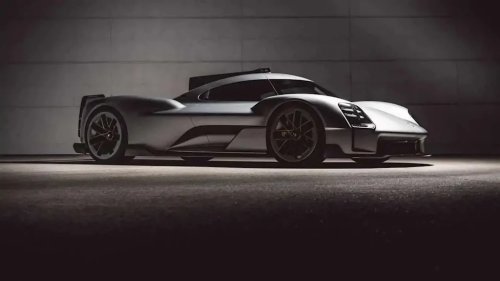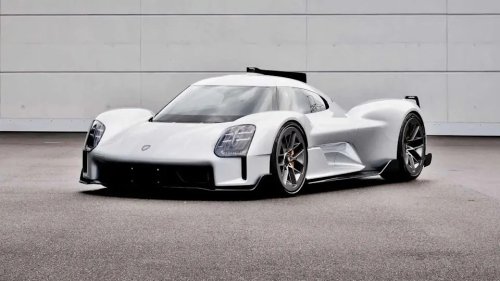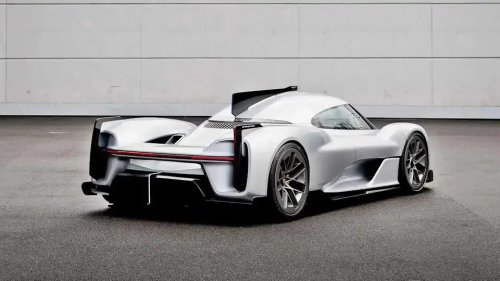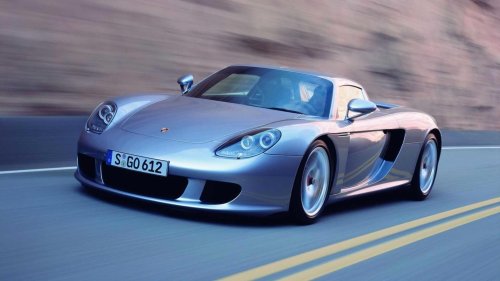
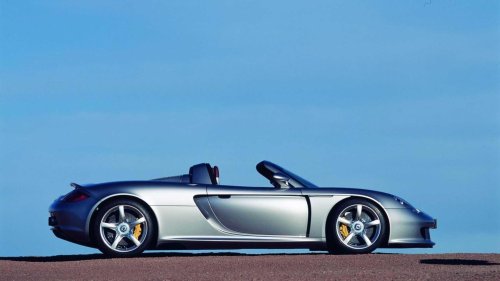
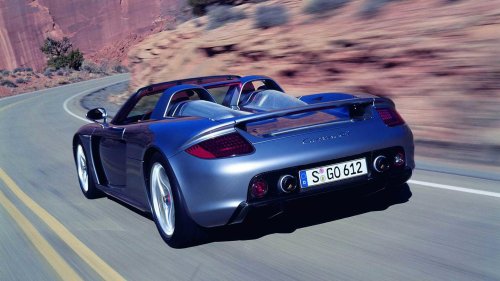
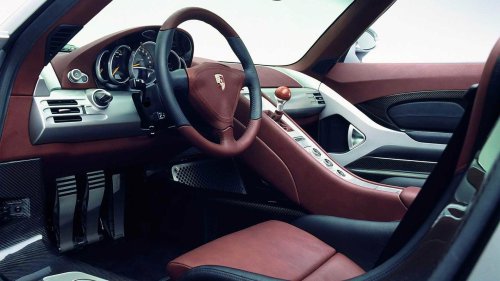
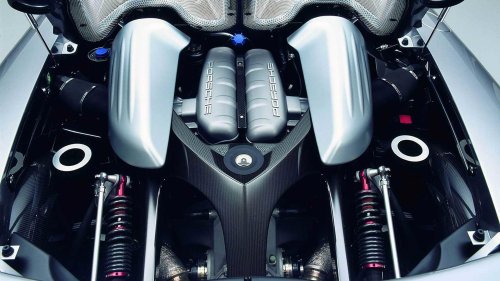
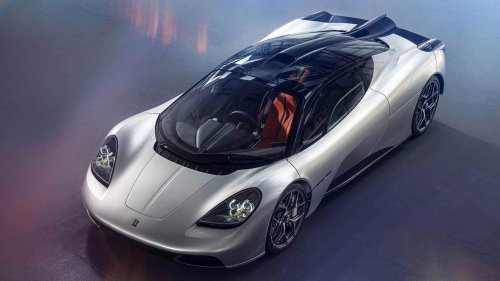
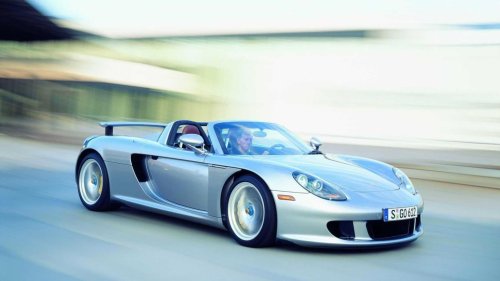



















It was at the 2000 Paris Motor Show that Porsche first stunned the automotive world with the Carrera GT. Intended as little more than a showcase of Porsche engineering, the V10-powered supercar, which at the time was only a concept, became an instant sensation and Porsche soon gave the green light for production, fast-tracking it so that the first customer cars were rolling off the line as soon as 2003.Porsche But as brilliant as it was, the Carrera GT arrived in the shadow of the Ferrari Enzo and Mercedes-Benz SLR McLaren, two rivals that generated bigger headlines and embraced the latest technology. Porsche's insistence on a traditional manual made the Carrera GT seem old-fashioned in an era increasingly obsessed with paddle shifters. Today, that analog purity is precisely what sets it apart. As modern supercars have grown faster, heavier, and more computerized, the Carrera GT has become one of the most coveted driver's cars ever built, and its value has climbed accordingly.This article is for informational purposes only and should not be considered financial or investment advice. Vehicle values and market data reflect conditions at the time of publication and are subject to change. Porsche Carrera GT Values Have Skyrocketed Porsche The Carrera GT was never a bargain, but its original MSRP of $440,000 undercut the SLR McLaren by several thousands and landed at roughly two-thirds the price of the Enzo. Porsche ultimately built 1,270 examples over four years, giving buyers a relatively realistic shot at ownership compared with the Enzo’s far more exclusive run of 399 cars. Key Facts To Know Offered for the 2004 and 2005 model years in the US Uses a V10 engine based on a design from canned Formula 1 and Le Mans programs Features different color centerlocks (blue and red) on each side to mark different threads Fast-forward two decades, and the math gets a lot more interesting. A Carrera GT bought new and held until today would be worth multiple millions, placing it among the strongest appreciating supercars of its era. Adjusted for inflation, that original MSRP comes out to roughly $790,000 in today’s dollars, yet recent market data from Classic.com puts average transaction prices above $3 million (a real return of 280%), with standout examples trading as high as roughly $6.7 million. Few supercars from the early 2000s have climbed this steeply, holding costs notwithstanding.The main exception is ultra-limited exotics like the Ferrari Enzo, the value of which has risen even further on extreme scarcity, with average prices now well into eight-figure territory. But what’s particularly interesting about the Porsche is that its ascent hasn’t been as linear as the Ferrari’s.The Carrera GT spent much of its life hovering below the million-dollar mark, only breaking decisively into seven-figure territory after 2020. That inflection point reflects a shift in perception as buyers began to fully appreciate its analog character and recognize it as something of a watershed moment, marking the end of an era for traditional, unfiltered supercars. The Ultimate Analog Supercar Porsche In an era when computers increasingly mediate the driving experience, there's something refreshing about a car that still relies almost entirely on the driver's skill. The Carrera GT isn't completely devoid of electronic aids – it has ABS and traction control – but notably lacks electronic stability control, a deliberate decision by Porsche to keep the experience as raw and unfiltered as possible. From behind the wheel, this reveals itself almost immediately.The steering communicates everything from changes in road surface to the ebb and flow of tire grip. You feel the car's weight transfer under braking and cornering, along with every small movement of the stiff carbon-fiber chassis as the tires load and unload. The tradeoff comes when grip starts to disappear. The Carrera GT rewards smooth, precise inputs, but it offers little forgiveness for mistakes. Unlike modern supercars that quietly intervene when things go wrong, the Porsche expects the driver to manage the situation.Porsche That challenge is precisely what makes the car so appealing today. Mastering a Carrera GT requires genuine skill, and the sense of connection that results is difficult to replicate. Anyone considering one today should note that Porsche a couple of years back worked with Michelin to develop a Pilot Sport Cup 2 tire specifically for the car and, after a 2023 suspension recall, strengthened key components. The result is a sharper, more predictable car at the limit.Beyond the chassis, the six-speed manual transmission, complete with its weight-saving balsa wood gear knob, has its own learning curve to master. While slower than the automated gearboxes entering the scene at the time, the manual is lighter, simpler, and far more engaging. It also pairs with a compact ceramic twin-disc clutch, a technology derived directly from racing.The design makes it easier for the V10 to spin up quickly, giving it a sharp, eager feel. However, it also means you need to be smoother with inputs, especially at low speeds. Smooth launches require practice, as the clutch engages quickly rather than gradually. Ironically, one of the car's few electronic interventions works behind the scenes here, with the engine's ECU adding revs when necessary to help prevent stalls. A V10 Born From A Failed Racing Program Porsche The Carrera GT's 5.7-liter V10 ranks among the greatest engines ever fitted to a production car. Part of its appeal comes from its unlikely origin story. Porsche never designed the engine for a road car. Instead, the V10 traces its roots to Formula 1. After supplying an overweight and underperforming V12 to the Footwork Arrows team in 1991, Porsche began developing a new 3.5-liter V10 to replace it.The project never reached the grid. Porsche withdrew from Formula 1 before the engine could race, leaving the V10 shelved for years.The design resurfaced in the late 1990s when Porsche engineers adapted it into a 5.5-liter V10 for a secret Le Mans prototype known as the LMP2000. Intended to succeed the dominant 911 GT1 and LMP1-98 race cars starting with the 2000 motorsports season, the LMP2000 promised to keep Porsche at the sharp end of endurance racing.Budget constraints killed the project before it ever turned a competitive lap, and Porsche kept the car's existence hidden from the public for years. Fortunately, neither the engine nor the engineering behind it disappeared. Both found a new purpose in the Carrera GT.For production duty, Porsche increased displacement to 5.7 liters, but the V10 never lost its racing character. Run it to its 8,400-rpm redline and its sound edges close to something befitting an F1 car or a Le Mans prototype. Its naturally aspirated design only adds to its mystique in an era dominated by turbochargers and electrification.More than two decades after its debut, the Carrera GT's V10 remains one of the most visceral and unforgettable engines ever installed in a supercar, only making the Porsche even more desirable. Modern Cars Attempting To Recapture The Magic Gordon Murray Automotive Electrification has pushed supercar performance into territory that once seemed impossible. Today's fastest machines can blast to 60 mph in less than two seconds and tear through the quarter-mile in the eight-second range, numbers that would have sounded absurd just a decade ago. The problem is that performance has started to outpace the environments where most people drive.At the same time, increasingly sophisticated computers, all-wheel-drive systems, and electronic driver aids have made many modern supercars feel less involving from behind the wheel, even as they've become stupidly fast.That shift has created an opportunity for manufacturers willing to prioritize engagement over outright speed. Cars such as the Gordon Murray Automotive T.50 and NILU embrace old-school enthusiast values with naturally aspirated engines and manual transmissions.Koenigsegg took the idea even further with the CC850, developing a transmission that can mimic the behavior of a traditional manual gearbox, complete with a clutch pedal. Together, these cars prove that there is still strong demand, not to mention serious money, with analog supercars that put driver involvement ahead of lap times. Engagement Is The New Horsepower Porsche The Carrera GT isn't worth millions because it's the fastest car Porsche ever built. It's worth millions because Porsche may never build another car quite like it. In an age of electrification, automation, and algorithmic speed, the Carrera GT remains gloriously, stubbornly human.