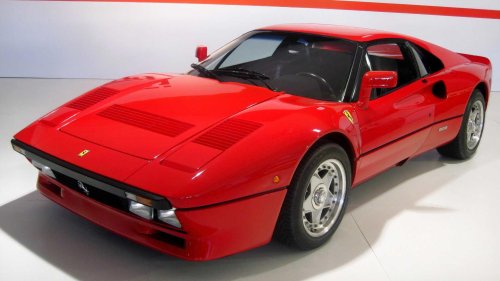
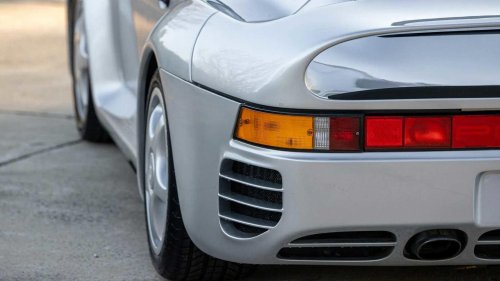
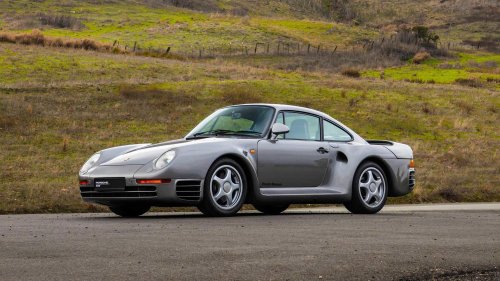
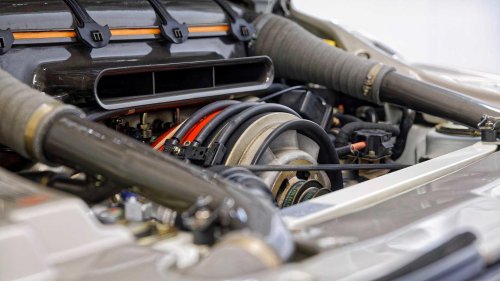
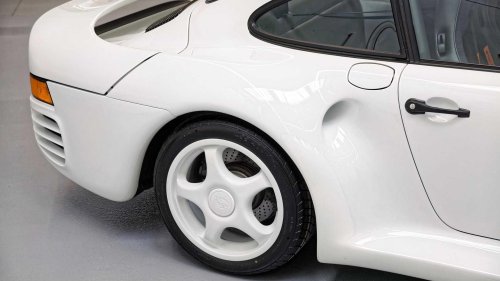
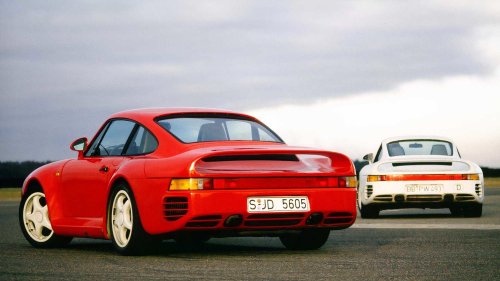
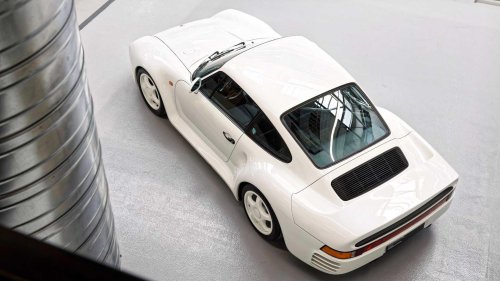

















The mid-1980s supercar playbook was simple and unchanged for a generation. Build a mid-engined car, send every horsepower to the rear wheels, and trust the driver to manage whatever the chassis could not. Ferrari, Lamborghini, and the rest had settled into a formula that prized brute force over sophistication. All-wheel drive was something you used on a rally stage, not a Nürburgring lap. Porsche saw it differently. In 1986, the German manufacturer launched a limited-production coupe that put four driven wheels, sequential twin turbocharging, and active suspension into a road car designed to outrun everything else on the planet. The supercar establishment had a crisis on its hands, and the loudest panic came from Maranello. The Supercar World Was Still Built Around Rear-Wheel Drive GTHO, via Wikimedia Commons In 1985, the Ferrari 288 GTO was the most extreme road-going Ferrari in production, making 400 horsepower from a twin-turbocharged V8 and sending all of it through the rear wheels. The Lamborghini Countach was still in production with its 455-horsepower V12 and the same rear-wheel-drive layout that had defined the marque since the Miura. Porsche's own 911 Turbo had just received a bump to 300 horsepower and continued to challenge the limits of what rear-drive could handle without putting its driver through a hedge. These were the cars that defined supercar performance, and every single one of them put power down through two tires.All-wheel drive was understood as a rally technology. Audi's Quattro had proven its value in the World Rally Championship, Lancia was campaigning the 037 and would soon field the Delta S4, and the Group B rally class was pushing manufacturers to develop four-wheel-drive systems for loose surfaces. Translating that idea to a supercar was a different problem entirely. The extra weight of a transfer case, front differential, and driveshafts worked against the power-to-weight obsession that defined the category. Nobody in the supercar establishment thought AWD belonged in a 200 mph coupe. One ambitious German engineering project was about to prove all of them wrong. Why Group B Forced One Manufacturer To Rewrite the Supercar Rulebook BaT The Group B rally class that the FIA introduced in 1982 set off an engineering arms race that nobody had quite anticipated. The regulations allowed almost any technical solution as long as a manufacturer built 200 road-going examples for homologation, and the resulting machinery was unlike anything that had come before. Audi's Quattro had already proven what all-wheel drive could do on a rally stage. Lancia and Peugeot followed with their own four-wheel-drive monsters. The class was producing cars that made the supercar establishment look stuck in the 1970s.One German manufacturer saw an opportunity. The plan was to build a Group B contender that would homologate as a road car, and to use the program as the technical proving ground for everything the company believed the next generation of high-performance machinery would need. The brief that went to the engineering team in 1981 called for sequential twin turbocharging, computer-controlled all-wheel drive, active ride height adjustment, magnesium wheels with hollow spokes, and a body built from composite materials over a steel monocoque. None of this had ever been combined in a single production car. The resulting machine would arrive years late, with Group B already cancelled by the time it reached customers, and would change what a supercar was expected to do regardless. The Porsche 959 Made Every Other Supercar Feel Obsolete Overnight PorscheThe Porsche 959 entered production in 1986 after a development program that began in 1981 under Porsche's chief engineer Helmuth Bott. Originally conceived as a Group B rally homologation special, the 959 evolved into something else entirely when the Group B category was cancelled in 1986 following a string of fatal rally accidents. Porsche pressed ahead anyway. The road car that emerged was built around a 2.85-liter flat-six derived from the 956 and 962 Le Mans racing engines, breathing through sequential twin turbochargers and producing 444 horsepower.The performance numbers read like science fiction for the era. Period testers recorded 3.6 seconds to 60 mph in a 959 Komfort, nine tenths of a second faster than any other car tested in the entire decade. Top speed stood at 197 mph, enough to make the 959 the fastest production car in the world when it went on sale. The Ferrari 288 GTO, Lamborghini Countach, and Porsche's own 911 Turbo were all comfortably beaten in every measurable performance category. Ferrari's response was to rush the F40 into production the following year, with Enzo himself signing off on a car designed specifically to reclaim the top speed crown. The 959 had genuinely shaken the establishment. The Sequential Twin-Turbo Flat-Six That Came From Le Mans Porsche The 959's engine was a direct descendant of Porsche's Le Mans racing program. The 2.8-liter flat-six displaced less than the Ferrari's V8 or the Lamborghini's V12 but used air and water cooling in combination and sequential turbocharging to deliver a wider usable power band than any rival. The sequential layout used one smaller turbo to handle low-rpm boost and a second larger unit that came online as revs climbed, eliminating the brutal on-off power delivery that plagued early turbocharged supercars.Magnesium alloy wheels with hollow spokes were a production-car first, as was the electronic tire pressure monitoring system that Porsche developed with Bridgestone to manage the specially designed RE71 Denloc run-flat tires. The body combined an aluminum hood and doors with fiber-reinforced plastic panels over a steel monocoque structure. Every element had been engineered to push the boundaries of what a road car could be. Porsche reportedly lost around $500,000 on every 959 it sold, which says everything about how seriously the company took the project. How The PSK All-Wheel Drive System Changed Everything Porsche The technological centerpiece of the 959 was its Porsche-Steuer Kupplung all-wheel-drive system, a computer-controlled setup that could continuously vary torque distribution between the front and rear axles. Under normal conditions the system ran a 40:60 front-to-rear split, but it could shift as much as 80 percent of the engine's power rearward under hard acceleration. Four driver-selectable modes, labeled for dry, wet, snow, and traction, changed the system's behavior to suit conditions. This was active torque vectoring in 1986, years before the term entered the automotive vocabulary.The system transformed how a supercar could be driven. Where a contemporary 911 Turbo rewarded experience and punished mistakes, the 959 used its AWD system to put power down cleanly in conditions that would have left its rivals spinning helplessly. Porsche executives were so convinced by what the 959 had proven that they made all-wheel drive standard on every turbocharged 911 starting with the 993 generation. The technology filtered down to every successive 911 Turbo, and the principle was eventually adopted by almost every manufacturer chasing the same combination of power and usability. The modern Lamborghini Huracán, Ferrari SF90, and every other AWD supercar on the road today traces its lineage back to what Porsche proved with the 959. What the Porsche 959 Costs Today PorscheThe Porsche 959 has quietly become one of the blue-chip collectibles of the 1980s supercar market. Market data suggests an average sale price of roughly $3.4 million across all recorded 959 transactions, with Komfort cars typically trading between $1.5 million and $2.2 million in strong condition. A 1988 959 Sport, one of just 29 lightweight variants ever built, set a new 959 world record of $5,505,000 at auction in March 2026, confirming that the Sport variant now occupies the same tier as halo Ferraris and analogue hypercars.The original $225,000 list price looks almost reasonable against current values. Total production stood at 292 series cars plus 29 Sport variants, with some sources including development prototypes to arrive at figures as high as 337. The scarcity is a major driver, but so is the recognition that the 959 represents a technological leap that nothing else from the 1980s can match. Where the contemporary Ferrari F40 remains a pure analogue driving experience, the 959 is the car that proved advanced electronics and supercar performance could coexist, and the market has started valuing it accordingly. Why the 959 Was Never Legal in the United States Porsche The 959 was never officially sold in the United States because Porsche refused to supply four examples for the crash testing required by the National Highway Traffic Safety Administration. The company's reasoning was commercial. Destroying four cars that each cost more than the factory charged for them would have added further losses to a program that was already bleeding money, and the total US market for a seven-figure Porsche was too small to justify the expense. The result was that American enthusiasts could not legally register a 959 regardless of how much they were willing to pay for one.The situation changed in 1999 with the passage of the Show and Display law, which created an exemption for fewer than 500 vehicles of historical or technological significance. Microsoft co-founder Bill Gates and his partner Paul Allen had both imported 959s through bonded warehouses and had been unable to drive them legally on US roads. Gates lobbied for the Show and Display exemption specifically to get his 959 registered, and the successful passage of the legislation finally allowed federalized 959s to enter the country. The story of the richest man in the world fighting the US government for the right to drive his Porsche has become part of the car's legend, and it is arguably as significant as the engineering itself in cementing the 959's cultural status.Sources: Classic.com, Hagerty, Broad Arrow Auctions, Porsche