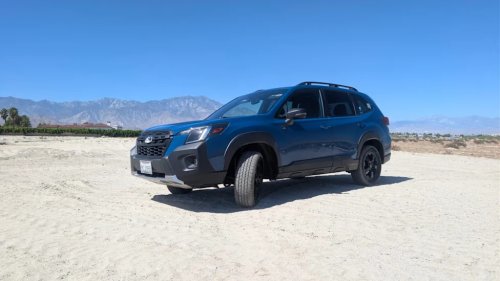
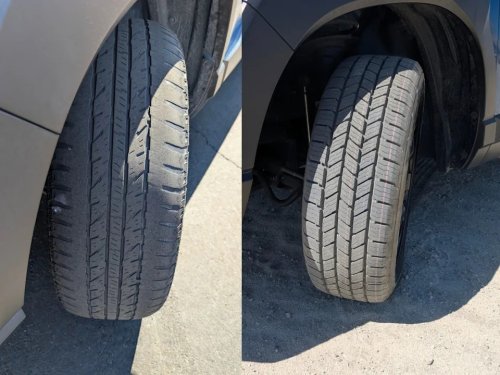
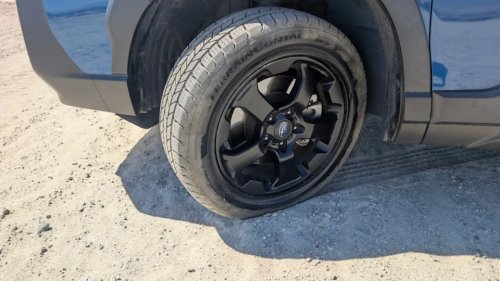
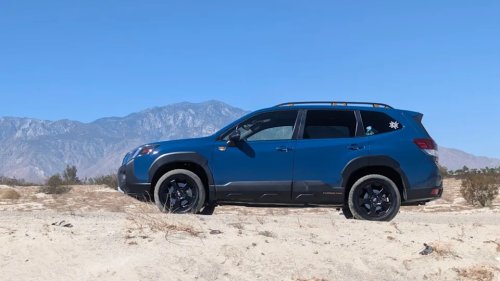
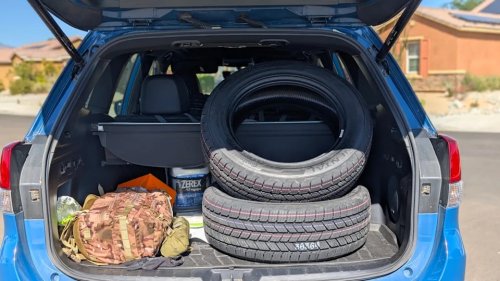
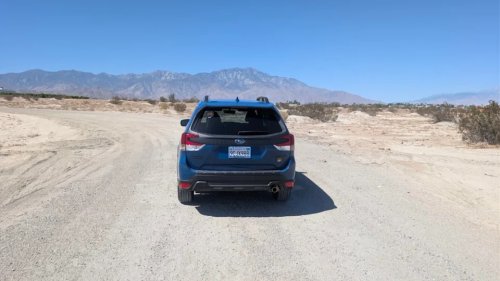























Jillian FinleyWhen it came to replacing her Subaru Forester Wilderness's factory A/T tires, she felt drawn to Continental TerrainContact H/T tires. Here's why you should look into them, too.In case it wasn't obvious, my family is a Subaru family. My husband and I both drive Subarus, my dad still drives his 2003 Forester every day, my mother-in-law loves her 2003 Outback, and my younger sister recently brought home a 2023 Subaru Forester Wilderness. On that Wilderness, though, were the factory Yokohama Geolandar A/T (all-terrain) tires. By the time she took ownership, they had seen much better days. She was torn: does she stick with an aggressive all-terrain as Subaru suggests for its trail-ready trim, or branch out into something better suited to every day's driving demands?Being thrilled with my own Continental SecureContact AW (all-weather) tires, I suggested she take a gander at what Continental offered in her size. She quickly sent a text with a link: "What about these? They seem cool." It was Continental's TerrainContact H/T (highway touring) tire. Having never heard of an H/T tire, I immediately fell down the research rabbit hole. Intrigued by the concept, I reached out to Continental. After seeing photos of her worn Yokohama's, they agreed to send her a fresh set just in time for the rainy season in Palm Springs, California.It didn't take long for her to fall in love with them on her Wilderness. Between the dramatic drop in road noise, surefooted braking, and composed manners on gravel roads, we both struggled to find a single downside—save for the price tag, which typically ranges from $225 to $365 per tire. But when it comes to replacing factory A/Ts for real-world driving, here's why we think they're worth every penny.This story is 100% human-researched and written based on actual first-person knowledge, extensive experience and expertise on the subject of cars and trucks. My sister received a complimentary set of TerrainContact H/T tires, but all impressions and opinions are our own.What are Highway Touring (H/T) Tires, and Why Would You Put One on an Off-Road-Specific Trim?My sister's worn A/T tires (left) compared to the new H/T tires (right)Highway tires, to put it simply, are designed to be durable and quiet for, well, highway driving. All-terrain tires, like the ones that came on my sister's Subaru, are engineered as off-road tires first, and highway tires second. And it shows: softer, winter-rated rubber with more aggressive tread tends to wear more quickly (and therefore needs replacing sooner), and at highway speeds, can translate a substantial amount of noise into the interior. Continental's highway tires, by contrast, are highway tires first and off-road tires second. They're engineered with peace and quiet in mind for commuters, with low rolling resistance to reduce vibration and humming to make every drive smooth.Instead of deep, aggressive tread blocks made to give you grip off-road, highway tires are shallow and tight, prioritizing noise reduction over traction and grip off-road. But the TerrainContact H/T tires are [literally] built differently. Their H/T tire bridges the gap between plush passenger car touring tires and rugged truck tires. It offers the reinforced construction and puncture resistance required for SUVs and light trucks, but with a tread tuned for high-speed stability, wet braking, cabin silence, and longevity—making it a very worthy replacement for her Yokohama's.What's So Special About the Continental TerrainContact H/T Tires?Continental markets them as having an "optimal balance between on-road manners and off-road durability." And it shows.While all-terrain (A/T) tires are designed with blocky, aggressive treads built to claw through loose dirt, mud, and jagged rock, H/T tires are engineered for the real world. They combine the tough, puncture-resistant internal construction of a light-truck tire with the smooth, quiet tread pattern of a premium passenger touring tire. Instead of tall, squirmy rubber blocks that howl and hum at 65 mph, the TerrainContact H/T uses stable, interlocking tread ribs designed to stay planted, track straight, and eliminate road fatigue.For my sister's everyday routine, that distinction made all the difference. Her Forester Wilderness isn't tackling the Rubicon Trail on a Tuesday afternoon—she's navigating her campus' parking lot with routine highway stints across the Coachella Valley. The factory knobby, aggressive tires looked undeniably cool, but their thicker sidewalls and thick tread blocks were penalizing her on the 95% of roads she drove on. Swapping to the H/T tires instantly gave the Forester a plush, cloud-like ride quality and silenced the cabin hum, turning high-speed driving into something enjoyable.As a bonus, Continental specifically markets the TerrainContact H/T tires as having an "optimal balance between on-road manners and off-road durability." With its TractionPlus Technology, the tire uses a cut-and-chip-resistant compound specifically designed for off-road durability on gravel, packed dirt, and washboard fire roads. You're giving up the mud-slinging claw of a true off-road-specific A/T tire, but you aren't getting a fragile passenger car tire either—the company promises the TerrainContact H/T tires have the backbone needed to wander off the beaten path when camping or trailhead parking calls.Her Region Helped Make the Decision, TooThe TerrainContact H/T tires are perfect for where she livesLiving in the Palm Desert area brings its own unique driving hazards. Out there, rainfall is rare—but when desert downpours do hit, flash floods are all too common. Months of built-up road oils and fine dust float straight to the surface, and the dry, non-porous desert asphalt turns slick almost instantly. During the rainy season, hydroplaning becomes a very real danger.That's when the TerrainContact H/T's water evacuation design enters from stage right. Continental engineered this tire with wide, deep circumferential grooves paired with lateral evacuation channels that actively scoop standing water and fling it out from beneath the footprint. Combined with a high-silica compound that bites into greasy, wet asphalt, the tires give her massive stopping confidence when a sudden desert storm rolls over the mountains.It's the ultimate reality check for an adventure SUV: keeping the rugged durability you bought an SUV for, while giving you the wet-weather safety, silence, and highway composure you actually need every single day of a well-rounded, rigorously tested all-season touring tire.When Should You Buy an H/T Tire Over an A/T Tire?These tires promise both a quiet ride and off-road capabilityChoosing between a H/T tire and an A/T tire comes down to an honest assessment of how you use your car versus how the commercials tell you to use it. Both tire categories are built with sturdy, reinforced internal plies capable of handling the curb strikes, potholes, and weight of modern trucks and SUVs. The divergence happens at the tread surface—where rubber meets your daily routine.For my sister, doing away with the off-road focus for better highway manners (without sacrificing all-season capabilities) made more sense.Choose an H/T tire if:Your commute is 90%+ paved asphalt: If your week consists of interstate highway merging, suburban errands, and school drop-off lanes, an H/T tire gives you the steering precision, short wet stopping distances, and low rolling resistance that keep daily drives comfortable and efficient.You value cabin peace and quiet: Aggressive all-terrain tires develop a distinct low-frequency drone over time, especially as the tread blocks wear down. H/T tires keep road noise down, making hands-free phone calls and backseat conversations effortless.Your off-pavement driving is mild and relatively infrequent: An H/T tire handles groomed dirt roads, gravel driveways, packed beach sand, and campsite access roads without breaking a sweat. It keeps the puncture resistance needed to shrug off sharp driveway gravel without the harsh, stiff ride of most A/T tires.You want maximum tread life: High-silica touring compounds wear evenly across the contact patch, making it easier to keep tread depths uniform across all four corners—critical for protecting sensitive all-wheel-drive differentials like the ones on my sister's Subaru. Most A/T tires, thanks to a typical 3PMSF rating, can wear faster.When Should You Buy an A/T Tire Over an H/T Tire?All-terrain tires really only make more sense if you drive off-road frequentlyAll-terrain tires are typically marketed to off-road hobbyists, and for good reason: they're designed and engineered for it. Their priority is to handle themselves off-road with plenty of grip, snow- and ice-rated performance, and thicker sidewalls to protect them from the boulders and logs you're using them to traverse.Here's when you should pick an A/T tire:You regularly encounter loose, unpredictable trail surfaces: If your weekends involve climbing rocky trailheads, traversing rutted fire roads, or driving over sharp volcanic rock, the deep voids, staggered shoulder lugs, and chunky bite of a typical A/T tire provide the mechanical clawing power an H/T isn't designed to compete with.You frequently drive through severe winter conditions: If you live where snowplows don't run frequently or you regularly cross mountain passes with strict winter traction laws, an A/T tire carrying the 3PMSF severe snow symbol will bite into deep snow, packed ice, and heavy slush far more effectively than an M+S highway tire.You want aggressive, rugged vehicle aesthetics: There's no denying the visual stance of an aggressive sidewall. If knobby tread is an essential piece of your vehicle's character, an A/T delivers that off-road styling directly. Though both my sister and I agree, the TerrainContact H/T tires look quite handsome.For My Sister's Forester Wilderness, These Tires Feel Like a GodsendThe rear end of my sister's 2023 Subaru Forester Wilderness on a dirt roadFor so long, it felt like the only "proper" tire for Subaru's most capable Forester was an aggressive all-terrain. Others might argue a rugged all-weather, like my SecureContact AW tires, would be the smarter compromise. But the Continental TerrainContact H/Ts feels like the quiet student in the back of the classroom who rarely raises their hand, but nails the question every single time they're called on. With these tires, you don't have to choose between quiet highway comfort, high-mileage longevity, and trailhead-ready durability. You truly can have both.Given the price point, they certainly should deliver—and they do. A huge thank you to Continental for providing my sister with a set of TerrainContact H/Ts to replace her exhausted factory A/Ts, and for opening our eyes to a category of tire that more SUV drivers should be paying close attention to.