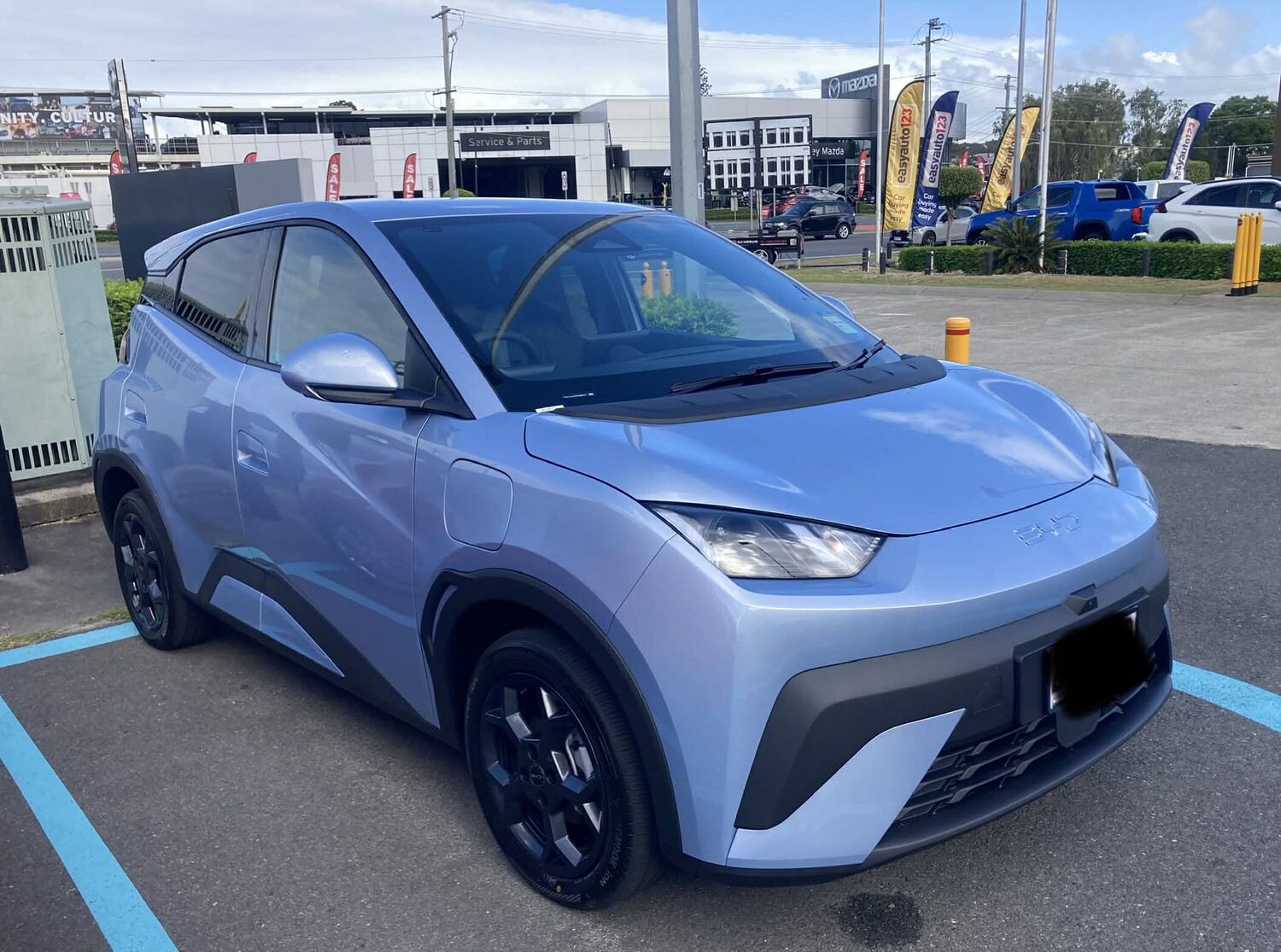
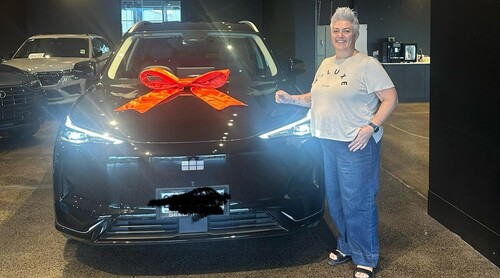
Ever increasing petrol and diesel prices are fueling a surge in interest in plugin cars. As reported by CleanTechnica here and here. It looks like every second-hand EV has sold and the ones still available have increased in price. But what about the new car market? David and Hyundai Elexio. 288 already sold. Photo courtesy of Majella Waterworth. Data released in the last week about new car sales in Australia tell the exciting story. Mainstream media has picked this up and reports massive ongoing orders for the next three months at least. BYD Australia, alone, has ordered 30,000 cars for delivery. So, when we consider the March figures, we need to remember — this is just the tip of the tsunami! (Don’t you just love mixed metaphors?) Plenty of BYDs, and more to come. Photo courtesy of Majella Waterworth. In March, in Australia, 15,839 BEVs were sold, out of a total market of 105,058. Add to this the 8,215 PHEVs sold and you have a total of 24,054 cars with a plug. Almost 23% of the market could run primarily on sun-sourced free electricity. In an ideal world on a sunny day, of course. This is the highest monthly share in Australia on record, and it will only increase over the coming quarter. A year-on-year 90% increase, and a month-on-month of increase of 42%. Most of these sales were made before (yes, before) the Iran-Israel-US war sent prices into the stratosphere — passing the returning lunar module, no doubt. Petrol in Australia is currently selling for around AU$2.23 a litre, diesel around AU$3.30. Yesterday’s petrol prices. Photo courtesy of Elizabeth Milton. The market is responding to the anguished cries of buyers’ wallets. The sales of cars running purely on petrol dropped 21%, and on diesel 10%. The total market declined 3%. For those who like graphs, there are some great ones here — thanks, James. The top ten for Australian battery-electric vehicle sales in March 2026 are (drum roll): Tesla Model Y — 2,818 sales | year to date — 5,897 BYD Sealion 7 — 1,970 sales | year to date — 4,468 Zeekr 7X — 679 sales | year to date — 1,725 Tesla Model 3 — 667 sales | year to date — 1,363 Geely EX5 — 606 sales | year to date — 1,437 Kia EV5 — 587 sales | year to date — 1,148 BYD Atto 2 — 572 sales | year to date — 1,484 Omoda Jaecoo J5 — 569 sales | year to date — 1,153 BYD Atto 1 — 488 sales | year to date — 1,082 MG S5 — 475 sales | year to date — 765 BYD Atto 3 — 466 sales | year to date — 1,064 Kia EV3 — 461 sales | year to date — 861 MG 4 — 451 sales | year to date — 1,016 Toyota BZ4X — 447 sales | year to date — 840 BYD Dolphin — 373 sales | year to date — 905 In the battle for the brands, BYD outsold Tesla. BYD has five models in the top 15, whereas Tesla just has two. BYD sold a total of 4,206 BEVs in March, beating Tesla’s 3,485, “although the Model Y regained its position as the top selling EV with 2,818 — which would put it at number 3 in the overall list behind the popular Ford and Toyota diesel utes.” Australia desperately needs competition from capable utes. It is noteworthy that KMG sold 33 of their “real” utes in March. BYD’s March sales total would swell to 7,217 when we include its PHEV range. I took the list to 15 so that I could include Toyota, which is still doing remarkably well, considering its antipathy to EVs and its still not quite up to par offerings. I wish the Japanese carmakers well — we need them to participate wholeheartedly in the rEVolution. More from a recent Toyota Australia press release: “The bZ4X, which recorded 1,041 sales in 2025, is now forecast to achieve more than 5,000 sales in 2026. This result is supported by the introduction of the upgraded bZ4X in late 2025, new bZ4X Touring variant – expected to arrive in Q2….” The Atto 1, current leader in the small price war, sold as many units as the similarly priced petrol Kia Picanto. Prices appear to moving downwards across all vehicle segments at the moment, and then there are offers, freebies, and discounts on top of that. Makes it very difficult to state a firm price. BYD Atto 1 is moving up the sales charts in 2026. Photo courtesy of Majella Waterworth. Despite the evidence of hard data from sales and orders, there are still some in the automobile establishment who question the transition, wondering whether this will be just a blip and things will return to “normal” once the current war is over. Federal Chamber of Automotive Industries chief executive Tony Weber opines: “It is too early to determine whether this represents a structural shift in the market. More consumers are considering EVs due to the disruption to fuel supply caused by conflict in the Middle East, along with the review into the fringe benefits tax concession for EVs.” He cites the main issue delaying EV takeup — lack of public charging infrastructure. He finds himself in a difficult position, the FCAI has long been a bastion of Western legacy fossil fuelled brands, but now finds itself having to represent upstart Chinese EV brands also. Mr Weber continues: “The automotive industry would welcome a sustained shift to EVs, given its substantial investment in bringing more than 100 EV models to the Australian market and the industry’s efforts to meet ambitious New Vehicle Efficiency Standards targets. A long-term shift to EVs will require Australian governments to sharpen their focus on public charging infrastructure, particularly in regional areas and locations where home charging is not practical. Ensuring infrastructure keeps pace with consumer demand will be critical to enabling sustainable growth in EV adoption beyond short-term influences.” Always got to find a dead cockroach in the cake! Countering this narrative is Julia Del Vecchio, CEO of The Electric Vehicle Council, which lobbies on behalf of the EV industry. She is in no doubt about the indications from data — it is a structural shift in the market. “Volatile global oil markets are changing the conversation,” says EVC head Julie Delvecchio. “Australians aren’t asking whether EVs are the future anymore. They’re asking which one they can get their hands on, and when.” “With fuel prices rising, every EV on the road is doing something simple but powerful – taking pressure off fuel supply for the people who need it most. “EV drivers are driving the country’s fuel resilience while cutting costs on their household budget. This has never been more important than now, given the PM’s address urging people to use petrol and diesel responsibly and ‘save fuel for people who have no choice but to drive.” Headlines in the mass media have changed and become more positive. This morning my newsfeed contained the following headlines: “The end of range anxiety,” citing the new long-range batteries being fitted into electric cars. “Cheaper than a Corolla,” citing the prices of BYD’s economical range. The Melbourne auto show is on at the moment, full of Chinese EVs. The headlines are pointing out which carmakers are not there! Toyota, Ford, Mazda, amongst others. It seems like a new EV is launched each week. Here are a few we are hearing about: Great Wall Motor’s new ORA 5, the MG4 Urban, the Subaru Trailseeker, Geely’s EX2, a variety of electric vans, BYD’s Denza (complete with flash charging capability). And I hear whispers of new electric vans, and more price wars. Sadly, there are still no Cadillacs reported sold into the Australian market. The sun is shining, the wind is blowing, renewable energy is flowing into the grid as Australians embrace energy security by adding batteries and battery-powered vehicles to their lifestyle. It is becoming a bright future indeed.