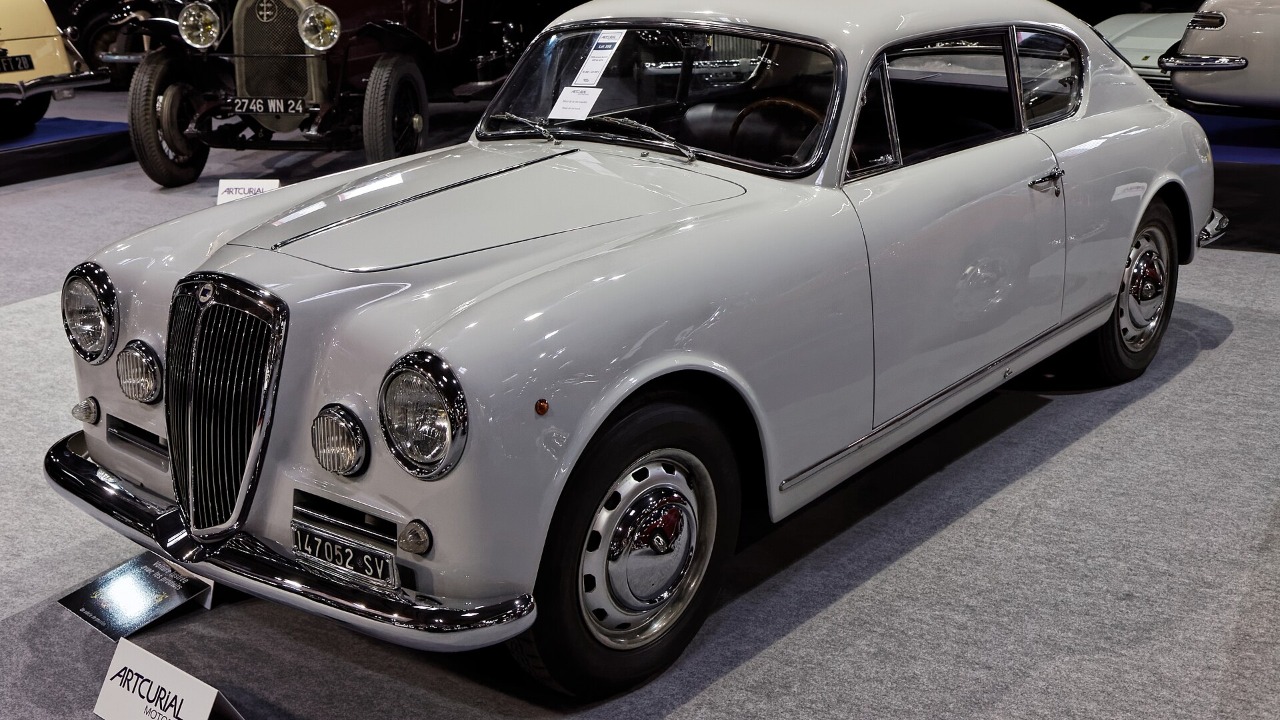
The Lancia Aurelia berlina reached the public at the Turin show in May 1950, and its V6 engine gave Lancia a claim no other maker could match. Today the coupes and the Spider take the spotlight at concours lawns. The four-door cars and the odd coachbuilt variants get much less attention. That gap matters if you are shopping. An Aurelia changed a great deal over eight years. Engines grew, suspensions changed, and the focus drifted from sport to comfort. So two cars with the same badge can feel like different machines. These are our picks: five Aurelias we would think twice about before buying, and why. The verdicts are our opinion. However, every engine size, output figure and build count below comes from the references we checked, and the famous B24 Spider and the early B20 coupes are deliberately left off. 1. 1950 Lancia Aurelia B10 berlina The B10 was the first Aurelia, and the berlina was the only body Lancia offered at launch. Its 1,754 cc V6 had a light-alloy block and aluminium heads. In a 1988 retrospective, Motor Sport magazine listed it at 56 bhp at 4,000 rpm. That is not much for a car of this size. Hagerty’s model history puts the first-series top speed at 84 mph, while the later 2.0-liter cars reached 90 mph. Lancia built 5,451 B10 sedans between 1950 and 1953, so they are not as scarce as the coupes. The bigger worry is the structure. Hagerty advises collectors to judge condition carefully, because the early unibody cars suffered from metal fatigue. On a car with no separate frame, tired metal is a body-shop problem, not a bolt-on fix. Our take: we would pass on a B10 unless you love it for its place in history. Buyer advice: pay a marque specialist to inspect the floors, sills and suspension mounts before you bid, and expect a later 2.0-liter sedan to be the better drive. 2. 1951 Lancia Aurelia B50 Cabriolet Pininfarina Lancia sold the B50 as a bare rolling chassis for coachbuilders from 1950, and it supplied 485 of them. A heavier-duty B51 chassis followed for larger bodies. Pinin Farina clothed many B50s as a four-seat cabriolet, mostly between 1950 and 1952. The car in our photo is one of those Pinin Farina cabriolets. It looks lovely with the top down. Yet it carries a full four-seat open body on the same 1,754 cc V6 size as the first sedan. As a result, it is a boulevard cruiser rather than a quick car. The coachbuilt body brings a second issue. Because every builder shaped its own panels, trim and glass, a dented wing or a missing piece of brightwork cannot simply be ordered. Instead, a craftsman usually has to make it by hand. Our take: the B50 cabriolet is a car for a devoted Lancia collector, not a first Aurelia. If you want open-air Aurelia style with more go, our look at how the 1955 Aurelia B24 blended luxury and sport covers the later answer. Buyer advice: confirm the body maker and chassis number with a marque club, and budget for hand-made parts. 3. 1952 Lancia Aurelia B22 berlina The B22 was the hot sedan. Lancia introduced it in the autumn of 1952, partly so privateers could enter touring-car racing. It used the 1,991 cc V6 with twin Weber carburetors and a hotter camshaft. Hagerty says that special Weber sedan made 90 hp and could reach 100 mph, against 94 mph for the basic model. Lancia built only 1,074 B22s across 1952 and 1953. On paper, that makes it the sedan to own. In our view, that is also the catch. A car built with competition in mind often lived a hard life, and many B22s will have seen club events or rough tuning. In addition, the engine predates a key change. Lancia did not switch the B20 coupe’s V6 from white-metal bearings to shell bearings until the fourth series, after 1953. Twin Webers also need careful balancing to run well. A set that is out of tune can make the car feel worse than a plain B21. Our take: a tired B22 can cost more to sort than a good standard sedan. Buyer advice: ask for the engine’s rebuild history, check the oil pressure when it is hot, and walk away from any car with a vague past. 4. 1954 Lancia Aurelia B12 berlina Lancia showed the B12 at the spring Turin show in 1954, and it replaced the B10, B21 and B22 sedans at once. It used a 2.3-liter V6. Hagerty lists the 2,266 cc engine at 87 hp, which is less than the twin-Weber B22 made two years earlier. The B12 was also a gentler car. Lancia finished the cabin more luxuriously and fitted a De Dion rear axle in place of the old independent rear. The result was a sedan that had lost much of its sporting character. That shift explains why the B12 sits in the shadow today. Lancia built 2,400 of them from 1954 to 1956, and then the sedan line ended. Meanwhile, the same years gave buyers the far more desirable B20 coupe and the B24 Spider. None of this makes the B12 a bad car. Still, you are paying classic-Lancia money for an Aurelia that trades the brand’s sharp handling for comfort. Our take: we would skip it unless comfort is the whole point. Buyer advice: if you buy one, price it as a comfortable 1950s sedan rather than an early Aurelia, and check the De Dion rear for worn joints. 5. 1958 Lancia Aurelia B20 GT sixth series The B20 GT coupe is the Aurelia most people picture, and the 1958 car shown here comes from the final, sixth series. That series arrived in 1957. By then the 2,451 cc V6 was the only engine on offer, rated at 112 hp according to Hagerty. Earlier B20s were stronger. Motor Sport listed the third-series 2.5-liter engine at 118 bhp. The magazine also singled out the fourth series as the pick of the B20s, with its De Dion rear suspension and Vandervell main bearings. By the sixth series, Lancia had dialed power back and raised torque to cope with a heavier car. It added vent windows and a chrome strip down the bonnet. The fuel tank moved to the trunk, too. These were sensible touring changes, and they made the late coupe the most touring-oriented B20 of all. Our take: the sixth series is a fine car, but it is the softest way into a B20. If you want the sharper drive that built the Aurelia’s name, look earlier. Its Flaminia successor kept the same grand-touring idea, as our story on why the 1957 Flaminia aimed upmarket explains. Buyer advice: compare a fourth-series coupe before you commit. Production of the Aurelia ended with this sixth series in 1958, according to Hagerty.

 Liked by Gabriel Moreau, Ava Tremblay




























 Liked by Gabriel Moreau, Ava Tremblay


