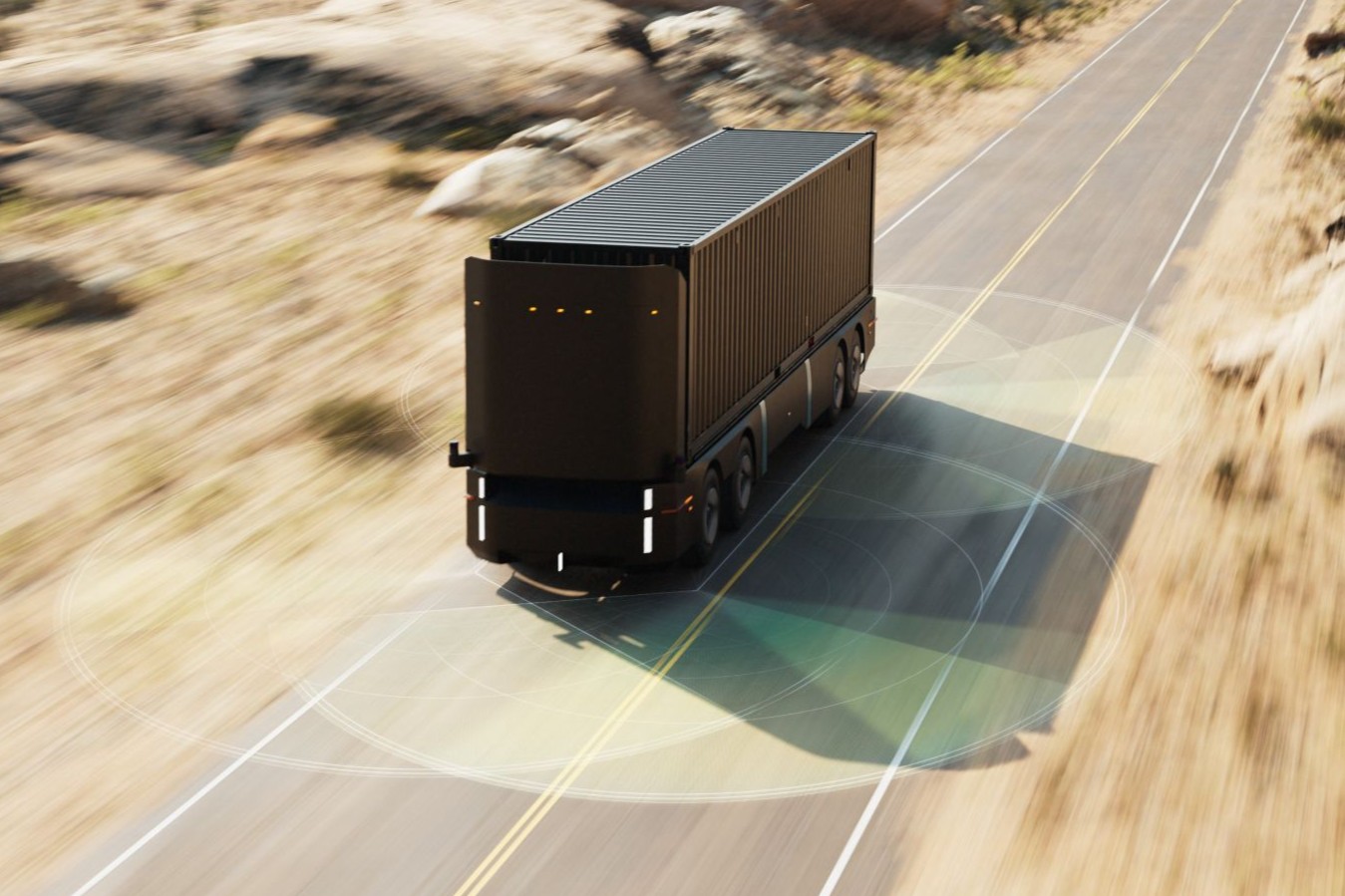
Rendering of the Humble HaulerImage: Humble RoboticsAt its core, the Humble Hauler is an autonomous flatbed platform that replaces the conventional driver’s cabin with a narrow front wall equipped with cameras and sensors. This minimalist design choice is intentional. Rather than retrofitting a legacy vehicle with a traditional cabin for autonomous operation, the San Francisco-based startup says it is “Rethinking Class 8 freight from the ground up.” This approach involves entirely redesigning existing heavy goods transport with a purpose-built autonomous vehicle that eliminates the driver’s cabin, increasing available payload capacity.“Trucks were never designed to be autonomous,” Eyal Cohen, Humble’s CEO and founder, said in an interview with US publication, Fortune. “Removing the cab allows us to rethink the whole vehicle for an autonomous future.” Cohen brings relevant experience from his previous roles at Uber, Spark, and Waabi. The team also includes former employees of Apple, Google, Rivian, and Tesla. To date, the startup has raised $24 million in initial funding.In its currently presented configuration, the Humble Haulier is a container chassis. It will be available in a long version with four axles for 40- and 53-foot containers, as well as a shorter version with three axles for 20-foot containers. In container terminal ports and freight transport hubs, many processes are already automated, making fully autonomous trucks a natural fit. For example, starting next year, autonomous terminal trucks from Terberg will operate in the Port of Rotterdam.For the US startup, container trucks are just the beginning. Humble Robotics describes its platform as a “versatile, electric platform that can be adapted for any purpose.” A universal ‘Lock & Twist’ interface enables dozens of use cases and vehicle configurations. The company’s website features a sketch of a concrete mixer truck as an example.Technically, Humble Robotics relies on approaches already established in other projects, such as 360-degree sensor coverage using cameras, LiDAR, and radar. According to the Fortune report, the autonomous driving architecture is based on AI models that integrate image processing, speech recognition, and decision-making—a more modern approach than traditional rule-based systems.In Europe, the Swedish startup Einride has long pursued a similar approach to transforming freight transport with autonomous electric trucks. In 2022, Einride introduced its self-developed Gen 2 Rigid Large, which has since been renamed the eBot. Like the Humble Hauler, this vehicle has no driver’s cabin and, consequently, no steering wheel, accelerator, or brake pedal. However, the current prototype features a box body and container chassis, though this could change in the future.heise.de, fortune.com



















 +78 others